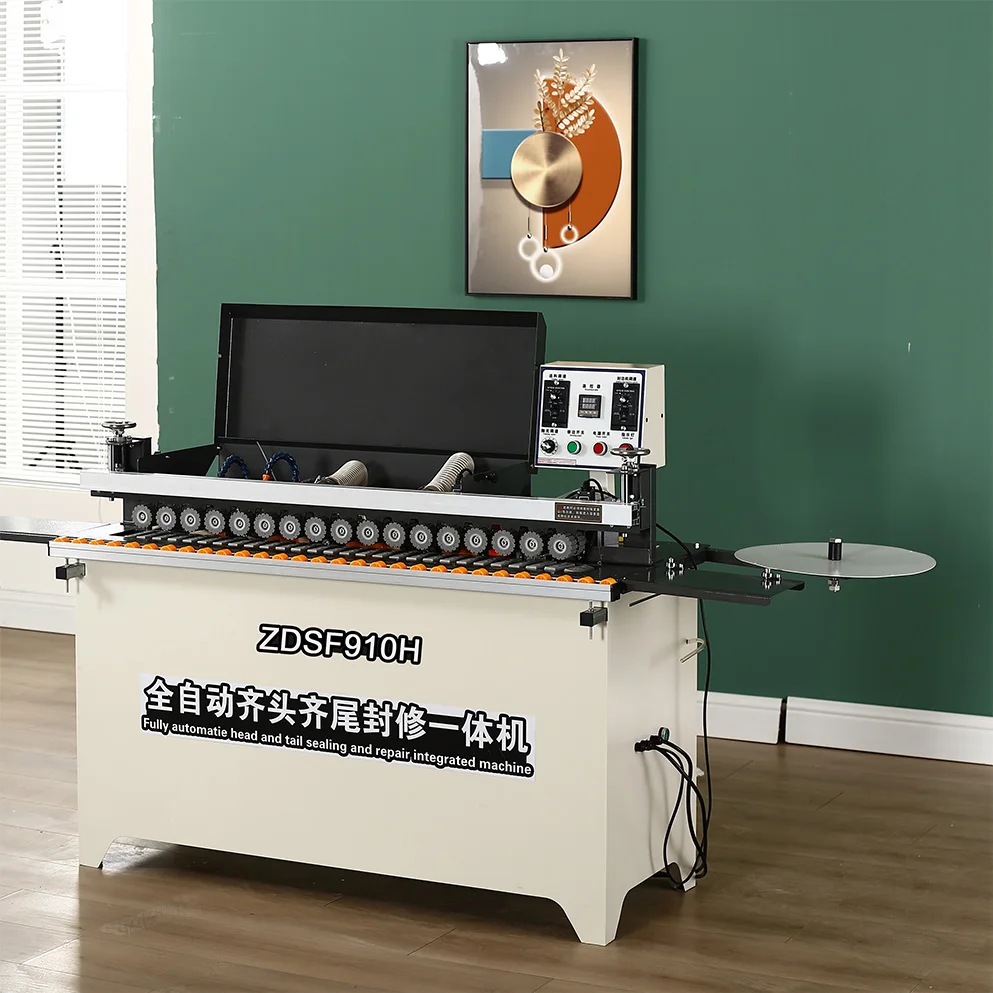
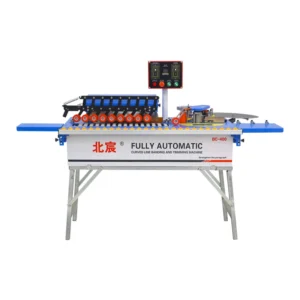
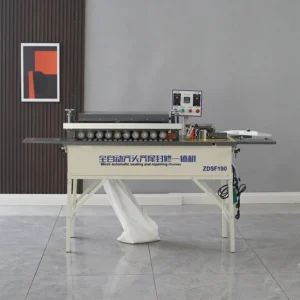
Verified Factory Build — Every 910H unit undergoes substrate-specific validation on MDF, particleboard, or plywood before leaving Ningjin, not a generic pass stamp.
Technical Specifications
| Parameter |
Value |
| Model |
910H |
| Product Type |
Automatic Curved and Straight Edge Banding Machine |
| Edge Type |
Both curved and straight lines |
| Voltage & Frequency |
220V 50Hz |
| Rated Power |
4 kW |
| Heating Power |
800 W |
| Trimming Power |
800 W × 2 |
| Polishing Power |
180 W × 2 |
| Suction Power |
1200 W |
| Belt Power |
25 W |
| Transmission Power |
120 W |
| Rated Air Pressure |
0.4–0.6 MPa |
| Sheet Thickness Range |
10–50 mm |
| Strip Thickness Range |
0.5–2.5 mm |
| Minimum Board Width for Edge Sealing |
2.5 cm |
| Glue Capacity |
1000 ml |
| Overall Dimensions (L×W×H) |
1300 × 560 × 1090 mm |
| Net Weight |
140 kg |
| Control System |
Multi-function button operation panel |
| Transmission |
Crawler transmission with steel rod slide rails |
| Trimming Mechanism |
4-blade alloy arc knife, square slide rail profiling |
| Feed Mechanism |
Double-row rubber pressure wheels, automatic plate feeding |
| Glue Application |
Glue roller with adjustable volume, double-sided gluing |
| Pressure Beam |
Adjustable aluminum alloy |
| Curved/Straight Switch |
180-degree rotation for curved edge banding mode |
| Dust Extraction |
Two large-diameter dust collectors (collection effect basis not stated in source) |
Application Suitability
| Application |
Material or Output |
| Custom cabinet door edging |
MDF and particleboard with PVC banding |
| Curved furniture component finishing |
Plywood and shaped solid wood panels |
| Small-batch joinery production |
Veneer edge banding on straight and curved profiles |
| Workshop-scale panel processing |
Melamine-faced boards up to 50 mm thickness |
Why the Voltage Question Should Come Before the Price
A machine rated for 220V 50Hz will stall or burn out on a 60Hz supply — and that mismatch is rarely caught until the container is opened.
When sourcing an edge banding machine OEM factory for regional distribution, the first specification to lock down is electrical compatibility, not feed speed or trimming count. I have watched importers receive containers of woodworking equipment only to discover the motors hum at the wrong frequency, the glue pot never reaches melt temperature, and the control board throws faults on startup. The 910H is configurable across voltage and frequency ranges at the quotation stage, but that conversation must happen before production begins, not after [NEED_CITE: voltage and frequency standards by export market]. Skipping this step means the machine sits idle while transformers are sourced locally — if they can be found at all.

How the Arc-Knife Trimming Holds Tolerance on Curves
The 910H uses a 4-blade alloy arc knife mounted on a square slide rail for profiling. Unlike single-blade trimmers that drag across a curve and leave witness marks, this mechanism follows the panel contour through the rail geometry. For OEM partners placing this edge banding machine into turnkey lines, consistent trim quality on curved components means fewer rejects at the assembly station downstream.
Double-Sided Gluing and Substrate Behavior
The adjustable glue roller applies adhesive to both the strip and the panel edge simultaneously. MDF absorbs glue at a different rate than particleboard — a substrate-specific test record accompanies every shipment so the receiving workshop knows the melt temperature and feed speed validated for their material. This eliminates the trial-and-error commissioning period that stalls production on unfamiliar substrates [NEED_CITE: substrate absorption rates affecting glue bond strength].
Reading the Specs That Matter for Panel Quality
The 10–50 mm sheet thickness range paired with the adjustable aluminum alloy pressure beam means the 910H handles everything from thin shelf stock to thick worktop panels without swapping tooling. The crawler transmission on steel rod slide rails keeps panel delivery stable across both straight and curved modes — a belt-driven feed would slip on tight radii. The double-row rubber pressure wheels grip without marring melamine or veneer surfaces. For the glue line itself, the dedicated cleaning device removes squeeze-out before it sets, so finished edges arrive at the next workstation clean. The 0.5–2.5 mm strip thickness range covers standard PVC through to thicker veneer banding used in premium cabinet work.
The Hidden Cost of Skipping OEM Configuration Lock-In
Machines ordered without confirming control panel language arrive with button labels the operator cannot read, stalling commissioning for days while translations are improvised on masking tape. A single-unit order placed without verifying local voltage compatibility turns into a costly transformer installation — if the workshop electrical panel can handle the load at all. Entry-level machines pushed beyond their designed production volume develop premature wear on trimming blades and feed mechanisms [NEED_CITE: production volume mismatch and premature component wear]. These are not warranty claims; they are configuration failures that a thorough OEM specification process prevents entirely.
Why Procurement Teams Source This Machine Here
The 910H is built in-house with proprietary arc-knife trimming mechanisms, not assembled from third-party sub-contracts — this gives OEM partners control over private label specifications from component level upward. Voltage customization from 110V to 440V and multilingual control panels are confirmed at quotation, not discovered as limitations at dispatch. Four-stage quality control covers incoming material through pre-shipment verification, so the unit you receive matches the test record. Factory visits are open for production audits and sample processing runs on your actual panel stock. Engineer-led configuration means the proposal accounts for your line throughput, not just a catalog price.
Documentation & Verification
- CE declaration of conformity matching the 910H configuration shipped
- Factory test record on your specific panel thickness and substrate before dispatch
- Electrical schematic confirming voltage and frequency at destination standard
- Operation and maintenance manual in the agreed operator language
- Spare parts list with OEM-compatible trimming blades and glue rollers
- Packing photographs for customs and freight insurance verification
Installation, Commissioning & Support
- 1300 × 560 mm footprint fits standard workshop aisles without floor reinforcement
- Dedicated 4 kW circuit required — confirm panel capacity before delivery
- Arrives fully assembled; connect power and air supply at 0.4–0.6 MPa to commission
- First-run parameter setting validated against your substrate test record
- Multi-function button panel walkthrough included with operator manual
- Replacement arc-knife blades and glue rollers listed in spare parts documentation
What We Need to Configure Your Quotation
Provide the panel materials and thickness range you process most frequently, along with the PVC or veneer strip thickness you run. Confirm your workshop voltage and frequency so the motor and heating elements are wound correctly. If you are integrating the 910H into an existing line, share the upstream and downstream equipment feed heights so throughput alignment can be verified before production.
Frequently Asked Questions
Q: What OEM and private label customization is available for the 910H?
A: Custom logo placement, machine color, control panel language, and voltage configuration from 110V to 440V are confirmed during the quotation stage. OEM partners can specify branding on the machine body and documentation package. Each unit ships with private label documentation matching the destination market requirements.
Q: How does the four-stage QC verify trimming tolerance before shipment?
A: Incoming materials are inspected, in-process assemblies are measured, finished units run test panels through both curved and straight modes, and pre-shipment verification confirms trim quality against the substrate-specific test record. The 4-blade arc knife mechanism is checked for consistent profiling across the full sheet thickness range.
Q: Can the 910H be configured for different regional voltage and frequency standards?
A: Voltage and frequency are locked in at the specification stage before production begins. The motor, heating element, and control board are all matched to the destination electrical standard. This prevents the common failure where machines arrive unusable because local supply was never confirmed.
Q: What documentation accompanies OEM orders for customs and resale?
A: Each shipment includes a CE declaration, ISO 9001 certificate, machine specification sheet, electrical schematic, factory test record, operation manual in the agreed language, spare parts list, packing photographs, and customs documentation support for the destination country.
Q: What is the lead time for OEM sample approval before a bulk order?
A: Sample processing tests run on your specified substrate and edge banding material, with results documented in the test record. Once the sample is approved and configuration is locked, production lead time follows typical multi-week scheduling for OEM runs depending on order volume and customization scope.