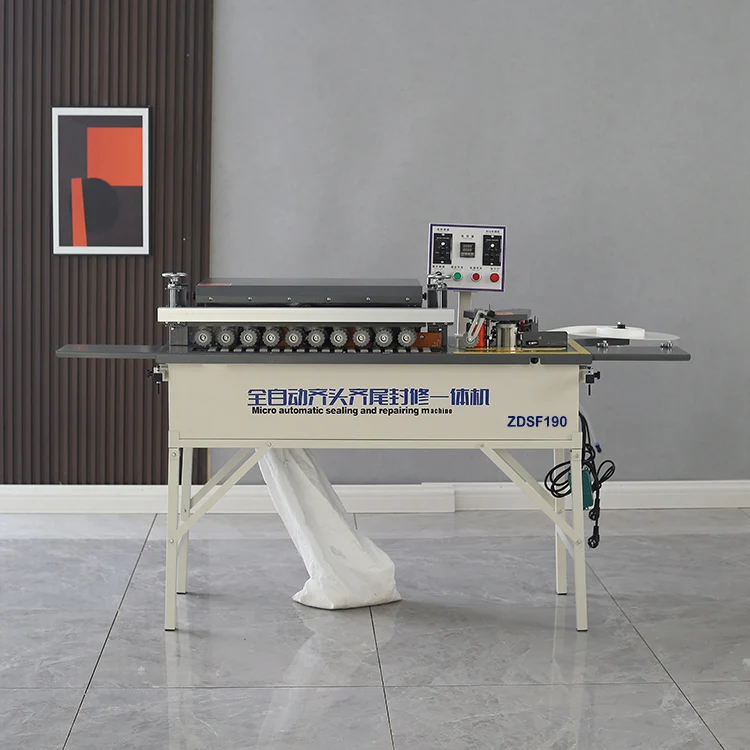
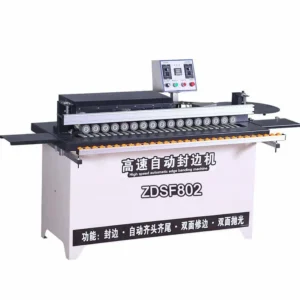
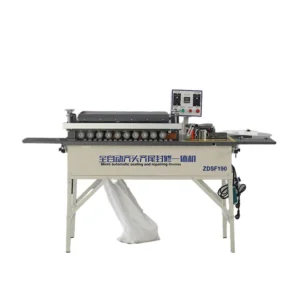
Patented Cutting Mechanisms — The ZDSF190 dual-purpose edge bander is built around an in-house developed trimming assembly, verified on both curved and straight profiles before it leaves the Shandong assembly floor.
Technical Specifications
| Parameter |
Value |
| Model |
ZDSF190 |
| Product Type |
Automatic Edge Banding Machine |
| Edge Type |
Both curved and straight lines |
| Voltage |
220V 50Hz |
| Rated Power |
4kW |
| Heating Power |
800W |
| Trimming Power |
800W × 2 |
| Polishing Power |
180W × 2 |
| Suction Power |
1200W |
| Feed Speed |
0-14m/min |
| Sheet Thickness Range |
10-50mm |
| Strip Thickness Range |
0.5-2.5mm |
| Glue Capacity |
1000ml |
| Rated Air Pressure |
0.4-0.6MPa |
| Pressure Beam |
Adjustable aluminum alloy |
| Trimming Cutter |
4-edge arc-shaped alloy cutter head |
| Control Panel |
Multi-function button operation |
| Overall Dimensions |
1900×560×1300mm |
| Net Weight |
120kg |
| Key Features |
Automatic plate feeding, double-sided gluing, upper and lower trimming and polishing, curved and straight edge banding, large diameter surrounding vacuum |
Application Suitability
| Application |
Material or Output |
| Custom cabinet door edging |
MDF and plywood panels with PVC edge banding |
| Curved furniture components |
Shaped solid wood panels with veneer strip |
| Small-batch joinery production |
Particleboard shelving with 0.5-2.5mm PVC |
| Prototype and sample making |
Mixed substrate test runs for furniture designers |
| Workshop-scale panel finishing |
Straight and contoured edges in a single setup |
Why Voltage Confirmation Must Happen Before the Crate Is Closed
Every ZDSF190 Automatic Edge Banding Machine ships with a signed voltage confirmation sheet matched to the destination grid.
I spent years on the assembly floor in Shandong before moving into technical sales. Early on, we dispatched an edge bander to a Middle East cabinet factory. The local grid was 440V, but the order paperwork never flagged it. The machine sat on their floor for three weeks waiting for a step-down transformer while their production schedule collapsed. Since that job, I staple a voltage confirmation document to the first page of every technical agreement. For an Automatic Edge Banding Machine factory, getting the electrical spec right is not a detail — it is the difference between a machine that runs on day one and one that becomes expensive warehouse furniture [NEED_CITE: voltage and frequency standards by export market].
Dual-Profile Trimming in a Single Footprint
Most small workshops buy a straight-line edge bander first, then add a separate curved-edge unit once contoured panels enter their order book. The ZDSF190 collapses both into one chassis. The worktable rotates 180 degrees, switching between straight feed and curved profiling without swapping cutter heads or re-calibrating the glue roller. For an OEM partner evaluating this Automatic Edge Banding Machine factory, that dual capability means one SKU covers a wider range of end-user needs, simplifying inventory planning for regional distributors.
Precision Ground Components and Assembly Discipline
Each ZDSF190 passes through four quality gates before crating: incoming material inspection, in-process assembly checks, finished-product functional testing, and pre-shipment verification under load. The 4-edge arc-shaped alloy cutter heads are ground to hold tight tolerances on both concave and convex profiles. The adjustable aluminum alloy pressure beam, fitted with double-row rubber pressure wheels, keeps panels flat against the reference fence regardless of whether the workpiece is 10mm melamine-faced chipboard or 50mm solid stock [NEED_CITE: CE machinery directive requirements for edge banding equipment].
Reading the Spec Sheet Against Actual Workshop Conditions
The 0-14m/min variable feed speed matters less as a top number than as a usable range. When running 0.5mm PVC on thin particleboard, operators typically dial the feed back to prevent edge chatter; at the upper end, 2.5mm veneer on 50mm solid panels demands slower travel to let the 800W trimming motors complete a clean arc cut. The 1000ml glue pot holds enough adhesive for sustained runs without constant refilling, while the 800W heating element maintains consistent melt viscosity across varying ambient temperatures. The large-diameter surrounding vacuum at the trimming station captures swarf at the source — a feature that matters when the machine sits inside a finished-furniture assembly area rather than an isolated rough-machining bay.

The Cost of Skipping the Configuration Conversation
When an edge bander arrives with a control panel the operator cannot read, commissioning stalls until someone fabricates a translated overlay or waits for a bilingual technician. When feed height and throughput are mismatched to the rest of the line, panels pile up between stations. When tolerance claims are not backed by a factory test record, the first sign of trouble appears on the assembly bench — panels that refuse to close, visible glue lines on finished carcasses, or edge banding that lifts after a few humidity cycles. These failures are rarely mechanical; they are configuration failures that could have been caught with a single pre-shipment test run on the buyer’s own material [NEED_CITE: common causes of edge banding delamination in humid climates].
Why Procurement Teams Source This Machine Here
In-house manufacturing of the trimming mechanism means tolerance claims can be verified on the shop floor, not just on a brochure. The product family spans entry-level to full-function models, so a distributor can offer a range without juggling multiple supplier relationships. Voltage, control panel language, and branding are treated as standard customization options rather than special requests. The four-stage quality process includes a pre-shipment run on actual panel stock, not just a no-load spin test. Engineer-led configuration recommendations arrive within 24 hours of inquiry, backed by a formal quotation that locks in every electrical and mechanical variable.
Documentation & Verification
- CE declaration of conformity specific to the ZDSF190 edge banding configuration
- ISO 9001 certificate covering the manufacturing and quality control process
- Electrical schematic with confirmed voltage and frequency for the destination market
- Factory test record run on buyer-supplied panel thickness and edge strip material
- Operation and maintenance manual in the language agreed at order placement
- Packing photographs and customs documentation support for export clearance
Installation, Commissioning & Support
- Requires a dedicated 220V 50Hz circuit rated for the 4kW total draw
- 1900×560mm footprint fits through standard workshop doors without disassembly
- Air supply must deliver 0.4-0.6MPa clean dry air to the 1200W vacuum and pneumatic circuits
- First-run calibration covers glue temperature, feed speed, and trimming depth on actual stock
- Spare parts list includes replacement arc-shaped cutter heads, pressure wheels, and glue roller
- Belt tension and conveyor alignment checked at commissioning and after the first 50 operating hours
What We Need to Prepare Your Quotation
Send us your typical panel materials, thickness range, and the edge banding strip specifications you run most often. Confirm the local voltage and frequency at the installation site, along with the preferred control panel language. If you are integrating this machine into an existing line, share the upstream and downstream equipment models so we can verify feed height and throughput compatibility.
Frequently Asked Questions
Q: What customization is available for OEM logo, color, and control panel language?
A: The ZDSF190 supports custom branding on the machine body, color matching to your distributor identity, and control panel labels in your target market’s language. Packaging artwork is adapted to your specifications. We treat these as standard options included in the initial quotation, not as post-order change requests, so your private-label edge bander ships ready for your market from day one.
Q: How do you confirm the machine matches our local voltage and frequency?
A: Before production begins, we issue a voltage confirmation document listing the exact voltage, phase, and frequency for your destination market. The electrical schematic is updated to reflect those values, and the machine is tested under matched load conditions during pre-shipment verification. This process was formalized after early export experiences where unconfirmed electrical specs caused weeks of downtime on site.
Q: Can we visit the factory and run our own panel materials before ordering?
A: Factory visits are welcomed at our Shandong facility. You can observe the assembly process, inspect component sourcing and precision grinding, and run sample panels with your own edge banding stock on a finished ZDSF190. The test results and tolerance readings are documented and included with your quotation file for internal approval.
Q: What spare parts and technical support do distributor partners receive?
A: Distributor orders include a detailed spare parts list with recommended first-order quantities, a technical training session for your service team covering adjustment, troubleshooting, and cutter replacement, and full electrical and mechanical documentation. We also supply wiring diagrams in your preferred language so your technicians can diagnose issues without waiting for remote support.
Q: Which quality checks does the ZDSF190 go through before shipment?
A: Each unit passes four stages: incoming material inspection of critical components, in-process assembly verification, finished-product functional testing under power, and a pre-shipment run using panel stock that matches the buyer’s specification. Test records documenting trimming accuracy, glue adhesion, and feed consistency are included in the shipping documentation package.