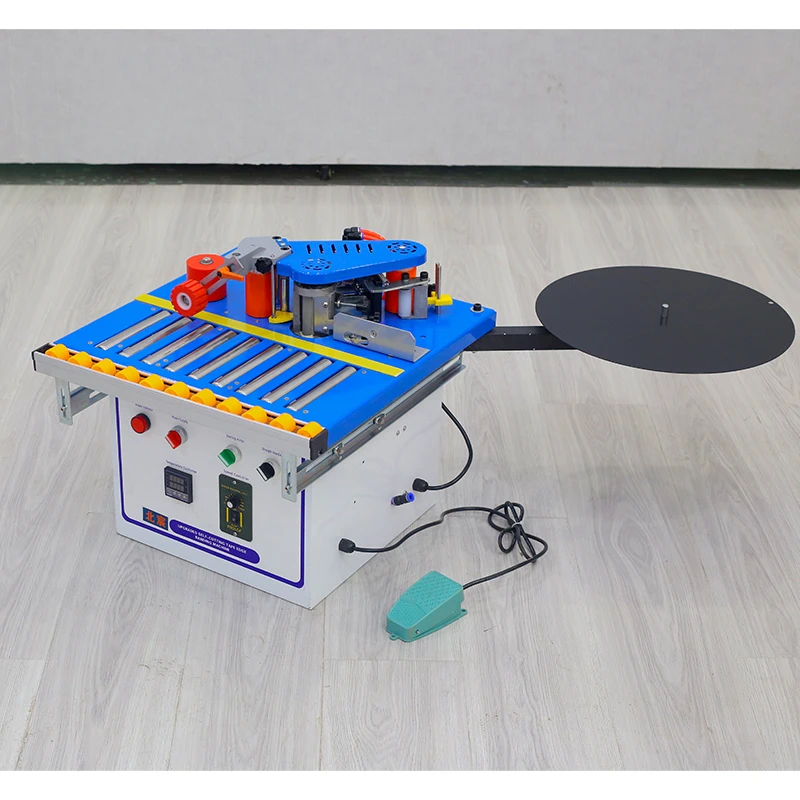
Factory-Built Portable Edge Bander — voltage, language and branding confirmed to your export market before production begins, so the ST-70 arrives ready for local commissioning.
Technical Specifications
| Parameter |
Value |
| Model |
ST-70 |
| Product Type |
Mini Portable Edge Bander |
| Total Power |
1000W |
| Voltage Options |
220V / 380V / Custom Configuration |
| Edge Banding Height |
0–50 mm |
| Edge Banding Thickness |
0.3–3 mm |
| Minimum Sheet Length |
25 cm |
| Minimum Sheet Width |
3 cm |
| Glue Pot Capacity |
1000 ml |
| Edge Trimming Power |
20W |
| Required Air Source Pressure |
0.5–0.8 MPa |
| Product Dimensions |
50 × 50 × 47 cm |
| Net Weight |
23 kg |
| Edge Profile Capability |
Curved and Straight |
| Control Panel Language |
Chinese, English (configurable to Spanish or other languages) |
| Assembly State |
Fully Assembled at Factory |
| Certification |
CE |
Application Suitability
| Application |
Material or Output |
| Custom cabinet door edge sealing |
MDF and particleboard with PVC or ABS tape |
| Small-batch furniture panel finishing |
Plywood and ecological board with melamine tape |
| On-site home decoration trim work |
Solid wood board with 0.3–3 mm veneer or PVC strip |
| Furniture repair and re-banding |
Mixed panel substrates requiring curved profile sealing |
| Workshop pilot runs before full-line investment |
Test pieces across multiple board thicknesses |
Why Voltage Confirmation Must Precede the Purchase Order
Every ST-70 Mini Edge Bander factory order is built to the destination market’s electrical standard, not adapted after arrival.
I have watched containers arrive at ports with machines wired for a grid that does not match the buyer’s country. The 220V unit lands in a region running 380V three-phase, or a 60Hz market receives a motor spec’d for 50Hz. The machine sits in a crate while transformers are sourced, or worse — someone plugs it in and burns out the heating element on day one. [NEED_CITE: voltage and frequency standards by export market]
The ST-70 ships with voltage configured to 220V, 380V, or a custom specification confirmed in writing before the production run begins. The electrical schematic is issued with the pre-shipment documentation so the importer’s compliance team can verify ahead of customs clearance.
OEM Branding and Private Label Configuration
When a regional distributor adds a Mini Edge Bander to their catalog, the machine needs to carry their brand identity — not the factory’s default markings. The ST-70 supports full OEM treatment: custom logo placement on the housing, private label packaging to the distributor’s graphic specification, and control panel language set to the end market. Whether the destination is a Spanish-speaking territory or a Southeast Asian market requiring localized instructions, the panel text and operation manual are produced in the agreed language before the unit leaves the assembly bench. This is standard procedure, not an afterthought negotiated post-order.
Glue System Behavior Across Tape Materials
A handheld edge bander lives or dies by how consistently it lays adhesive under the tape. The 1000 ml glue pot on the ST-70 holds enough hot melt to run extended batches without stopping for refills — important when a small workshop is sealing a full kitchen run of cabinet doors. The 0.3–3 mm thickness range covers the three tape families most commonly stocked by distributors: thin PVC for budget furniture, ABS for impact-resistant surfaces, and melamine for color-matched particleboard work. [NEED_CITE: hot melt adhesive temperature requirements by edge banding material]
Different tapes demand different glue temperatures. PVC melts and curls if the pot runs too hot; ABS needs sufficient heat to bond to the porous edge of MDF. The operator adjusts temperature on the panel, but the machine must hold that setting steadily across a production session.

Edge Trimming and Panel Thickness Relationship
The 0–50 mm banding height range determines which panel thicknesses the ST-70 can handle. Standard 18 mm particleboard used in cabinet carcasses falls well within this envelope, as does 25 mm stock for shelving and 12 mm material for drawer boxes. The 20W trimming unit cleans the overhang after the tape is pressed on, and its effectiveness depends on the operator maintaining a steady feed speed along the panel edge. On curved profiles — think radius corner cabinets or arched headboards — the 23 kg weight of the machine provides enough mass to keep the glue roller pressed against the contour without the operator having to force it. The minimum sheet dimension of 25 cm length by 3 cm width means small offcuts and narrow stiles can be banded without the material slipping past the guide.
The Cost of Skipping Pre-Shipment Verification
When a portable edge bander arrives with the wrong plug type or a control panel in a language the workshop cannot read, the delay is not measured in hours — it stretches across weeks while replacements are shipped or local electricians attempt rewiring. [NEED_CITE: CE machinery directive requirements for industrial equipment] I have seen distributors lose an entire selling season because a batch of machines arrived with Chinese-only panels in a Latin American market. The operators could not set glue temperature, the tape bonded poorly, and the distributor absorbed return shipments and reputational damage that took years to rebuild.
Why Distributors Source This Model From Our Facility
Our four-stage QC process runs incoming material inspection, in-process assembly checks, finished product testing, and pre-shipment verification on every ST-70 before it is crated — the factory test record is included in your documentation package. Voltage and language are confirmed in writing during the quotation stage, not assumed. The patented cutting mechanisms used across our edge bander family give verified trimming tolerance, and the CE declaration of conformity travels with each shipment for customs clearance. We engineer the configuration recommendation around your target market’s panel materials and tape types, then issue a formal quotation within 24 hours so your catalog planning stays on schedule.
Documentation & Verification
- CE declaration of conformity issued per ST-70 shipment batch
- Factory test record confirming glue temperature stability on specified tape type
- Electrical schematic with confirmed voltage and plug type for destination market
- Operation manual produced in agreed language before dispatch
- Pre-shipment packing photographs documenting crating and accessory inclusion
- ISO 9001 certificate available for distributor compliance files
Installation, Commissioning & Support
- Plug-and-run unit arrives fully assembled — no on-site mechanical build required
- 1000W total power draw runs on standard single-phase circuits in most markets
- Air supply connection requires 0.5–0.8 MPa source with standard industrial fitting
- Glue pot first-heat cycle and temperature calibration verified during pre-shipment test
- Spare glue roller and trimming blade included for initial operational period
- Multilingual control panel language confirmed and validated before crating
What We Need to Configure Your Order
To match the ST-70 to your regional market, share the destination country’s standard voltage and frequency, the edge banding tape materials your customers stock most, and the control panel language required for end-user operation. If you are building a private label program, provide your branding artwork and packaging specifications so we can confirm print layout before production.
Frequently Asked Questions
Q: What OEM and private label customization is available for the ST-70?
A: The ST-70 supports custom logo placement on the machine housing, private label packaging to your graphic specification, and control panel language configured to your target market. Operation and maintenance manuals are produced in the agreed language. Artwork and layout proofs are confirmed with the distributor before the production run begins, so branding is integrated into manufacturing rather than applied as an afterthought.
Q: How is voltage and plug type confirmed before production for different export markets?
A: During the quotation stage, we request the destination country’s voltage, frequency, and plug standard in writing. The ST-70 is then built to that specification — whether 220V, 380V, or a custom configuration. An electrical schematic confirming the exact wiring is issued with the documentation package before dispatch, allowing your compliance team to verify ahead of customs clearance.
Q: What documentation accompanies each ST-70 shipment for customs and compliance?
A: Each shipment includes a CE declaration of conformity, ISO 9001 certificate, electrical schematic with confirmed voltage, factory test record showing glue system performance, operation manual in the agreed language, spare parts list, and pre-shipment packing photographs. These documents are prepared in parallel with production so nothing delays container release at the destination port.
Q: How is the glue pot and banding mechanism tested during pre-shipment verification?
A: The pre-shipment test runs the ST-70 glue pot through a full heat cycle at the temperature required for the buyer’s specified tape material — PVC, ABS, or melamine. The 1000 ml pot is filled, brought to operating temperature, and test strips are banded on curved and straight profiles. Trimming quality and adhesion are inspected, and results are recorded in the factory test record included with the shipment.
Q: What spare parts and technical training support is offered to regional distributors?
A: A spare parts list is provided with every ST-70 order, covering consumable items such as glue rollers, trimming blades, and heating elements. Distributors can order spare kits sized to their regional stock requirements. Technical documentation includes electrical schematics and assembly diagrams, enabling the distributor’s own service team to perform maintenance and field support without requiring factory intervention for routine issues.