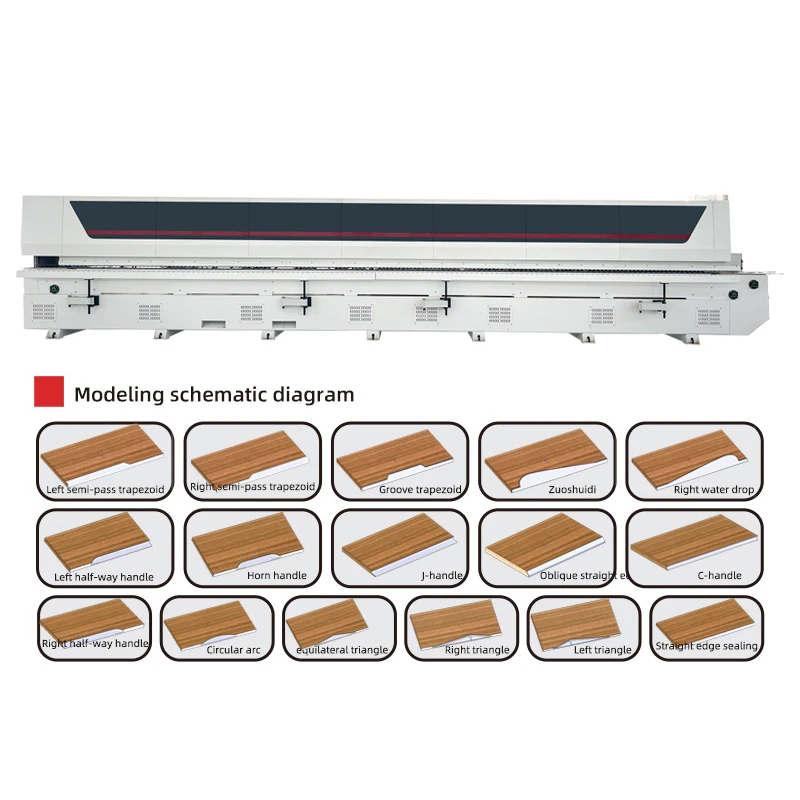
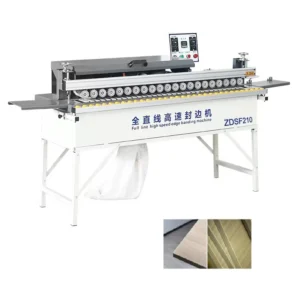
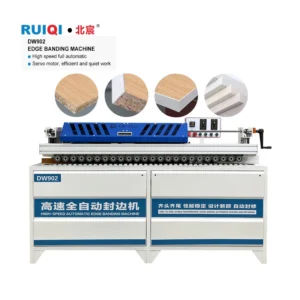
Precision-Ground Components — Every critical surface on the DW985 soft forming edge banding machine is ground in-house at our Ningjin facility before assembly, verified through four-stage quality control from raw material to pre-shipment test.
Technical Specifications
| Parameter |
Value |
| Model |
DW985 |
| Product Type |
Soft Forming Edge Banding Machine |
| Processing Speed |
8–12 m/min (basis not stated in source — confirm panel material / edge banding thickness / profile shape) |
| Voltage |
380V (frequency not specified in source) |
| Control System |
Touch screen with remote upgrade capability |
| Overall Dimensions |
950 × 98 × 184 cm |
| Gross Mass |
4.2 t |
| Semi-J Rough Milling Motor |
5 kW |
| Inclined Straight Edge Pre-milling Motor |
5 kW |
| Semi-J Finish Milling Motor |
6 kW × 2 |
| Milling Servo Drive |
0.75 kW × 3 |
| Slab Chamfering & Edge Banding Breaking |
0.55 kW × 2 |
| Edge Banding & Slotting Motor |
0.3 kW |
| End-to-End Motor |
0.37 kW × 2 |
| Coarse & Fine Finishing Department |
0.75 kW × 2 |
| Plate Polishing |
0.37 kW × 2 |
| Plate Conveying Motor |
5.5 kW |
| Pressure Beam Lifting Motor |
0.37 kW |
| Process Stations |
16 stations: Separate → Linear Pre-milling → Rough Mill → Inclined Straight Pre-milling → Finish Milling → Finishing Milling 2 → Handle-free Chamfer → Plate Heating → Wash → Edge Banding & Slotting → Rubber Coating → Heating System → Soft Forming & Pressing → Edge Banding Breaking → End-to-End → Rough Repair → Truing → Edge Scraping → Copying Chamfer → Wash → Polish |
| Language Options |
Chinese & English (customizable to Spanish or other languages) |
| Plug Options |
EU / USA / AU / UK |
| Operating Temperature Environment |
Adaptable to high and low temperature environments (range to be confirmed) |
Application Suitability
| Application |
Material or Output |
| Custom furniture and cupboard manufacturing |
MDF, particleboard, plywood with soft-forming / shaped edge profiles |
| Cabinet door and drawer front production |
PVC and veneer edge banding on profiled panel edges |
| OEM / private-label equipment programs |
Distributor-branded soft forming edge banding machines for regional resale |
| Furniture factory phased capacity expansion |
Consistent edge banding platform deployed across multiple production sites |
Why Voltage Confirmation Must Precede the Purchase Order
A soft forming edge banding machine that arrives wired for the wrong grid sits idle until an electrician rewinds every motor.
I spent years fielding emergency calls from workshops where the machine was physically perfect but electrically dead on arrival. One cabinet factory in southern China ordered a unit rated for 50 Hz, only to find their local supply ran 60 Hz — the conveyor motor overheated within the first shift. With the DW985 Soft Forming Edge Banding Machine factory OEM program, voltage and frequency are locked in writing before production starts, not assumed from a catalog default [NEED_CITE: voltage and frequency standards by export market].
How the 16-Station Sequence Handles Substrate Variability
Soft forming differs from straight edge banding because the edge profile is rarely a simple flat surface. The DW985 routes each panel through pre-milling, heating, rubber coating, and contour pressing stations in sequence, so that PVC or veneer material conforms to the milled profile rather than bridging across it. The dedicated plate heating station softens the adhesive before the soft forming and pressing unit applies pressure, which matters when the ambient workshop temperature drops below the glue’s open-time threshold. Each of the three 0.75 kW milling servo drives adjusts independently, so the machine can track compound curves without leaving witness marks on the finished edge.
Manufacturing Depth Behind the OEM Label
When a distributor puts their own name on a soft forming edge banding machine, the end user will call that distributor — not the original builder — when a bearing fails or a servo alarms out. That is why the DW985 is manufactured entirely in-house at Ruiqi’s Ningjin facility, from precision-ground shafts to the touch screen firmware. The OEM scope covers logo placement on the machine body and control panel, voltage adaptation across the 110V–440V range, and multilingual interface configuration [NEED_CITE: CE machinery directive requirements for industrial equipment]. Component sourcing is transparent: buyers can review the bill of materials during a factory visit and verify that servo drives, contactors, and PLC modules come from brands with service networks in their target market.
What the Motor Configuration Tells You About Edge Quality
The DW985 carries six dedicated finishing and trimming motors — two at 6 kW for semi-J finish milling, two at 0.75 kW for coarse and fine finishing, and two at 0.37 kW for plate polishing. This separation means the rough milling stage removes the bulk of excess material without loading the finish cutters, so the final edge surface is produced by a tool that only has to take a light pass. The two 5 kW pre-milling motors (rough and inclined straight) prepare the panel edge before glue application, which directly affects how well the banding material bonds to MDF or particleboard end grain. The 5.5 kW plate conveying motor maintains feed stability across the full 950 cm machine length, preventing the micro-stutters that show up as periodic ridges on the finished edge.

What Happens When Process Stations Are Underspecified
A distributor once sent me photos from a customer site where the edge banding was peeling off shaped cabinet doors within weeks of installation. The machine they had purchased skipped the dedicated plate heating and rubber coating stations, relying on a single glue roller to bond PVC to a milled profile. In cold workshops, the adhesive set before the banding fully conformed to the contour. With the DW985, the heating system and soft forming pressing station work in sequence to keep the adhesive pliable while the banding wraps the profile, reducing delamination risk on shaped edges [NEED_CITE: edge banding adhesion failure modes on contoured profiles].
Why OEM Buyers Audit the Factory, Not Just the Brochure
Private-label equipment only works when the manufacturing partner can prove consistency across production runs. The DW985 program includes a factory visit to the 10,000㎡ Ningjin facility, where buyers inspect precision grinding stations, review the four-stage QC workflow, and witness a pre-shipment test on their specified panel material and edge banding stock. In-house manufacturing means the same engineering team that designed the 16-station sequence also handles voltage adaptation and control panel customization, so there is no handoff between a sales office and an unnamed contract assembler.
Documentation & Verification
- CE declaration of conformity covering the full 16-station soft forming sequence
- ISO 9001 certificate linked to the four-stage QC workflow
- Machine specification sheet with confirmed voltage, frequency, and plug type for target market
- Electrical schematic showing each of the 18 motor circuits with rated amperage
- Factory test record run on buyer-supplied panel thickness and edge banding material
- Operation and maintenance manual in the agreed language with spare parts cross-reference
Installation, Commissioning & Support
- Foundation must support 4.2 t gross mass on a level concrete slab with vibration isolation
- Dedicated 380V circuit sized for total connected load across all 18 motors
- Machine ships as a single assembled unit; verify door clearances against the 950 × 98 × 184 cm footprint
- First-run commissioning includes touch screen calibration and remote profile upgrade testing
- Operator training covers profile switching, servo drive tuning, and daily lubrication points
- Initial spare parts kit includes cutter inserts, scraper blades, and polishing wheels sized for the DW985
Requesting a Configuration Proposal
To scope the DW985 for your market or production line, share the panel substrates and edge banding materials you run most frequently, the shaped profiles you need the soft forming sequence to handle, and the voltage and frequency at the installation site. If you are evaluating this unit as part of an OEM program, include your branding requirements, target documentation language, and the spare parts inventory depth your service team will need to stock locally.
Frequently Asked Questions
Q: What is included in the OEM customization scope for the DW985?
A: The OEM program covers logo placement on the machine body and HMI screen, voltage adaptation from 110V to 440V with confirmed frequency, multilingual touch screen interface, plug type selection, and private-label documentation. Buyers can review the full customization checklist during a factory visit before production begins.
Q: How does the four-stage QC process apply to each DW985 unit?
A: Incoming materials are inspected before machining, in-process checks verify grinding tolerances on critical shafts, finished product testing runs the full 16-station sequence under load, and pre-shipment verification includes a test on the buyer’s specified panel material and edge banding stock with documented results.
Q: Can the soft forming profile system be updated for new shapes after delivery?
A: The touch screen control system supports remote profile upgrades, so new contour shapes can be added to the machine’s library without replacing mechanical components. The wheeled profiling design allows operators to switch between stored profiles through the HMI rather than changing physical tooling.
Q: What component brands are used and how are spare parts sourced?
A: Servo drives, contactors, and PLC modules are sourced from brands with established service networks. The spare parts list is included in the documentation package, and OEM partners can stock consumables such as cutter inserts, scraper blades, and polishing wheels through their own regional distribution channels.
Q: What information do I need to provide for a voltage and frequency confirmation?
A: Provide the nominal voltage, phase configuration, and frequency in hertz at the installation site. The engineering team will confirm motor winding specifications and issue a signed electrical schematic before production, ensuring every motor on the DW985 matches the local grid without field modification.