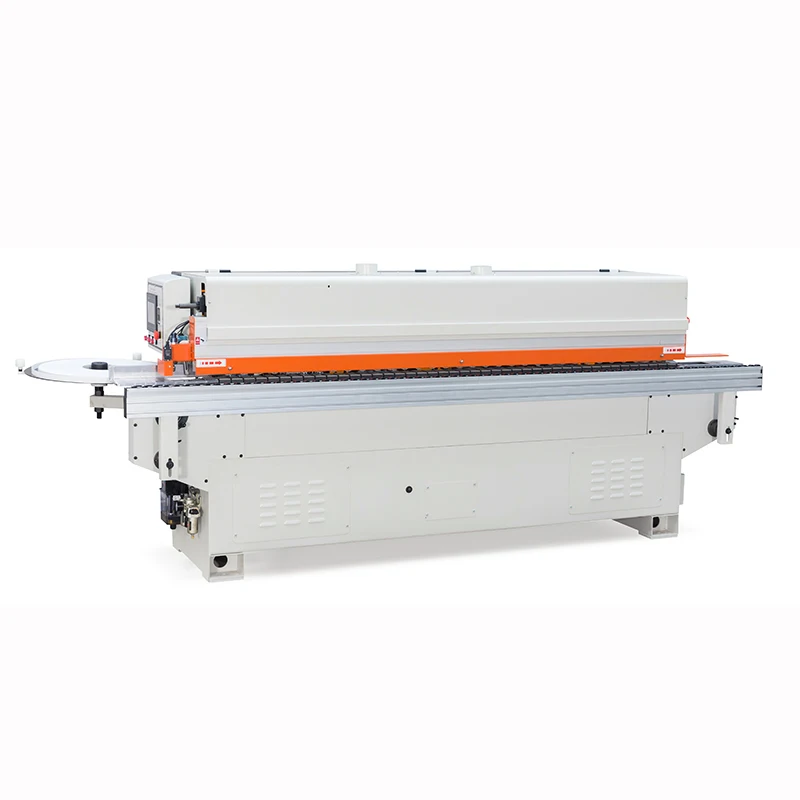
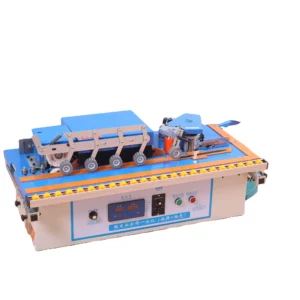
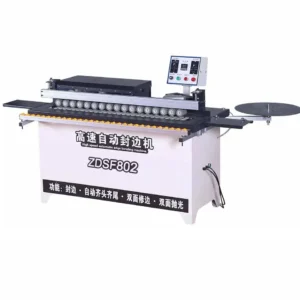
Precision-Built Core Mechanisms — Every ZDS280 Linear Edge Banding Machine leaves our Ningjin assembly floor with a factory test record verifying trim tolerance on your specified panel material, not just a spec sheet promise.
Technical Specifications
| Parameter |
Value |
| Model |
ZDS280 |
| Product Type |
Linear Edge Banding Machine |
| Main Functions |
Gluing, End Trimming, Fine Trimming, Scraping, Buffing, Cleaning |
| Working Pressure |
0.65 MPa |
| Voltage |
380V / 3-Phase (frequency configurable to 50Hz or 60Hz) |
| Conveyor Belt Speed |
9–12 m/min |
| Rated Power |
9 kW |
| Min. Panel Width |
60 mm |
| Min. Panel Length |
120 mm |
| Panel Thickness Range |
10–60 mm |
| Edge Banding Thickness Range |
0.3–3 mm |
| Net Weight |
890 kg |
| Overall Dimensions (L×W×H) |
2950 × 750 × 1250 mm |
| Control System |
PLC with Touch Screen (Taiwan Delta) |
| Frequency Converter |
Taiwan Delta |
| Contactor |
Schneider Electric |
| High-Speed Motor |
UFC brand |
| Gluing System |
Teflon-coated glue pot with anti-carbonization design |
| Pressing System |
Dual pneumatic pressure rollers with adjustable stroke |
| End Trimming |
Air pressure balance device |
| Buffing Motor |
0.37 kW × 2 (upper and lower polishing) |
| Guide Rail |
Imported wide linear guide rail |
| Edge Banding Support |
Rotary support disc |
| Warranty |
1 year |
Application Suitability
| Application |
Material or Output |
| Custom cabinet door edge banding |
MDF and particleboard with 0.4–2 mm PVC edge banding |
| Plywood shelving edge finishing |
Plywood panels with veneer or PVC strip up to 3 mm |
| Solid wood panel edge treatment |
Solid wood boards with thin veneer banding at 0.3–1 mm |
| Office furniture panel production |
Particleboard and MDF with standard PVC edge tape |
Why Frequency Confirmation Must Happen Before the Quotation Is Signed
A motor rated for 50Hz will overheat and trip breakers on a 60Hz supply within the first week of operation.
I spent years on the buyer side before moving to our Southeast Asia rep office, and the pattern was always the same: a container arrives, the electrician wires it up, and the main drive trips within minutes. One edge bander I inspected sat idle on a factory floor for weeks while the importer argued with the supplier over who should have confirmed the local grid frequency. The ZDS280 Linear Edge Banding Machine factory configuration process addresses this by locking voltage and frequency at the quotation stage — 380V at 50Hz for most Asian and European markets, or re-specified for 60Hz regions before the motor and transformer are sourced. [NEED_CITE: voltage and frequency standards by export market]
Component Traceability from Glue Pot to Polishing Head
When distributors evaluate a Linear Edge Banding Machine factory partner, the first question is usually about branding and logo placement. The more important question is whether the supplier can trace every critical component back to its source. On the ZDS280, the Taiwan Delta PLC and touch screen are standard across all units, the contactors are Schneider Electric, and the high-speed trimming motors are UFC brand. This matters for your regional service team: when a contactor fails eighteen months after installation, your technician can source a replacement locally instead of waiting for an air-freighted part from a supplier who never documented what went into the cabinet.
Assembly Depth Versus Bolt-Together Operations
Some facilities calling themselves manufacturers are essentially assembly halls — they receive sub-assemblies from three different workshops, bolt them to a frame, paint the enclosure, and ship. [NEED_CITE: CE machinery directive requirements for industrial equipment] Our Ningjin facility handles precision grinding of the linear guide rail mounting surfaces in-house, which directly affects how the end-trimming and fine-trimming stations hold alignment over thousands of production hours. The imported wide linear guide rails on the ZDS280 are not simply bolted on; the mounting surfaces are ground to tolerance first, then verified during our in-process QC stage before the trimming heads are fitted. This is the difference a distributor can verify during a factory audit by asking to see the grinding station and the inspection records.
How Panel Thickness Range and Feed Speed Shape Your Downstream Quality
The ZDS280 handles panel thickness from 10 mm to 60 mm, which covers the full spectrum from thin shelving stock to heavy worktop substrates. At the 9–12 m/min conveyor speed range, the glue pot must maintain consistent temperature across varying feed rates — the Teflon-coated pot with anti-carbonization design prevents glue degradation when the machine runs at lower speed on thicker panels that require longer open time. The dual pneumatic pressing rollers with adjustable stroke ensure uniform bonding pressure whether you are running 0.3 mm veneer on a 10 mm MDF shelf edge or 3 mm PVC on a 60 mm particleboard countertop. End trimming uses an air pressure balance device rather than a simple mechanical stop, which keeps the cut square across the full thickness range without manual recalibration between jobs.

The Hidden Cost of Skipping Pre-Shipment Verification
Distributors who accept a machine based on catalog specifications alone often discover tolerance issues only after their customer’s panels fail during assembly. Edge banding that leaves a visible glue line on one substrate but not another is not necessarily a machine fault — it can be a pressure roller adjustment that was never set for the specific banding thickness the end user runs most often. [NEED_CITE: common edge banding defects traced to setup parameters] When the ZDS280 ships without a pre-shipment test on your actual panel and banding material, your technical team inherits that setup work in the field, often without the benefit of our engineer being present.
Why OEM Partners Choose This Assembly Floor
Our in-house manufacturing means OEM logo application, private-label control panel graphics, and custom voltage winding are handled on the same floor where the machine is built — not outsourced to a third-party branding shop after assembly. The four-stage QC process covers incoming material inspection, in-process verification during assembly, finished product testing, and pre-shipment validation, each producing a documented record that travels with your order. Voltage customization from 110V to 440V is standard, and multilingual control panel configuration is locked in before the Delta touch screen is programmed. Factory visits are welcomed at any production stage, and we encourage distributors to bring their own panel material for a live test run on the ZDS280 before the machine is crated.
Documentation & Verification
- CE declaration of conformity matched to the ZDS280 configuration shipped
- ISO 9001 certificate available for direct verification with issuing body
- Factory test record documenting trim tolerance on your panel thickness and banding material
- Electrical schematic confirming voltage, frequency, and breaker rating for your market
- Operation and maintenance manual in your specified language with spare parts list
- Pre-shipment photograph set showing machine serial plate, wiring, and crating condition
Installation, Commissioning & Support
- 2950 × 750 mm footprint requires a level concrete pad with clearance for infeed and outfeed tables
- 9 kW rated power demands a dedicated 3-phase circuit with correct breaker sizing for 380V or confirmed local voltage
- Machine ships fully assembled; positioning requires fork access on both long sides
- First-run calibration covers glue temperature, pressure roller stroke, and trimming head alignment on your material
- Delta touch screen configured in your operator’s language before dispatch to avoid commissioning delays
- Wear parts list identifies scraping blades, buffing wheels, and trimmer cutters with order codes for your regional stock
What We Need to Prepare Your OEM Quotation
Send us your target market voltage and frequency, the primary panel materials and thickness range your customers run, and the edge banding types and thicknesses most common in your region. If you plan to private-label the machine, include your logo files and preferred control panel language. Let us know whether you want to arrange a factory visit for a live production test or if you will send sample panel and banding material for us to run and document on video before shipment.
Frequently Asked Questions
Q: Can you apply our logo and customize the machine for our regional voltage?
A: Yes. OEM logo placement on the enclosure, private-label control panel graphics, and voltage winding from 110V to 440V are all handled on our assembly floor. The Delta touch screen is programmed in your specified language before the machine ships. We confirm all electrical specifications in writing at the quotation stage to prevent grid mismatch on arrival.
Q: Can we visit the factory and run a live test on our panel material?
A: Factory visits are welcome at any production stage. We encourage distributors to bring their own MDF, particleboard, or plywood samples along with the edge banding material they stock. We will run the ZDS280 on your material, document the trim quality and glue line result, and provide the test record with your shipment.
Q: What spare parts are included, and how do we supply our service team?
A: Each machine ships with a spare parts list identifying wear items — scraping blades, buffing wheels, trimmer cutters, and fuses — with order codes. Your regional service team can source Schneider contactors and Delta components locally in most markets. We stock consumable wear parts for direct shipment to your warehouse on request.
Q: Do you provide technical training for our distributor engineers?
A: Yes. We offer hands-on training at our Ningjin facility covering machine setup, pressure roller adjustment, trimming head alignment, and routine maintenance procedures. Your engineers work alongside our assembly team on a live ZDS280 unit, and we provide training documentation in your preferred language for ongoing reference.
Q: What is the production lead time for OEM orders?
A: Lead time depends on order volume and customization scope. Standard voltage configurations with logo application typically move through our four-stage QC and ship within a multi-week window. Large batch orders with non-standard voltage or custom control panel programming require a longer scheduling window, which we confirm at the quotation stage.