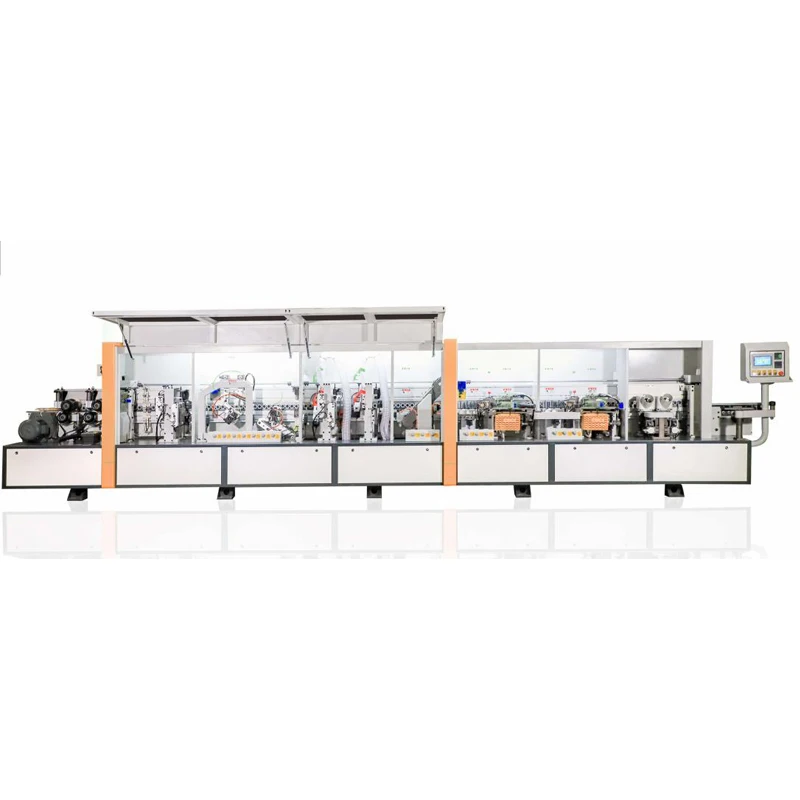
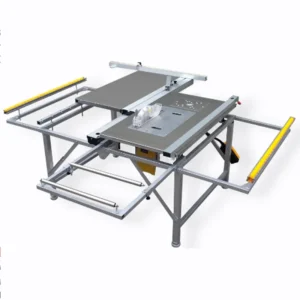
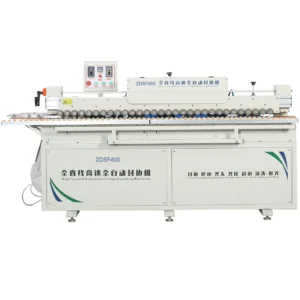
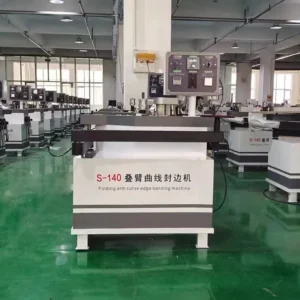
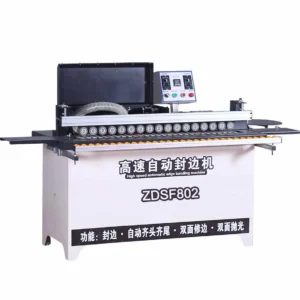
In-House Manufacturing Depth — every ZDS series edge banding machine is built on-site with precision-ground components and patented cutting mechanisms, giving distributors full control over private-label specifications from electrical schematics to multilingual operator panels.
Technical Specifications
| Parameter |
Value |
| Model |
ZDS365 / ZDS-368 / ZDS-468 / ZDS-468J / ZDS-468JJ |
| Product Type |
Automatic Edge Banding Machine |
| Pre-milling Unit |
Available on ZDS-468J and ZDS-468JJ (diamond cutters, 2×2.2 kW, 12000 rpm, max cut depth 2 mm) |
| End Trimming |
0.37 kW × 2 motors, 12000 rpm |
| Rough Trimming |
0.75 kW × 2 high-frequency motors, 12000 rpm, 6-teeth flat cutters, manual thickness adjustment |
| Fine Trimming |
0.75 kW × 2 high-frequency motors, 12000 rpm, 6-teeth R2 cutters, manual thickness adjustment |
| Corner Rounding |
Four-motor profiling on ZDS-468 / ZDS-468J / ZDS-468JJ |
| Buffing Stations |
1 (ZDS365 to ZDS-468J); 2 (ZDS-468JJ) |
| Glue Pot |
Teflon-coated, anti-carbonization design; optional upper glue pot / PUR glue pot / dual glue pot |
| Pressing Roller |
4 sets (optional 6 sets) |
| Panel Thickness Range |
10–60 mm |
| Edge Thickness Range |
0.4–3 mm |
| Min. Panel Size |
300×60 mm (ZDS365 / ZDS-368 / ZDS-468); 300×60 mm or 150×150 mm (ZDS-468J / ZDS-468JJ) |
| Total Power |
8.15 kW (ZDS365) / 9.65 kW (ZDS-368) / 13 kW (ZDS-468) / 16 kW (ZDS-468J) / 18.5 kW (ZDS-468JJ) |
| Overall Dimensions (L×W×H) |
4070×900×1600 mm (ZDS365) to 8000×900×1600 mm (ZDS-468JJ) |
| Net Weight |
1200 kg (ZDS365) to 2300 kg (ZDS-468JJ) |
| Working Pressure |
0.6 MPa |
| Voltage |
3-phase 380V (configurable from 110V to 440V to match destination market) |
| Control System |
PLC control system |
| Key Features |
Scraping on all models; optional quick-melt glue unit, flexible edge scraping, narrow plate auxiliary device, slotting device, double buffing unit |
| Warranty |
1 year |
Application Suitability
| Application |
Material or Output |
| Custom furniture panel edge banding |
MDF, particleboard, and plywood with PVC or ABS edge banding |
| Cabinet door and carcass production |
Melamine-faced board with 0.4–3 mm veneer or thermoplastic banding |
| Joinery workshop automation upgrade |
Solid wood panels requiring pre-milling for chip-free right-angled edges |
| Panel processing plant line integration |
High-volume board sizing and edge finishing across varying substrate thicknesses |
Why the Voltage Question Should Come Before the Quotation
Every ZDS series machine ships only after the destination voltage and frequency are confirmed in writing — not assumed from a catalog default.
I learned this lesson the hard way in a furniture factory outside Riyadh. A container arrived carrying a high-spec edge bander wired for 50 Hz, while the local industrial grid ran 380V at 60 Hz. The motor tripped the breaker on first startup, and the entire production line sat idle until an electrician could source and fit a compatible frequency converter. [NEED_CITE: voltage and frequency standards by export market]. That kind of incident erodes distributor credibility faster than any machine defect. The OEM edge banding machine manufacturer process now locks electrical schematics to the confirmed destination grid before production scheduling begins, ensuring each unit matches the local industrial environment.

Component Sourcing and Assembly Transparency
The ZDS series is assembled entirely in-house, meaning every stage from frame welding to final calibration stays under one roof. Distributors evaluating an automatic edge banding machine factory need to verify that the manufacturer actually controls the production process rather than outsourcing subassemblies. This facility handles precision grinding of critical contact surfaces, alignment of feed chains, and installation of high-frequency trimming motors on-site, giving importing partners confidence that the machine they inspect during a factory visit is the same configuration that ships.
Four-Stage Quality Control Before the Crate Closes
Quality verification follows four distinct gates: incoming material inspection, in-process assembly checks, finished-product functional testing, and a pre-shipment run that simulates actual panel processing. Each gate generates documented records that travel with the shipment. [NEED_CITE: CE machinery directive requirements for industrial equipment]. For a distributor stocking machines across a territory, this layered approach reduces the chance that a unit arrives with a tolerance issue discoverable only when the buyer’s customer attempts cabinet assembly.
Reading the Spec Sheet Against Real Production Conditions
Panel thickness range of 10–60 mm determines whether a machine can handle both thin drawer sides and thick countertop stock without manual reconfiguration between runs. The pre-milling unit available on ZDS-468J and ZDS-468JJ uses diamond cutters spinning at 12000 rpm to remove up to 2 mm of material from the board edge, eliminating chips left by the panel saw and ensuring a clean glue line. The Teflon-coated glue pot with anti-carbonization design keeps adhesive properties stable during long shifts, which matters when switching between standard EVA and optional PUR glue systems for moisture-resistant bonding. Feed pressure from four pressing roller sets — expandable to six — directly influences how tightly the banding conforms to the substrate contour before trimming begins.
The Hidden Cost of Skipping Configuration Verification
A distributor who orders edge banders without locking down the full specification set faces predictable downstream problems. [NEED_CITE: common commissioning failures in imported woodworking machinery]. Control panels printed in a language the end user cannot read stall the commissioning process. Machines quoted at a base configuration arrive without the pre-milling unit the buyer’s market demands, forcing a costly retrofit or a lost sale. Entry-level models pushed into production volumes beyond their design intent wear through bearings and feed chains prematurely, generating warranty claims that the distributor — not the factory — must absorb on the ground.
Why Distributors Source This Product Line Here
The five-model range from 8.15 kW to 18.5 kW lets a regional importer cover the full market segment — from small joinery shops to established furniture factories — without splitting orders across multiple suppliers. Private-label capability extends beyond a logo swap: control panel language, machine color, electrical cabinet layout, and documentation all carry the distributor’s branding. Factory visits are actively encouraged so importing partners can inspect precision grinding stations, witness the four-stage QC sequence, and discuss territory-specific model mix before committing to a container order. [NEED_CITE: OEM and private-label standards for industrial machinery exports]. Engineer-led configuration recommendations arrive within 24 hours of inquiry, keeping the distributor’s sales cycle moving.
Documentation & Verification
- CE declaration of conformity matched to the specific automatic edge banding machine configuration shipped
- Electrical schematic and voltage confirmation document locked to destination frequency before production
- Factory test record run on the buyer’s specified panel thickness and edge material before crating
- ISO 9001 certificate available for distributor review during the evaluation stage
- Operation and maintenance manual produced in the end user’s language as confirmed at order
- Packing photographs documenting crate condition and machine securing method prior to container loading
Installation, Commissioning & Support
- Foundation must support 2300 kg maximum net weight on the ZDS-468JJ with level tolerance across the 8000 mm length
- Dedicated 3-phase circuit required matching confirmed voltage and total power up to 18.5 kW
- Machine ships fully assembled; only select spare parts packed knock-down for transport protection
- PLC control system commissioning includes parameter setting for the buyer’s actual panel thickness range
- Operator training covers glue pot temperature management for the specified edge material type
- Wear parts list with part numbers provided so the distributor can maintain local spare stock
What to Include in Your Inquiry
Send the panel substrates and edge banding materials your market processes most frequently, along with the typical board thickness range and the daily processing volume your buyers expect. Confirm the local industrial voltage and frequency so the electrical cabinet can be built to match from day one. If your customers run mixed small-batch work, indicate whether the narrow plate auxiliary device or slotting option should be included in the configuration.
Frequently Asked Questions
Q: What can be customized under OEM or private-label agreements?
A: Beyond logo placement, the scope covers machine color, control panel language, electrical cabinet layout, and all accompanying documentation. Voltage is built to the confirmed destination standard from 110V to 440V. The distributor’s branding appears on the nameplate, operator interface, and manuals, making the machine indistinguishable from a locally manufactured product in the end user’s eyes.
Q: How is voltage and frequency confirmed for different export markets?
A: At quotation stage, the buyer provides the destination industrial voltage and frequency. An electrical schematic reflecting those values is issued for written approval before production scheduling begins. No unit enters assembly until that confirmation is signed, eliminating the grid-mismatch failures that plague unverified shipments.
Q: What is the minimum order for distributor-volume production runs?
A: Orders range from single units through to full container loads. Lead time varies with order size and customization depth. Distributors planning regional inventory typically batch multiple models in one shipment to cover entry-level and full-function segments simultaneously.
Q: How are spare parts and technical training handled for the distributor’s service team?
A: A spare parts list with numbered diagrams ships with every machine. The distributor’s technicians can attend factory training covering PLC troubleshooting, trimming motor replacement, and glue pot maintenance. Ongoing parts supply is arranged through the same channel as the original order.
Q: Is territory exclusivity or model mix planning available?
A: Model mix recommendations are based on the distributor’s regional market profile — balancing entry-level units for workshop startups against full-function pre-milling models for established furniture factories. Territory arrangements are discussed case by case depending on market coverage and service capability.