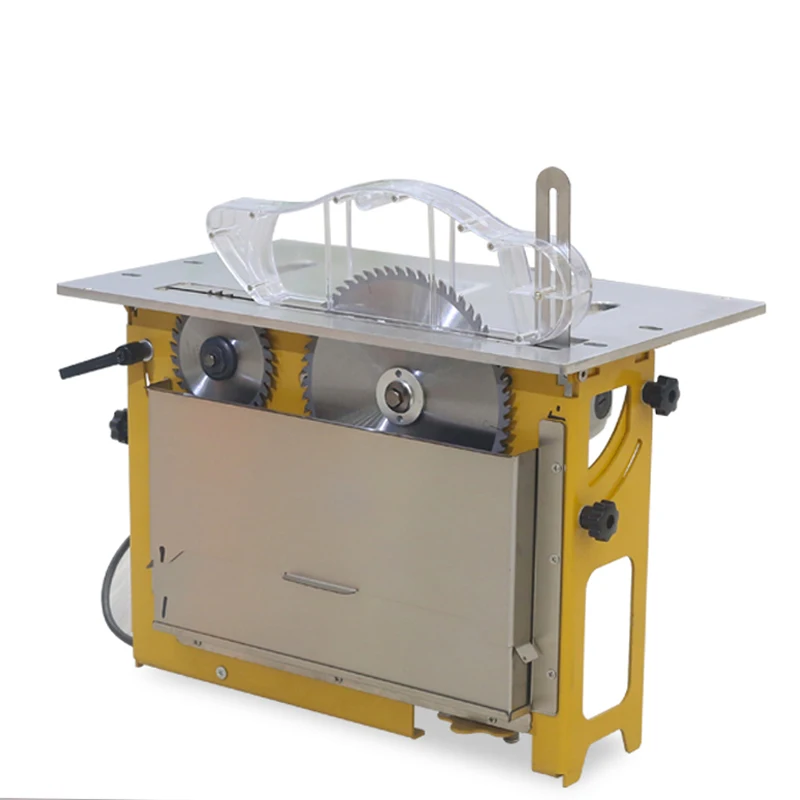
Voltage-matched production — every portable panel saw ships with a confirmed electrical schematic and frequency specification aligned to the destination market, preventing the costly reality of machines arriving unusable at the installation site.
Technical Specifications
| Parameter |
Value |
| Product Type |
Portable Sliding Table Panel Saw |
| Total Power |
6200W |
| Main Saw Motor Power |
3000W |
| Main Saw Speed |
3800 r/min |
| Main Saw Blade Diameter |
200mm |
| Sub Saw Motor Power |
2000W |
| Sub Saw Speed |
13000 r/min |
| Vacuum Cleaner Power |
1200W |
| Maximum Cutting Length |
2440mm |
| Maximum Cutting Thickness |
40mm |
| Net Weight |
22kg |
| Machine Dimensions (L×W×H) |
500×300×380mm |
| Dust Extraction |
Integrated 1200W vacuum cleaner |
| Language Options |
Chinese, English (configurable) |
| Plug Options |
EU, USA, AU, UK |
Application Suitability
| Application |
Material or Output |
| On-site panel sizing |
MDF, particleboard, plywood sheets up to 2440mm |
| Small workshop cross-cutting |
Laminated boards requiring scoring cuts |
| Custom furniture joinery |
Solid wood panels and veneer-faced substrates |
| Portable cutting operations |
Job-site and temporary workshop environments |
Why the Voltage Question Must Precede Every Portable Panel Saw OEM Manufacturer Order
A portable panel saw that cannot run on local power infrastructure is dead weight in a shipping container.
Importers and distributors frequently encounter machines quoted without voltage confirmation, only to discover upon arrival that the electrical configuration does not match regional standards. This portable panel saw OEM manufacturer process requires voltage and frequency documentation before production begins, ensuring the 6200W total power system aligns with destination grid specifications. The difference between a 50Hz and 60Hz market affects motor speed calculations, thermal management, and long-term component reliability [NEED_CITE: voltage and frequency standards by export market].
Precision Scoring for Laminated Substrates
The dual-motor architecture pairs a 3000W main saw running at 3800 r/min with a 2000W sub saw at 13000 r/min. This configuration allows the scoring blade to pre-cut the bottom laminate layer before the main blade completes the through-cut, preventing tear-out on melamine and veneer surfaces. For distributors evaluating manufacturing depth, this motor pairing demonstrates engineering consideration beyond single-motor alternatives.
Integrated Dust Management Without External Infrastructure
The built-in 1200W vacuum cleaner eliminates the need for separate dust extraction systems, a critical factor for portable operations and small workshops where floor space and power circuit capacity remain limited. This integrated approach means the machine arrives as a complete cutting solution rather than requiring additional capital expenditure on extraction equipment. Regional dealers building inventory for startup workshops recognize this as a simplified selling proposition.
Cutting Capacity and Workshop Workflow
The 2440mm maximum cutting length accommodates standard 8-foot panel sheets, while the 40mm thickness range covers typical furniture-grade materials. The 200mm main blade diameter provides adequate depth of cut without excessive power consumption. For joinery workshops transitioning from manual methods, this capacity range supports immediate production needs while allowing future scaling to larger format equipment [NEED_CITE: standard panel sheet dimensions in furniture manufacturing].

The Cost of Underspecifying Motor Power
Machines selected without matching motor capacity to actual production volume create cascading problems. A portable panel saw operating continuously beyond its designed duty cycle experiences accelerated bearing wear, motor overheating, and eventual failure during critical delivery periods. Distributors who stock underpowered units for demanding workshop environments face warranty claims and reputational damage that outweigh initial cost savings.
Why Manufacturing Depth Matters for OEM Partnerships
This facility maintains in-house manufacturing with proprietary cutting mechanisms and multi-stage precision grinding, providing the foundation for genuine OEM capability rather than simple relabeling. The four-stage quality control process covers incoming material inspection through pre-shipment verification, with factory test records accompanying each unit. For distributors evaluating long-term partnerships, this manufacturing depth enables specification modifications for regional requirements without compromising quality standards [NEED_CITE: quality control protocols in woodworking machinery manufacturing].
Documentation & Verification
- CE declaration of conformity for European market access
- ISO 9001 certificate demonstrating quality management systems
- Electrical schematic with voltage and frequency matched to destination
- Factory test record on specified panel thickness range before dispatch
- Operation manual in agreed language with spare parts documentation
Installation, Commissioning & Support
- Requires dedicated 220V or 380V circuit depending on confirmed configuration to handle 6200W total load
- Compact 500×300×380mm footprint allows placement in space-constrained workshops
- Integrated vacuum system eliminates separate dust extraction installation
- Initial blade alignment verification on 200mm main saw and scoring blade
- Operator training on dual-motor startup sequence and feed rate optimization
- Spare parts inventory including 200mm blades and scoring blade specifications
Moving Forward with Specification Alignment
Distributors and importers evaluating this portable panel saw should prepare destination market voltage and frequency requirements, target workshop profiles, expected daily cutting volume, preferred control panel language, and plug type standards. This information enables accurate configuration recommendations and formal quotation within the standard response timeframe.
Frequently Asked Questions
Q: What OEM customization options exist for branding and market adaptation?
A: Custom logo application, voltage configuration from 110V to 440V based on destination requirements, control panel language options beyond standard Chinese and English, and specification modifications for regional market demands. Each customization undergoes the same four-stage quality control process as standard production units.
Q: How do you confirm electrical compatibility before manufacturing begins?
A: The ordering process requires destination country and regional grid specifications, followed by electrical schematic preparation showing voltage, frequency, and plug configuration. Production proceeds only after buyer approval of these specifications, preventing the common problem of equipment arriving electrically incompatible with local infrastructure.
Q: What quality documentation ships with each portable panel saw?
A: Each unit includes CE declaration of conformity, ISO 9001 certificate, machine specification sheet, electrical schematic confirming voltage and frequency, factory test record demonstrating cutting performance on specified materials, operation manual in agreed language, and complete spare parts list with specifications.
Q: Can you modify specifications for regional distributor requirements?
A: Custom drawings and specification modifications are accommodated through the OEM process, including motor power adjustments, cutting length modifications, and control system adaptations. Engineering review confirms feasibility and performance implications before production commitment, ensuring modified units meet the same quality standards as standard configurations.
Q: What technical support structure exists for distributor service teams?
A: Distributor partnerships include technical training for service personnel, comprehensive spare parts documentation, electrical schematics enabling field troubleshooting, and direct engineering support for complex issues. This structure allows regional dealers to provide responsive local service while maintaining manufacturer-backed technical depth.