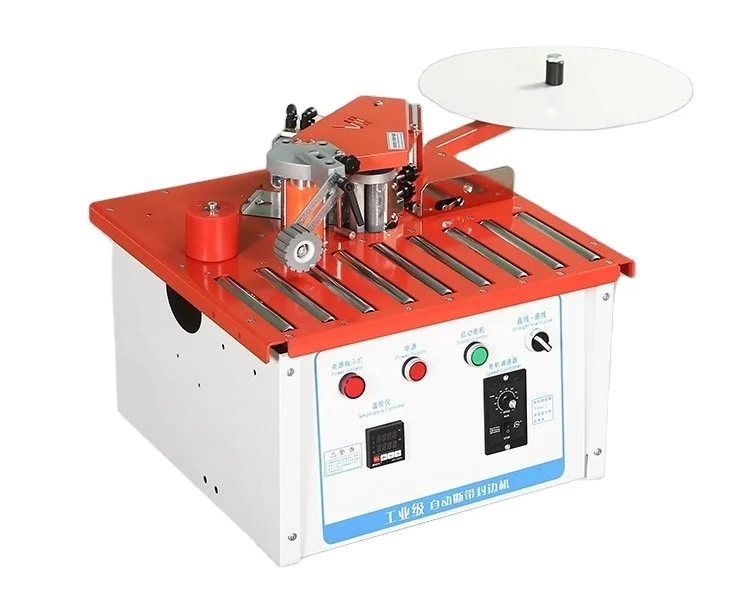
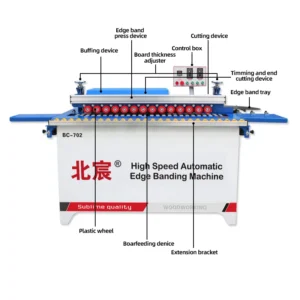
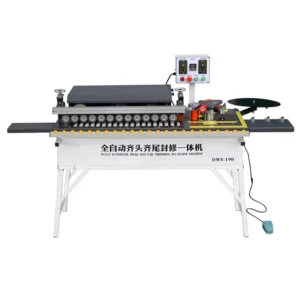
In-house manufacturing with patented mechanisms — The ZDSF50 mini edge banding machine is produced within a controlled facility where precision-ground components and a four-stage QC process ensure that every unit leaving the floor has been tested against its claimed tolerances before crating.
Technical Specifications
| Parameter |
Value |
| Model |
ZDSF50 |
| Product Type |
Mini Edge Banding Machine |
| Rated Voltage |
220V |
| Rated Power |
1.2 kW |
| Function |
Double side gluing for Straight, Curved, and Shaped Edges |
| Rated Air Pressure |
0.4-0.6 MPa |
| Strip Thickness Range |
0.5-1.5 mm |
| Sheet Thickness Range |
10-60 mm |
| Glue Pot Capacity |
1000 ml |
| Heating Time |
5-10 min |
| Feed Speed |
0-6 m/min |
| Overall Dimensions |
54×54×56 cm |
| Net Weight |
26 kg |
| Glue Heating |
4 heating tubes |
| Edge Strip Transport |
Adjustable bayonet for strip height |
| Pressure Rollers |
Adjustable rubber rollers |
| Belt Breaking Control |
Pneumatic with foot switch (curved) / Travel switch (straight) |
| Assembly State |
Portable desktop unit |
Application Suitability
| Application |
Material or Output |
| Custom cabinet edging |
MDF and particleboard with PVC strips |
| Joinery workshop repairs |
Plywood and solid wood panels with veneer banding |
| Small-batch curved furniture |
Shaped solid wood components with 0.5-1.5 mm strips |
| Prototyping and sample making |
Various panel substrates up to 60 mm thickness |
Why the Voltage Question Must Precede the Mini Edge Banding Machine OEM factory Order
Confirming local voltage and frequency before production prevents a machine from arriving as dead weight on the workshop floor.
I remember a small joinery shop that imported a portable edge bander without double-checking the local grid specs; the motor hummed but the glue pot never reached temperature, and the entire commissioning schedule stalled while a transformer was sourced locally. When evaluating a Mini Edge Banding Machine OEM factory, the first technical exchange should always cover the destination market’s electrical standards [NEED_CITE: voltage and frequency standards by export market]. A unit built for 220V/50Hz will underperform or fail on a 110V/60Hz supply, and rewinding a motor after arrival is rarely economical for a machine of this size.
Precision Grinding and Component Sourcing Under One Roof
The ZDSF50 is assembled from components that are ground and inspected within the same manufacturing environment, which means tolerance stack-up is controlled rather than left to chance across multiple outside vendors. When a distributor sources from a Mini Edge Banding Machine OEM factory that handles its own precision work, the runout on pressure rollers and the flatness of the glue application surface can be verified against internal standards before the unit reaches the packing station.
Four-Stage QC Before the Crate Is Sealed
Incoming raw material, in-process assembly, finished product testing, and a dedicated pre-shipment verification run form the quality gate sequence for every unit. This means a distributor or OEM partner receives a machine whose edge adhesion, strip tracking, and breaking mechanism have all been exercised on actual panel stock — not just powered on for a photo [NEED_CITE: CE machinery directive requirements for industrial equipment]. The factory test record travels with the shipment, giving the buyer a documented baseline.
Reading the Specs That Actually Matter on the Shop Floor
The 10-60 mm sheet thickness range and 0.5-1.5 mm strip thickness range define the working envelope; stepping outside either limit risks poor adhesion or strip fracture during the breaking phase. The 1000 ml glue pot with four heating tubes reaches working temperature in roughly 5-10 minutes, which suits intermittent small-batch use but means the operator should plan glue replenishment for longer runs. The adjustable bayonet for strip transport and the rubber pressure rollers work together to keep the strip aligned on curved profiles, where a fixed guide would cause the banding to drift off the panel edge. Feed speed is variable up to 6 m/min, allowing the operator to slow down on tight radii and speed up on long straight sections.
The Hidden Cost of Skipping OEM Configuration Details
A distributor who orders a generic unit without specifying control panel language or plug type will face complaints from end users who cannot read the operating instructions or who need an adapter for every socket in the workshop. These are small items at the factory stage but become disproportionately expensive once the machine is in the field and the local service team has to fabricate workarounds [NEED_CITE: common after-sales complaints in exported woodworking machinery]. Private label partners who skip the logo and color specification at the order stage also miss the chance to present a unified brand across their catalog.
Why Distributors and OEM Partners Source Here
The manufacturing depth extends to proprietary cutting and breaking mechanisms that are developed and tested in-house, not assembled from catalog parts. Voltage customization from 110V to 440V is treated as a standard configuration option rather than a special request, which simplifies ordering for markets with non-standard grids. OEM partners can specify custom logo placement, color, and control panel language at the order stage, and receive a complete documentation package that supports customs clearance and end-user onboarding. The engineer-led configuration process delivers a formal quotation with the full OEM scope within one working day.
Documentation & Verification
- CE declaration of conformity covering the ZDSF50 portable unit
- ISO 9001 certificate for the manufacturing quality management system
- Machine specification sheet with confirmed voltage and frequency
- Electrical schematic matching the destination market’s wiring standards
- Factory test record on the buyer’s specified panel and strip materials
- Operation and maintenance manual in the agreed language
Installation, Commissioning & Support
- Place the 54×54×56 cm unit on a stable workbench; no dedicated foundation required.
- Connect to a dedicated 220V circuit with appropriate breaker for the 1.2 kW load.
- Arrives fully assembled; verify pneumatic supply at 0.4-0.6 MPa before first run.
- Set glue pot temperature and run test strips on scrap material before production.
- Adjust bayonet height and pressure roller gap for each new sheet thickness.
- Stock spare heating tubes and rubber roller covers as priority consumables.
What to Include in Your Inquiry
Distributors and OEM partners should specify the target market’s voltage and frequency, the preferred control panel language, and any private label or packaging requirements. Including the typical panel materials and strip types that end users work with allows the engineering team to recommend the optimal configuration and confirm compatibility before the order is placed. If a sample test on specific substrates is needed, sending a panel coupon to the factory enables a pre-shipment processing trial.
Frequently Asked Questions
Q: What OEM customization options are available for the ZDSF50?
A: Logo placement, machine color, voltage from 110V to 440V, and control panel language can all be specified at the order stage. Each customization is documented in the formal quotation so that the distributor’s brand identity is applied consistently across batches.
Q: How is manufacturing depth verified for this mini edge banding machine?
A: The factory handles precision grinding of key components and assembly of the breaking and gluing mechanisms in-house. Distributors are welcome to visit the production floor to inspect grinding stations, assembly lines, and test runs before committing to a volume order.
Q: What does the four-stage QC process cover before shipment?
A: Incoming material inspection, in-process assembly checks, finished product functional testing, and a dedicated pre-shipment verification run on actual panel stock. A factory test record documenting edge adhesion and strip tracking is included with every unit.
Q: Can the voltage be adapted for markets with non-standard electrical grids?
A: Yes, the motor and glue pot heating circuit can be wound and configured for any voltage between 110V and 440V at the specified frequency. The electrical schematic provided with the machine reflects the confirmed configuration for the destination market.
Q: What spare parts and training support are provided to distributors?
A: A spare parts list covering heating tubes, rubber roller covers, and pneumatic components is included with the documentation package. Technical training for the distributor’s service team can be arranged at the factory or via remote video session.