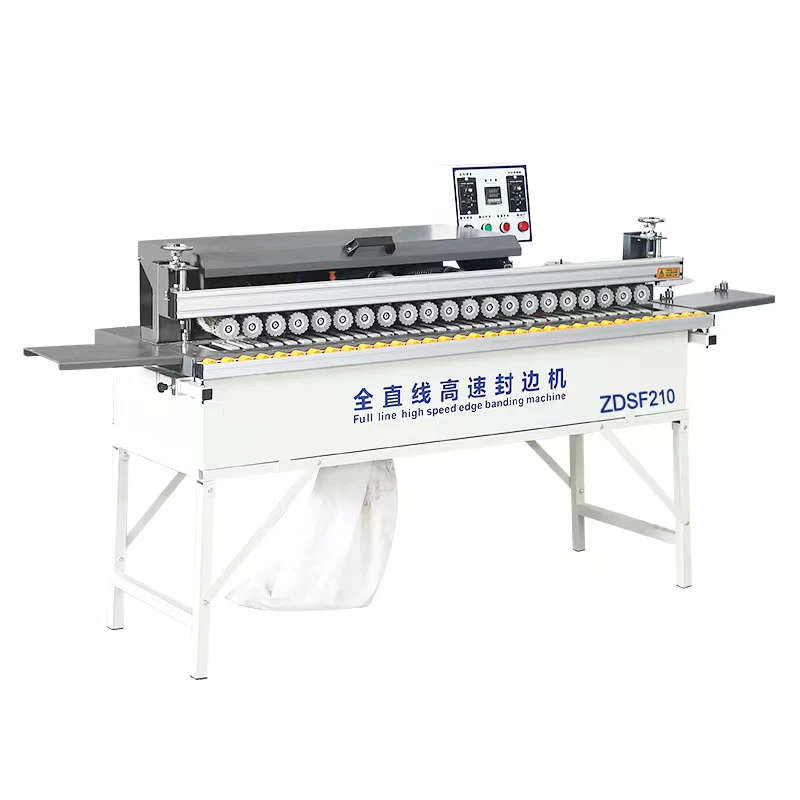
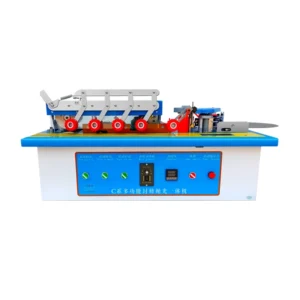
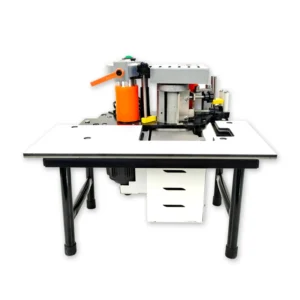
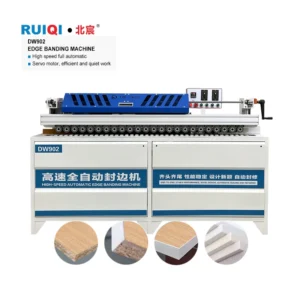
Precision-Ground Assembly — every ZDSF210 unit is built on a rigid frame-type motor base with steel rod guides, assembled under a four-stage QC protocol before OEM branding and dispatch.
Technical Specifications
| Parameter |
Value |
| Model |
ZDSF210 |
| Product Type |
Portable Automatic Edge Banding Machine |
| Edge Banding Speed |
6 m/min |
| Belt Feed Motor |
25 W |
| Board Feed Motor |
120 W |
| Trimming Motor |
800 W × 2 |
| Heating Motor |
800 W |
| Vacuum Fan |
1200 W |
| Overall Dimensions (L×W×H) |
1500 × 570 × 630 mm |
| Net Weight |
155 kg |
| Glue Capacity |
1000 ml |
| Guide Rail Type |
Steel rod guide rail |
| Trimming |
Up/down/left/right profiling trimming |
| Pressing |
Elastic device secondary pressing |
| Glue Pot Type |
Profiling glue pot (front and rear anti-shape) |
| Dust Extraction |
Integrated vacuum fan, airtight dust collection |
| Key Features |
Gluing, edge banding, profile trimming, flexible scraping, glue line cleaning, cross polishing, dust absorption |
| Warranty |
1 Year |
| Core Components Warranty |
1 Year |
| Voltage & Frequency |
Configurable (basis to be confirmed) |
| Panel Thickness Range |
(basis to be confirmed) |
| Panel Width Range |
(basis to be confirmed) |
| Tolerance |
(basis to be confirmed) |
Application Suitability
| Application |
Material or Output |
| Custom furniture edge finishing |
MDF and particleboard panels with PVC edge banding |
| Small workshop cabinet production |
Plywood substrates with melamine or veneer banding |
| Portable on-site edge banding |
Solid wood panels in joinery and fit-out projects |
| Transition from manual to machine finishing |
Mixed panel substrates in startup furniture operations |
Why the Voltage Question Must Come Before the Production Order
Machines built without confirmed local voltage arrive dead on the factory floor.
I have watched a container land at port only for the buyer to discover the heating element and vacuum fan were wound for a frequency their local grid does not supply. The ZDSF210 edge banding machine OEM factory builds each unit to the destination market’s electrical standard, but only when the buyer provides the correct voltage and frequency in writing before production starts. Assumptions made at the quotation stage regularly lead to weeks of downtime while transformers are sourced locally [NEED_CITE: voltage and frequency standards by export market]. For distributors placing multi-unit orders, a single voltage mismatch across the shipment can stall an entire regional rollout.

Component Sourcing and Assembly Depth
The ZDSF210 is assembled from a frame-type motor base that eliminates the vibration common in lighter portable banders. Dual 800 W trimming motors mount on precision slide mechanisms, allowing up, down, left, and right profiling movement that follows panel contours without manual intervention. The steel rod guide rail is precision-ground in-house to maintain alignment across the full feed path at 6 m/min. Every motor, heating element, and vacuum fan is logged against the unit serial number for traceability.
Four-Stage Quality Control on the ZDSF210 Production Line
Incoming material inspection verifies motor windings and steel rod straightness before they enter assembly. In-process checks confirm guide rail alignment and glue pot seating after the frame is welded. Finished product testing runs the ZDSF210 edge banding machine OEM factory unit through a full banding cycle on the buyer’s specified panel material, documenting trim quality and glue line consistency. Pre-shipment verification includes an electrical continuity test and video-recorded outgoing inspection shared with the buyer before crating [NEED_CITE: CE machinery directive requirements for industrial equipment]. This protocol applies to every unit, whether it is a single machine or a full container of private-label orders.
How Specifications Translate to Workshop Output
The dual 800 W trimming motors provide sufficient torque for profiling PVC and veneer banding without stalling on denser substrates. The profiling glue pot with front and rear anti-shape design distributes adhesive evenly, which reduces visible glue lines that would otherwise require manual scraping downstream. The elastic device secondary pressing tightens band adhesion before the trimming station engages, addressing the inconsistent bonding that often appears on curved or contoured panel edges. The 1200 W vacuum fan and airtight dust collection keep trimming debris away from the glue pot, preventing contamination that degrades edge finish over a production run. Panel thickness and width ranges should be confirmed with the factory to match the buyer’s specific substrate mix, as portable units have physical feed constraints that differ from stationary full-line banders.
The Cost of Skipping Electrical Confirmation
A distributor who assumes 380 V/50 Hz without checking the end user’s grid specification will face a machine that either trips breakers immediately or runs motors at incorrect speed, degrading trim quality and shortening motor life. Heating elements wound for the wrong voltage either fail to melt adhesive properly or overheat and burn out within the first week. For the ZDSF210 edge banding machine OEM factory, the cost of rewinding a motor in the field far exceeds the time spent confirming specifications before production [NEED_CITE: electrical compliance requirements for imported machinery]. Buyers who skip this step regularly absorb freight costs for return shipments or pay for local electricians to retrofit control panels.
Why Distributors and OEM Partners Source Here
In-house manufacturing of the frame-type motor base and precision-ground steel rod guides means the ZDSF210 is not assembled from generic sub-assemblies with no tolerance accountability. OEM branding extends to custom logos, private-label packaging, and branded operation manuals in the destination market’s language. Voltage configuration from 110 V to 440 V is confirmed with formal documentation before production begins, not assumed from a quotation template. Engineer-led configuration recommendations are provided within 24 hours, including a formal specification sheet that matches the buyer’s local electrical and panel processing requirements. Factory visits are welcomed for distributors who want to verify assembly depth before committing to a container order.
Documentation & Verification
- CE declaration of conformity covering the ZDSF210 portable edge bander
- Factory test record on your specified panel material before dispatch
- Electrical schematic with confirmed voltage and frequency for your market
- Machine specification sheet matching the agreed OEM configuration
- Operation and maintenance manual in your chosen language
- Spare parts list with part numbers for after-sales planning
Installation, Commissioning & Support
- Requires a dedicated circuit matching the confirmed voltage and frequency rating of all five motors and the vacuum fan
- 1500 × 570 mm footprint fits standard workshop floors without special foundation work
- Delivered fully assembled — uncrate, connect power, and run the first test panel
- First commissioning includes glue pot temperature calibration for your specific banding material
- 155 kg net weight allows repositioning within the workshop by two operators
- Integrated 1200 W vacuum fan connects to existing dust extraction or operates standalone
Before You Request a Quotation
Distributors and OEM partners evaluating the ZDSF210 edge banding machine OEM factory should provide their target market voltage and frequency, the panel substrates and banding materials their customers typically use, and any private-label or branding requirements. If the machine will be part of a broader catalog, specify whether you need single-unit sampling or container-volume pricing tiers. Confirming these details up front ensures the formal quotation includes the correct electrical configuration and OEM scope without revision cycles.
Frequently Asked Questions
Q: What can be customized under the OEM program for the ZDSF210?
A: Logo placement, private-label packaging, control panel language, voltage and frequency configuration from 110 V to 440 V, and color options are all available. MOQ for private-label orders depends on the scope of customization and is confirmed during the quotation stage. Each OEM unit receives the same four-stage QC treatment as standard production.
Q: How is the correct voltage confirmed before production begins?
A: The buyer provides the destination market voltage and frequency in writing. The factory then issues an electrical schematic and specification sheet confirming all motor ratings, heating element specifications, and vacuum fan power matched to that standard. Production only starts after the buyer approves this documentation, preventing unusable equipment on arrival.
Q: Which components are manufactured in-house versus sourced externally?
A: The frame-type motor base, steel rod guide rails, and profiling glue pot are machined and assembled in-house. Motors and electrical components are sourced from verified suppliers and logged against the unit serial number. Precision grinding of guide surfaces and all welding is completed on the factory floor under direct QC supervision.
Q: What QC records are provided to the buyer before shipment?
A: Each unit receives a factory test record documenting banding performance on the specified panel material, an electrical continuity test report, and video-recorded outgoing inspection footage. These records are shared with the buyer before crating. The four-stage QC protocol covers incoming material, in-process assembly, finished product testing, and pre-shipment verification.
Q: What technical support is available for the distributor’s service team?
A: Distributors receive operation and maintenance manuals in their chosen language, a spare parts list with part numbers, and electrical schematics for field troubleshooting. Technical training can be arranged during factory visits or remotely. Spare parts supply terms are agreed at the order stage to ensure stock availability for the distributor’s regional after-sales commitments.