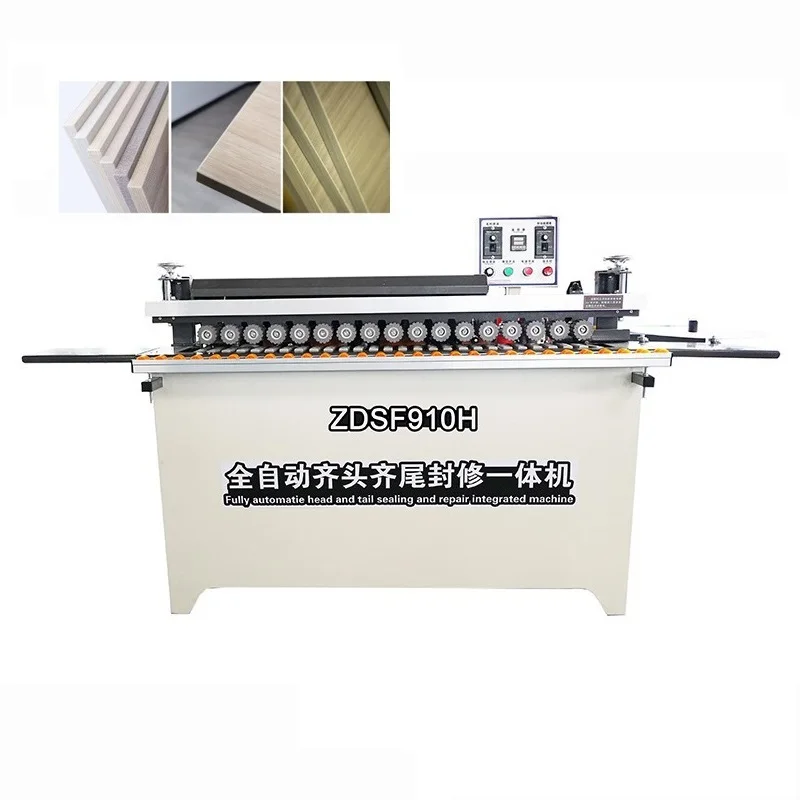
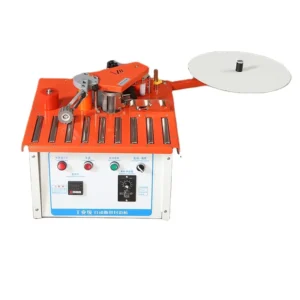
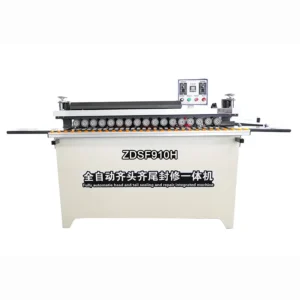
Verified Component Sourcing — Ruiqi’s four-stage QC process traces every ZDSF910H component from incoming material inspection through pre-shipment verification, ensuring OEM partners receive machinery built to documented specifications rather than unverified assembly claims.
Technical Specifications
| Parameter |
Value |
| Model |
ZDSF910H |
| Product Type |
Fully Automatic Edge Banding Machine |
| Function Sequence |
Automatic plate feeding, Double-sided gluing, End cutting, Upper and lower polishing, Automatic head and tail trimming, Dust collection, Cleaning glue line |
| Voltage & Frequency |
220V 50Hz (configurable 110V–440V per order) |
| Rated Power |
4 kW |
| Heating Power |
800 W |
| Suction Power |
1200 W |
| Polishing Power |
180 W × 2 |
| Trimming Power |
800 W × 2 |
| Transmission Power |
120 W |
| Belt Power |
25 W |
| Rated Air Pressure |
0.4–0.6 MPa |
| Panel Thickness Range |
10–50 mm |
| Edge Strip Thickness Range |
0.5–2.5 mm |
| Minimum Board Width |
2.5 cm |
| Glue Pot Capacity |
1000 ml |
| Trimming Mechanism |
Square slide rail profiling with 4-blade alloy arc knife |
| Transmission System |
Steel rod slide rails |
| Pressure Beam |
Adjustable aluminum alloy |
| Feed Mechanism |
Double-row rubber pressure wheels, automatic plate feeding |
| Edge Strip Cutting |
Pneumatically controlled |
| Control Panel |
Multi-function button operation |
| Overall Dimensions |
1300 × 560 × 1090 mm |
| Net Weight |
185 kg |
| Standards |
CE, ISO 9001 |
Application Suitability
| Application |
Material or Output |
| Custom cabinet door edge finishing |
MDF and particleboard with PVC edge banding |
| Small-batch furniture panel processing |
Plywood and melamine-faced board with veneer strips |
| Joinery workshop panel preparation |
Solid wood panels with 0.5–2.5 mm edge material |
| Entry-level automated production lines |
Panel stock requiring double-sided gluing and trimming |
| OEM-branded machine deployment |
Distributor-specified configurations for regional markets |
Why Voltage Verification Must Precede the Purchase Order
Every ZDSF910H Fully Automatic Edge Banding Machine leaves the factory with electrical specifications confirmed against the buyer’s local grid, not assumed from a catalog default.
Regional distributors and OEM partners frequently encounter situations where machines arrive at destination ports with control boards rated for a voltage standard that does not match the facility’s supply. The ZDSF910H ships from the factory with a 220V 50Hz configuration as standard, but export markets span regions operating at 110V 60Hz, 380V three-phase, or 440V industrial circuits. A control panel wired for one standard and connected to another can damage the heating element, burn the mainboard, or prevent the pneumatic end-cutting solenoid from actuating. [NEED_CITE: voltage and frequency standards by export market]
I once worked on an order where a buyer in the Middle East specified a machine without confirming their facility’s actual supply. The unit arrived wired for a voltage that did not match the workshop transformer. The mainboard failed on first power-up, and replacement components had to be shipped by air freight. The resulting delay extended well beyond what a pre-order voltage checklist would have prevented. That incident shaped how every subsequent order is handled — electrical confirmation happens before production begins, not as an afterthought during packing.

Four-Stage QC and What Each Stage Catches
The ZDSF910H passes through incoming material inspection, in-process assembly checks, finished product testing, and pre-shipment verification before release. At the incoming stage, steel rod slide rails and aluminum alloy pressure beams are measured for dimensional tolerance before entering the assembly line. During in-process checks, the pneumatically controlled cutting device is cycled repeatedly to confirm consistent actuation under the specified 0.4–0.6 MPa air pressure range. The pre-shipment test runs actual panel stock through the full sequence — feeding, gluing, end cutting, trimming, and polishing — to verify that the square slide rail profiling mechanism produces clean cuts across the 10–50 mm panel thickness range.
OEM partners sourcing a Fully Automatic Edge Banding Machine for private-label distribution benefit from this structure because each stage generates a documented record. When a distributor’s service team later troubleshoots a field issue, the factory test record provides a baseline to compare against. This traceability matters particularly for buyers deploying machines across multiple end-user workshops, where inconsistent edge quality complaints need to be traced back to either machine adjustment or operator technique. [NEED_CITE: machinery quality documentation standards for export equipment]
OEM Scope and Private-Label Configuration Depth
The ZDSF910H supports OEM customization across logo placement, control panel language, packaging marking, and electrical configuration. A distributor targeting Spanish-speaking markets can specify a multi-function button panel with Spanish labeling, while a buyer in Southeast Asia may require a different voltage adaptation alongside English-language documentation. The machine’s 4 kW rated power draw and 1300 × 560 × 1090 mm footprint remain constant across configurations, which simplifies warehouse planning for importers stocking multiple units with different electrical builds.
The double-sided gluing system and 1000 ml glue pot capacity are standard across all OEM variants, meaning spare parts inventory does not fragment across different private-label versions. Edge strip thickness handling from 0.5 to 2.5 mm also remains consistent, so a distributor’s technical training program does not need separate modules for each branded variant. For OEM partners evaluating manufacturing depth, the proprietary trimming mechanism and precision-ground components indicate that the factory controls the critical assemblies rather than sourcing complete sub-assemblies from third parties.
Reading the Specifications Against Production Requirements
The ZDSF910H’s panel thickness range of 10–50 mm and edge strip thickness range of 0.5–2.5 mm define which board stock the machine can process without manual intervention. Boards thinner than 10 mm may not engage the double-row rubber pressure wheels with sufficient grip, causing feed slippage during the trimming stage. The 800 W × 2 trimming motors paired with the 4-blade alloy arc knife handle PVC and veneer materials within the specified strip thickness, but attempting to trim edge banding beyond 2.5 mm risks overloading the profiling mechanism.
The 1200 W suction motor drives the full-envelope vacuum dust collection system, which captures trim waste and sanding residue at each station. In a compact workshop where the ZDSF910H’s 1300 mm length positions it near other machinery, effective dust extraction prevents accumulation on adjacent equipment and reduces airborne particulate that can settle on freshly glued surfaces. The adjustable aluminum alloy pressure beam accommodates varying panel thickness without requiring tool changes, which matters in job-shop environments where operators switch between 18 mm MDF shelving stock and 40 mm solid wood worktops throughout the same shift. [NEED_CITE: industrial dust extraction requirements for woodworking machinery]
The 2.5 cm minimum board width specification indicates that narrow strips and small offcuts cannot be edge-banded on this model. Workshops that regularly process narrow drawer sides or small cleats should evaluate whether their typical part dimensions fall above this threshold before specifying the machine for general-purpose use.
The Cost of Skipping Configuration Confirmation
Machines that arrive without voltage confirmation create cascading delays beyond the immediate electrical failure. The replacement board must be manufactured, tested, and shipped internationally while the original unit sits idle in the buyer’s facility. For distributors who have already committed delivery dates to their own customers, this delay damages relationships that took years to build. Pneumatic systems specified without confirming local compressor output can cause the edge strip cutting device to operate sluggishly or fail to complete cuts cleanly, producing ragged ends that require manual rework.
Control panels delivered in a language the operator cannot read stall commissioning entirely. The machine may be mechanically perfect, but if the multi-function button labels are incomprehensible to the workforce, production cannot begin until translated overlays or replacement panels arrive. These scenarios are preventable through pre-order specification review, yet they recur regularly across the industry because the confirmation step is treated as optional paperwork rather than a critical path item. [NEED_CITE: common causes of industrial machinery commissioning delays]
Why Source This Fully Automatic Edge Banding Machine Through Ruiqi
In-house manufacturing with patented cutting mechanisms means the factory controls the trimming assembly design rather than integrating purchased components. The four-stage QC process with pre-shipment verification generates test records specific to each machine’s serial number. Voltage and language customization happens as a standard order parameter rather than a special request requiring engineering approval. Factory visits are available for buyers who want to witness the production line walkthrough and observe pre-shipment testing on their specified panel stock.
An engineer-led configuration recommendation ensures that the ZDSF910H’s specifications match the buyer’s actual production environment rather than a generic catalog entry. The formal quotation arrives within 24 hours of confirmed requirements, which matters for distributors working against their own customer timelines. OEM and private-label capability extends across cosmetic branding and functional adaptation, allowing regional partners to differentiate their offerings without maintaining separate supply chains for different machine platforms.
Documentation & Verification
- CE declaration of conformity matching the ZDSF910H’s exported configuration and destination market requirements
- ISO 9001 certificate covering the manufacturing process from incoming inspection through dispatch
- Electrical schematic with voltage and frequency confirmation specific to the buyer’s facility supply
- Factory test record documenting trimming performance on the buyer’s specified panel thickness range
- Operation and maintenance manual produced in the agreed language for operator-level comprehension
- Spare parts list identifying consumables and wear items specific to the ZDSF910H configuration shipped
Installation, Commissioning & Support
- Facility power supply must match the confirmed voltage and frequency with a dedicated circuit rated for the 4 kW total draw
- Compressed air supply delivering 0.4–0.6 MPa clean dry air to the pneumatic edge strip cutting solenoid
- Machine arrives partially assembled; pressure beam and dust collection hood require field fitting
- First commissioning runs test panels through the full feed-glue-trim-polish sequence to calibrate the 4-blade arc knife
- Operator training covers multi-function button panel sequences and glue pot refill procedures for the 1000 ml capacity
- Wear parts inventory includes replacement alloy arc knives and rubber pressure wheel elements
Inquiry Preparation for OEM and Distributor Buyers
Prospective partners evaluating the ZDSF910H for their regional market should prepare their target voltage and frequency standard, the control panel language requirement, and the branding scope they intend to apply. Knowing the typical panel materials and edge strip thicknesses your customers process allows the engineering team to confirm that the 10–50 mm thickness range and 0.5–2.5 mm strip capacity match your market’s common stock dimensions. If you plan to witness pre-shipment testing, specify the panel material you want run during the factory verification so that appropriate test stock is available on the scheduled date.
Frequently Asked Questions
Q: What is the OEM and private-label scope available for the ZDSF910H?
A: OEM customization covers logo application on the machine body and control panel, packaging marking with the distributor’s branding, operation manual translation into the target market language, and electrical configuration built to the destination country’s voltage and frequency standard. The core mechanical specifications including the trimming mechanism and dust collection system remain consistent across all private-label variants.
Q: How does Ruiqi confirm voltage and frequency before building the machine?
A: The buyer provides their facility’s electrical supply specification during the inquiry stage, and the engineering team confirms compatibility against the ZDSF910H’s configurable 110V–440V range. The confirmed voltage and frequency appear on the electrical schematic included in the documentation package. This verification happens before production release, not during final inspection.
Q: Can buyers witness the pre-shipment test for their ZDSF910H order?
A: Factory visits are available and buyers can observe the pre-shipment verification stage where the machine runs actual panel stock through the complete edge banding sequence. The test covers feeding stability, glue application consistency, end cutting accuracy, and trimming quality across the specified panel thickness range. Test records from this session are included in the documentation package.
Q: What spare parts and support are provided for distributor service teams?
A: Each ZDSF910H ships with a spare parts list identifying wear items including alloy arc knives and rubber pressure wheel components. Distributor service teams receive technical documentation covering the pneumatic system, trimming mechanism adjustment, and electrical schematic for field troubleshooting. Ongoing technical support is available for complex fault diagnosis that exceeds local service capability.
Q: What is the typical production lead time for OEM-configured orders?
A: OEM orders requiring voltage adaptation, multilingual control panels, and custom branding typically require longer lead times than standard specification units due to the additional configuration and verification steps. The exact timeline depends on the scope of customization and current production scheduling. Buyers should confirm their required delivery date during the inquiry so that production can be planned accordingly.