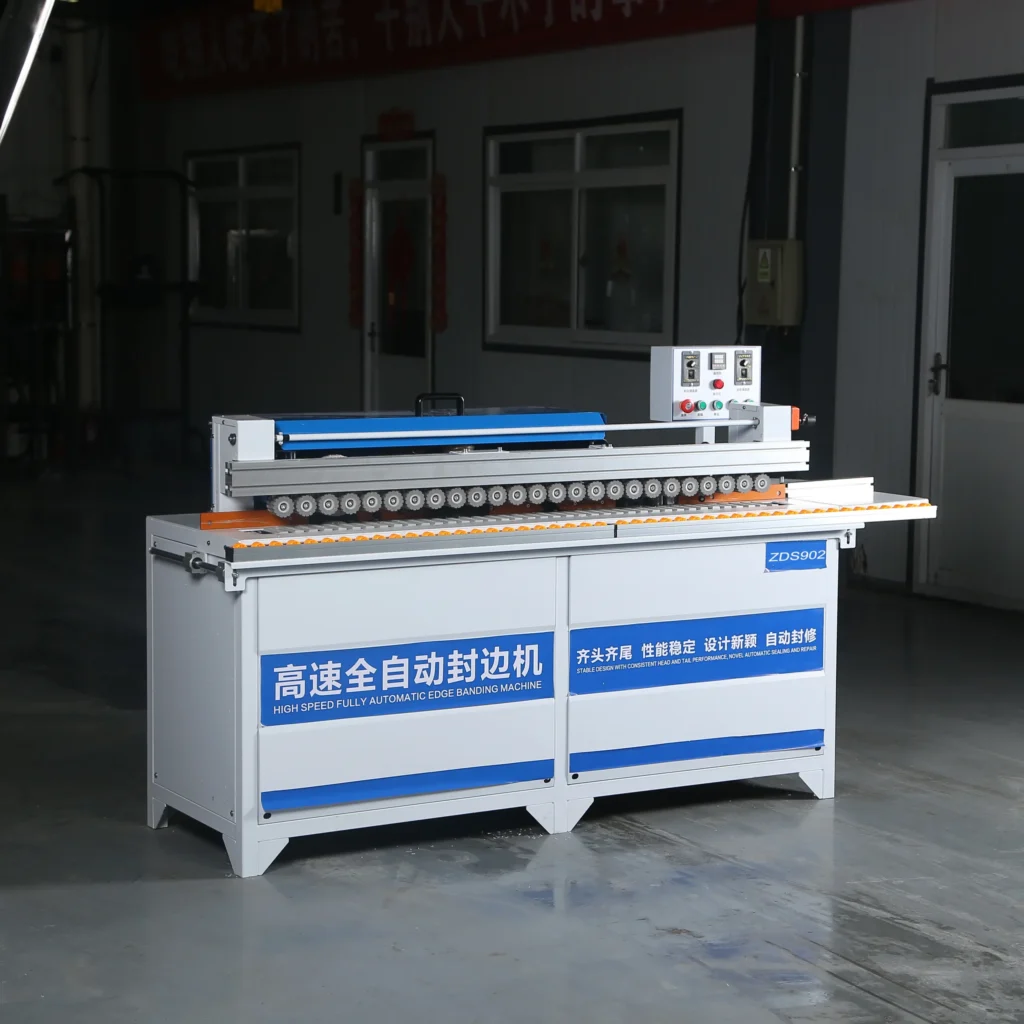
Four-Stage QC with Pre-Shipment Verification — Every automatic edge banding machine leaving our assembly floor carries documented inspection records from incoming material checks through final operational testing before crating.
Technical Specifications
| Parameter |
Value |
| Product Type |
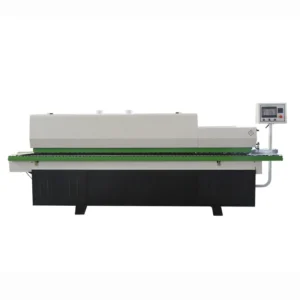
Automatic Edge Banding Machine |
| Voltage |
220V (configurable for target market) |
| Total Power |
4200W |
| Equipment Size (L×W×H) |
207×60×122 cm |
| Net Weight |
245 kg |
| Edge Band Height Range |
0–35 mm |
| Edge Band Thickness Range |
0.5–2.5 mm |
| Glue Pot Capacity |
4000 ml |
| Gluing Method |
Double-sided gluing |
| Trimming Configuration |
Top and bottom trimming with double high-speed motors |
| Polishing Configuration |
Up and down dual polishing motors |
| Conveyor Belt |
Silicone material |
| Pressure System |
Integrated pressure beam with double rows of pressure wheels |
| Edge Strip Cutting |
Pneumatically controlled |
| Temperature Control |
Intelligent temperature control |
| Warranty |
One year |
| Delivery Time |
25–30 days per order |
| Assembly State |
Partially assembled; some items require assembly per manual or video |
Application Suitability
| Application |
Material or Output |
| PVC edge banding on MDF panels |
MDF boards for cabinet doors and shelving |
| Particleboard edge finishing |
Particleboard for custom furniture carcasses |
| Plywood edge sealing |
Plywood panels for wardrobe and storage units |
| Straight/linear edge banding |
Panel-based workpieces for furniture assembly |
What "Plug and Play" Leaves Out When Voltage Does Not Match
Voltage mismatch is the most common reason an edge banding machine OEM factory order fails at commissioning, not because of the machine itself but because the local supply was never confirmed before production.
I once watched a distributor in Southeast Asia receive a batch of edge banders that sat idle for weeks. The factory had wired them for a standard that did not match the local grid frequency, and every motor ran hotter than designed. The glue pot temperature drifted, adhesive open time shortened, and panels came off the line with visible glue lines. [NEED_CITE: voltage and frequency standards by export market] An edge banding machine OEM factory should confirm these details at quotation stage, not after the container is already on the water.

Precision Assembly and Component Traceability on the Factory Floor
When a regional distributor evaluates an edge banding machine OEM factory, the first question is rarely about price — it is about whether the assembly process is repeatable and traceable. Our trimming motors are matched in pairs so that top and bottom cut at identical speeds, which matters because any imbalance leaves a visible step on the panel edge. The pressure beam is machined in-house and inspected for flatness before it ever meets the conveyor belt. Each pressure wheel row is tensioned to specification so that panels from 0.5 mm to 2.5 mm edge band thickness feed without lateral drift. This level of control is what separates a manufacturer from a trading company relabeling equipment.
Private-Label Readiness and Branding Depth for Distributors
An OEM partner needs more than a logo sticker on the control panel. We configure control panel language to match the operator market, adjust voltage and frequency to the destination grid, and rework the electrical schematic so the local service team can troubleshoot without translating from a foreign language. Packaging, nameplates, and documentation all carry the distributor’s brand. [NEED_CITE: CE machinery directive requirements for industrial equipment] For an importer building regional inventory, this means the machine arriving at their warehouse is already localized — not a generic unit that needs retrofitting before it can be demonstrated to end customers.
Reading the Specs That Actually Determine Edge Quality
The 4000 ml glue pot capacity is not just a volume number — it determines how long the machine can run between refills, which directly affects production continuity on a full shift. A smaller pot forces the operator to stop and top up, cooling the adhesive each time and introducing inconsistency. Double-sided gluing applies adhesive to both the panel edge and the banding strip simultaneously, which improves bond coverage on porous substrates like particleboard where single-sided application often starves the joint. The silicone conveyor belt grips the panel without marring the surface, something rubber belts struggle with on pre-finished boards. Intelligent temperature control maintains the glue within a narrow band, preventing the adhesive from degrading during long runs or thickening during short pauses. The pneumatic edge strip cutter ensures a square cut every cycle, removing the operator variable that causes ragged leading edges on manual machines.
The Cost of Skipping the Voltage and Language Confirmation Step
Distributors who rush past configuration details end up absorbing the cost of field modifications. A control panel printed in a language the operator cannot read stalls commissioning while someone improvises a translation overlay. Machines arriving without voltage confirmation require local electricians to rewire panels, which voids the original CE documentation and leaves the distributor liable. [NEED_CITE: equipment import compliance and relabeling regulations] Pneumatic circuits sized for one air pressure standard may cycle sluggishly on a workshop compressor set to another, causing the edge strip cutter to miss its timing and waste banding material.
Why Distributors Source This Equipment from Our Production Line
Our four-stage QC process covers incoming material inspection, in-process assembly checks, finished product verification, and pre-shipment testing — each stage generating documentation the buyer receives before the crate is sealed. We hold proprietary patents on trimming mechanisms, meaning the cutting geometry is developed and refined on our own floor rather than copied from a third-party design. Voltage and language customization is standard procedure, not a special request that delays the order. Factory visits are welcomed at any production stage, giving distributors the chance to witness assembly, test runs, and packing firsthand. Every unit ships with an electrical schematic matched to the confirmed voltage, so the local service team has an accurate reference from day one.
Documentation & Verification
- CE declaration of conformity matched to the confirmed machine configuration
- ISO 9001 certificate covering the manufacturing and QC process
- Electrical schematic reflecting the confirmed voltage and frequency for your market
- Factory test record run on panel samples matching your specified thickness range
- Operation and maintenance manual in the confirmed operator language
- Spare parts list with part numbers for local inventory planning
Installation, Commissioning & Support
- 207 cm footprint requires a level concrete floor with clearance for panel infeed and outfeed
- 4200W total power demands a dedicated circuit matching the confirmed voltage and breaker rating
- Partially assembled state means pressure beam and polishing stations need field mounting per video guidance
- Pneumatic edge strip cutter requires compressed air supply — confirm pressure and flow rate before connection
- Intelligent temperature control glue pot needs first-run calibration with the specific adhesive and banding material
- Dual high-speed trimming motors should be checked for alignment after transit before first production run
What We Need to Configure Your Order Correctly
Send us the target market voltage and frequency, the control panel language your operators require, and the edge banding materials you plan to stock — PVC, ABS, melamine, or veneer. If you are building regional inventory, let us know the panel thickness range your customers typically process so we can set the pressure beam and feed specifications accordingly. Samples of your chosen edge banding material help us confirm glue pot temperature and trimming parameters before the machine leaves the factory.
Frequently Asked Questions
Q: What OEM and private-label customization options are available for distributors?
A: We apply your logo to the machine body and control panel, customize packaging with your branding, adapt voltage and frequency to your market grid, configure the control panel language for your operators, and tailor specifications to regional demand. All documentation, including electrical schematics and manuals, carries your brand identity.
Q: How is the four-stage QC process documented before shipment?
A: Each machine passes through incoming material inspection, in-process assembly checks, finished product testing, and pre-shipment verification. We compile the inspection records into a package the buyer reviews before crating, including test run results on panel samples matching the buyer’s specified thickness and edge banding material.
Q: Can the factory produce machines for markets with different voltage and frequency standards?
A: Yes. We configure voltage from 110V to 440V and adjust frequency to match the destination market. The electrical schematic is reworked to reflect the confirmed configuration, so local service teams have an accurate wiring reference. This confirmation happens at quotation stage to prevent mismatches at delivery.
Q: What spare parts and technical training support do regional distributors receive?
A: We supply a detailed spare parts list with part numbers so distributors can plan local inventory. Technical training covers assembly, commissioning, and troubleshooting procedures. Our engineering team remains available for remote support when field issues arise that the distributor’s service team cannot resolve independently.
Q: Is a factory visit or sample processing test possible before placing a bulk order?
A: We welcome distributors to visit our facility at any production stage. You can observe assembly, participate in test runs using your own panel and edge banding samples, and inspect the QC process firsthand. Sample test results are documented and shared as part of the evaluation before any order commitment.

![【目标站】 ruiqifactory.com → MANUFACTURING AND OEM → 制造OEM类角色 → OEM Available / Factory Direct / Custom Build 【记录ID】15337 → 1+5+3+3+7 = 19 → 19 % 6 = 1 → 句式: [站点修饰词] [品类词] for [应用或物料] 19 % 3 = 1 → 池 (OEM Available / Factory Direct / Custom Build) 取 Factory Direct 品类词: Automatic Edge Banding Machine 应用或物料: PVC Edge Banding Plywood Making Factory Direct Automatic Edge Banding Machine for PVC Plywood](https://ruiqifactory.com/wp-content/uploads/2026/05/He4a5edec182345d899eff9858f03aaef2-1-300x300.webp)