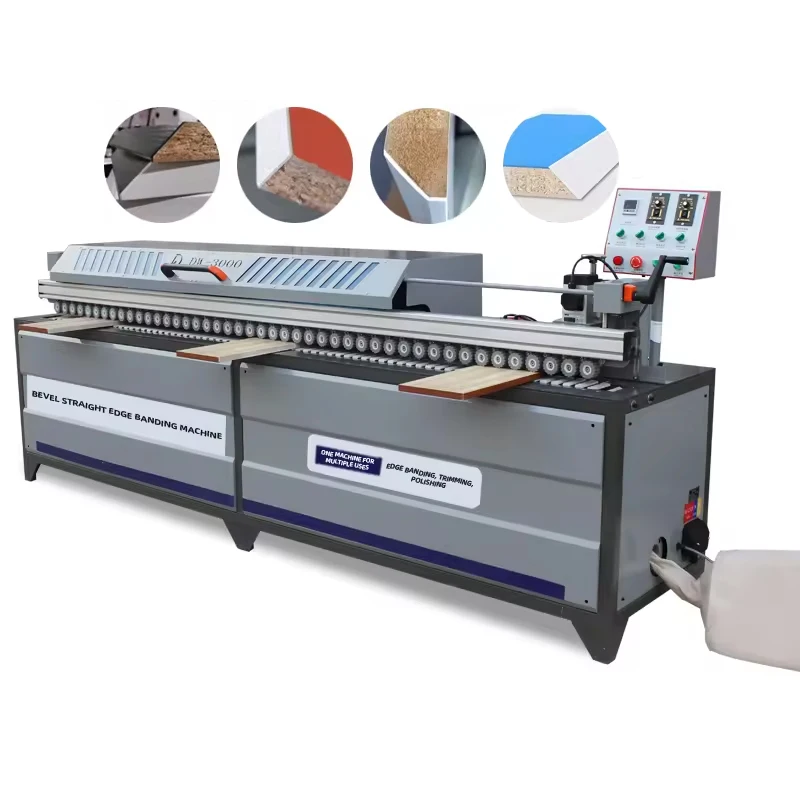
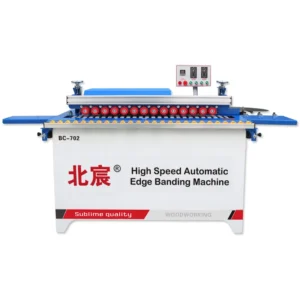
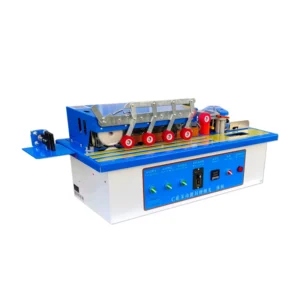
OEM Manufacturing Depth — The DW3000 is produced in-house with a dual heat gun assembly, patented trimming mechanisms, and private-label readiness, allowing distributors to verify build quality from component sourcing through final dispatch.
Technical Specifications
| Parameter |
Value |
| Model |
DW3000 |
| Product Type |
Fully Automatic Straight and Bevel Edge Banding Machine |
| Total Power |
11 kW |
| Voltage |
380V / 415V |
| Pre-milling Motor |
2.2 kW |
| Heating Power |
2.2 kW × 2 (Dual heat gun) |
| Feed Speed |
0–12 m/min |
| Transmission Motor |
180 W |
| Trimming Motor |
2.2 kW × 2 |
| Polishing Motor |
0.4 kW × 2 |
| Vacuum Motor |
550 W |
| Glue Pot Capacity |
4000 ml |
| Edge Banding Thickness |
0.3–3 mm |
| Edge Banding Height |
0–50 mm |
| Bevel Angle Adjustment |
30° to 90° (8 groups of oblique pressure wheels) |
| Minimum Sheet Dimensions |
300 mm (L) × 150 mm (W) |
| Air Source Pressure |
0.5–0.7 MPa |
| Overall Dimensions (L×W×H) |
2990 × 650 × 1300 mm |
| Net Weight |
430 kg |
| Key Features |
Pre-milling, 30–90° bevel banding, rough/fine trimming, scraping, polishing, high-power vacuum, slotting device |
Application Suitability
| Application |
Material or Output |
| Custom cabinet door production |
MDF and plywood with 45° bevel edge profiles |
| Straight-edge panel furniture |
Particleboard and MDF with PVC or veneer banding |
| Dual-profile batch processing |
Mixed straight and bevel panels in a single pass |
| Joinery workshop scale-up |
Solid wood panels requiring pre-milling and slotting |
Why the Voltage Question Should Come Before the Price
Every export order must be locked to a specific voltage and frequency before production begins, not after.
I have watched a cabinet factory in Chile stand idle for weeks because an edge banding machine factory shipped a unit wired for a voltage the site did not have. The motor burned on the first test run. That failure was not a mechanical defect; it was a documentation gap [NEED_CITE: voltage and frequency standards by export market]. When sourcing an OEM edge banding machine, the electrical specification must match the facility’s actual supply, complete with confirmed plug configuration and schematic verification.

Component Sourcing and Precision Assembly
Manufacturing an edge banding machine factory buyers can trust starts with verifiable component sourcing. The DW3000 uses a dual 2.2 kW heat gun configuration that maintains consistent glue activation temperature across both straight and bevel profiles. The 8-group oblique pressure wheel system allows arbitrary angle setting between 30 and 90 degrees, which requires precision-ground shafts and matched bearings to prevent banding drift during angled feed.
Private-Label and OEM Customization Scope
Distributors evaluating this OEM edge banding machine need more than a logo swap. The DW3000 supports full private-label configuration: custom voltage from the confirmed 380V/415V baseline through transformer integration, multilingual control panels including Spanish for Latin American markets, and tailored specification sheets under the distributor’s own branding [NEED_CITE: CE machinery directive requirements for industrial equipment]. Production runs from single evaluation units through container-quantity orders follow the same four-stage QC protocol.
How Bevel Pressure Wheels and Dual Heat Guns Affect Edge Quality
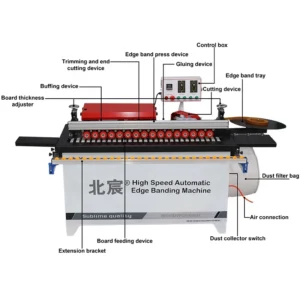
The 8-group oblique pressure wheel arrangement is the core mechanism enabling bevel edge banding on the DW3000. Each group must track the panel edge at the set angle without lateral slippage; any deviation shows as visible glue lines or banding lift on the finished panel. The dual 2.2 kW heat gun design ensures the glue reaches activation temperature even at the upper end of the 0–12 m/min feed speed range, which matters when processing thicker 3 mm banding on MDF substrates that absorb heat rapidly. The 4000 ml glue pot capacity reduces refill interruptions during continuous production runs, and the integrated pre-milling station removes saw marks before the glue application zone, directly improving bond surface quality. The 3-spindle trimming motor configuration then cleans both straight and bevel profiles without requiring a tooling change between angles.
The Hidden Cost of Skipping Voltage Confirmation
Ordering an edge bander without a signed voltage and frequency confirmation creates downstream failure that no amount of on-site troubleshooting can fix. A 415V motor connected to a 220V supply does not simply run slowly; it draws excessive current and burns the winding. The cost is not just the replacement motor and the shipping delay — it is the production line standing idle, the installer’s wasted travel, and the distributor’s damaged credibility with the end buyer [NEED_CITE: industrial motor failure modes under voltage mismatch]. Every DW3000 ships only after the target facility’s electrical specification is documented and cross-checked against the build order.
What Manufacturing Depth Means for Distributors
The DW3000 is built on a single factory floor from incoming material inspection through pre-shipment testing, which means a distributor’s technical team can audit the actual build process rather than reviewing assembled third-party components. Patented cutting and trimming mechanisms are machined in-house, so spare part geometry remains consistent across production batches. Voltage customization from 110V to 440V is handled at the wiring stage, not through external transformers bolted on afterward. The four-stage QC protocol generates documented inspection records at each phase, giving OEM partners traceable quality data for their own market compliance. Control panel language and layout are configurable per distributor territory, reducing operator training time at the customer site.
Documentation & Verification
- Factory test record on your specified panel thickness and bevel angle before dispatch
- Electrical schematic with confirmed voltage and plug type matching your facility supply
- CE declaration of conformity and ISO 9001 certificate included in shipment documentation
- Operation and maintenance manual in Spanish, English, or other agreed language
- Spare parts list with part numbers matching in-house manufactured trimming and pressure components
- Pre-shipment photograph package showing machine serial, wiring, and test run results
Installation, Commissioning & Support
- Requires a dedicated 3-phase circuit rated for 11 kW total draw at the confirmed voltage
- Air supply must deliver 0.5–0.7 MPa clean dry air to the machine’s pneumatic inlet
- Overall length of 2990 mm requires clear floor space with access on both sides for maintenance
- Dual heat gun system requires initial temperature calibration matched to your specific glue and banding material
- 8-group oblique pressure wheels need angle verification on your actual bevel profiles during commissioning
- First production run supervised remotely or via documentation to confirm feed speed and trimming settings
What to Include in Your Inquiry
Distributors and OEM partners evaluating the DW3000 should provide the target market’s standard voltage and frequency, the primary panel substrates and edge banding materials to be processed, and the required control panel language. If the machine will integrate into an existing production line, include upstream and downstream equipment specifications so feed height and throughput can be matched. Specify whether a factory visit or sample processing test on your actual materials is needed before order confirmation.
Frequently Asked Questions
Q: What OEM customization is available beyond logo placement?
A: The DW3000 supports custom voltage configuration, multilingual control panel text and layout, machine color, and specification sheet branding under the distributor’s own identity. Voltage options span 110V to 440V with confirmed plug type for the destination market. Each customization is documented in the build order and verified during the pre-shipment inspection stage.
Q: How can a distributor verify component sourcing before committing?
A: Factory visits are available to inspect precision grinding processes, patented trimming mechanism assembly, and the four-stage QC protocol in operation. Distributors can review incoming material inspection records and in-process verification documentation. A sample processing test using the distributor’s own panel materials can be arranged to confirm edge quality before production commitment.
Q: What happens if the destination facility’s voltage does not match the machine?
A: Voltage and frequency are confirmed in writing before the DW3000 enters production. The electrical schematic included in the shipment documentation reflects the exact configuration built. If the facility’s supply changes after order placement, the factory must be notified before wiring begins to prevent motor damage and commissioning failure on arrival.
Q: How are spare parts supplied to regional distributors?
A: The DW3000 ships with a spare parts list referencing in-house manufactured components, including trimming motors and pressure wheel assemblies. Distributors can stock critical spares regionally based on the factory’s recommended list. Technical training for the distributor’s own service team covers adjustment procedures for the bevel pressure wheel system and dual heat gun calibration.
Q: Can I arrange a pre-shipment test with my actual panel materials?
A: Yes. Send representative samples of your panel substrates and edge banding materials to the factory for a processing test on the DW3000. The test confirms bevel angle tracking, glue adhesion quality, and trimming finish on your specific material combination. Results are documented with photographs and included in the pre-shipment verification package.