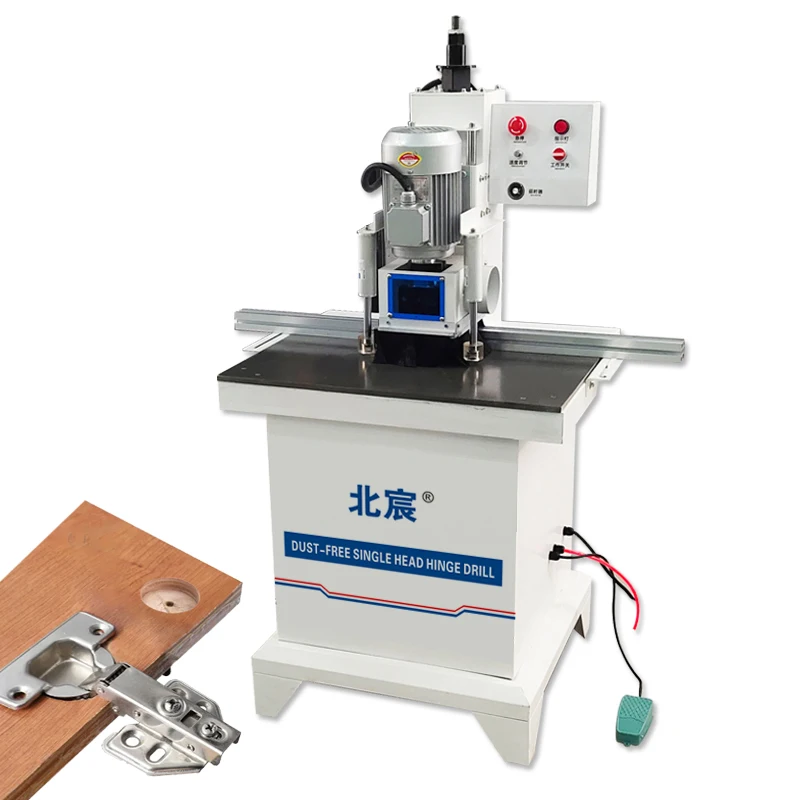
Voltage Customization as Standard — every hinge drilling machine leaves the Ningjin floor with an electrical schematic matched to your grid, from 110V single-phase workshops to 415V three-phase plants, eliminating the on-site wiring failures that stall commissioning.
Technical Specifications
| Parameter |
Value |
| Product Type |
CNC Wood Boring and Hinge Drilling Machine |
| Rated Power |
1.5 kW |
| Voltage & Frequency |
380V/415V three-phase four-wire (configurable 110V–440V) |
| Control System |
Foot switch control |
| Drill Configuration |
Large drill 35 mm, small drill 3 mm |
| Drilling Position Adjustment |
Vertical and horizontal adjustable |
| Guide Rail |
Precision guide rails for sliding adjustment |
| Motor Type |
Pure copper motor |
| Vacuum Power |
External vacuum connection |
| Overall Dimensions (L×W×H) |
70×56×145 cm |
| Net Weight |
55 kg |
| Assembly State |
Fully assembled |
Application Suitability
| Application |
Material or Output |
| Cabinet door hinge hole opening |
MDF, particleboard, plywood panels |
| Wardrobe and closet hinge boring |
Laminated board and melamine-faced chipboard |
| Loose leaf hinge drilling for door workshops |
Solid wood and engineered wood door blanks |
| Dowel and pilot hole drilling |
Furniture components requiring 3 mm bores |
Why the Voltage Question Must Come Before the Drill Count
Confirming local voltage and phase at inquiry stage prevents weeks of idle equipment on the workshop floor.
I watched a cabinet factory in South Asia sit on a CNC boring unit for three weeks because the three-phase supply at their site didn’t match the motor winding. The operator team was ready, the panels were stacked, and the hinge holes simply could not be drilled. A machine built for one grid cannot be rewired on the spot without risking motor burnout. This is the reason electrical schematics and voltage confirmation are locked in before production begins here, not after the crate arrives [NEED_CITE: voltage and frequency standards by export market].

Component Sourcing and Precision Grinding Standards
A wood boring machine factory that controls its own component sourcing can trace every guide rail and motor back to the incoming inspection bench. The precision guide rails on this hinge drilling machine undergo multi-stage dimensional checks before assembly, ensuring the vertical and horizontal drilling adjustments hold their position through repetitive production cycles. Pure copper motor windings are specified over aluminum alternatives to maintain thermal stability during continuous cabinet door boring runs.
Four-Stage Quality Control from Incoming Material to Crate
Every OEM hinge drilling machine produced here passes through incoming material inspection, in-process assembly verification, finished product testing, and pre-shipment validation. The factory test record documents actual drilling positions on sample panels, so the buyer sees measured hole placement rather than a claimed tolerance. This matters because a hinge bore that drifts even slightly from spec will show up as a misaligned door on the assembly bench downstream [NEED_CITE: ISO 9001 quality management requirements for woodworking machinery].
Reading the Specs That Matter for Hinge Drilling
The 35 mm large drill handles standard cup hinge bores used across European and American cabinet hardware, while the 3 mm small drill covers dowel and pilot holes in the same setup. This dual configuration reduces the number of machine changes between operations. The foot switch control keeps both hands free to hold the panel against the fence, which improves repeatability when an operator is working through a batch of identical wardrobe doors. External vacuum connection means the machine integrates with the workshop’s existing dust extraction network rather than requiring a standalone collector. At 55 kg net weight with a 70×56 cm footprint, the unit fits into tight joinery shop layouts where floor space is already committed to sliding table saws and edge banders.
What Happens When Drilling Position Drift Goes Unchecked
A hinge bore that sits one millimeter off from the hardware template creates a door that won’t close square. In a cabinet factory running hundreds of doors per batch, that drift means re-boring panels by hand or scrapping them entirely. The issue rarely surfaces until the hinges are mounted and the doors are hung, by which point the edge banding is already applied and rework is costly. Buyers who skip the factory test record and rely on a spec sheet tolerance claim often discover the gap during their first production week [NEED_CITE: common assembly defects from drilling misalignment in panel furniture].
Manufacturing Depth Behind the OEM Badge
In-house manufacturing means the drilling mechanism, guide rails, and motor are assembled under one roof, not sourced as a kit and bolted together. OEM hinge drilling machines can carry your brand logo and packaging without a middleman layer adding cost or obscuring the build origin. Voltage customization from 110V to 440V is handled during production, not as an afterthought with external transformers. The four-stage QC process generates documentation that distributors can present to their own end customers as proof of manufacturing standards. Factory visits are open, so buyers can walk the assembly benches and inspect precision grinding stations before committing to a production run.
Documentation & Verification
- CE declaration of conformity covering machinery directive requirements for this drilling unit
- Electrical schematic confirming voltage and frequency match for your specific grid
- Factory test record showing measured hinge hole positions on sample panels
- Operation and maintenance manual written in the language your operators speak
- Spare parts list with drill bit and guide rail wear component part numbers
Installation, Commissioning & Support
- Requires a dedicated circuit matching the confirmed 380V/415V three-phase supply with proper grounding
- Arrives fully assembled; position on level floor and connect external vacuum before first run
- Foot switch calibration and drilling depth adjustment set during initial commissioning
- Operator training covers vertical and horizontal position adjustment for different hinge patterns
- Pure copper motor requires periodic thermal inspection under continuous production loads
- Precision guide rails need cleaning and lubrication at intervals based on daily drilling volume
What We Need to Configure Your Machine
Share the hinge hardware brand and bore diameter your cabinet line uses so we confirm the drill configuration covers your templates. Provide your workshop voltage, phase, and frequency so the motor is wound correctly before assembly. Let us know if the machine will run standalone or integrate into a line with existing sliding table saws and edge banders, so feed height and throughput are matched.
Frequently Asked Questions
Q: Can you produce this hinge drilling machine under our brand with custom logo and packaging?
A: Full OEM and private-label production is available. Your logo is applied to the machine body and control panel area, and packaging is printed to your specification. We share a pre-production proof for approval before the first unit enters assembly, ensuring brand placement matches your market identity.
Q: How does the four-stage QC process verify drilling accuracy before shipment?
A: Incoming materials are inspected for dimensional conformity. During assembly, guide rail alignment and motor mounting are verified. Finished machines run test panels that are then measured for bore position and diameter. A final pre-shipment check confirms electrical safety and mechanical function before crating.
Q: What voltage configurations are available for different export markets?
A: The motor and control circuit can be configured from 110V to 440V, covering single-phase and three-phase grids. We confirm your local voltage and frequency during the inquiry stage and lock the specification into the electrical schematic before production begins.
Q: Can we visit the factory to audit manufacturing depth and inspect production lines?
A: Factory visits are welcome at any stage. You can inspect the precision grinding stations, observe assembly benches, and review QC documentation on machines currently in production. We coordinate the visit schedule around your travel plans and provide a full walkthrough with engineering staff.
Q: What component sourcing and precision grinding standards are applied to critical drilling parts?
A: Guide rails and drill spindles are sourced from qualified suppliers and undergo incoming dimensional inspection. Critical surfaces are precision-ground in-house to maintain drilling position accuracy. Each component batch is traceable through the four-stage QC documentation provided with your shipment.