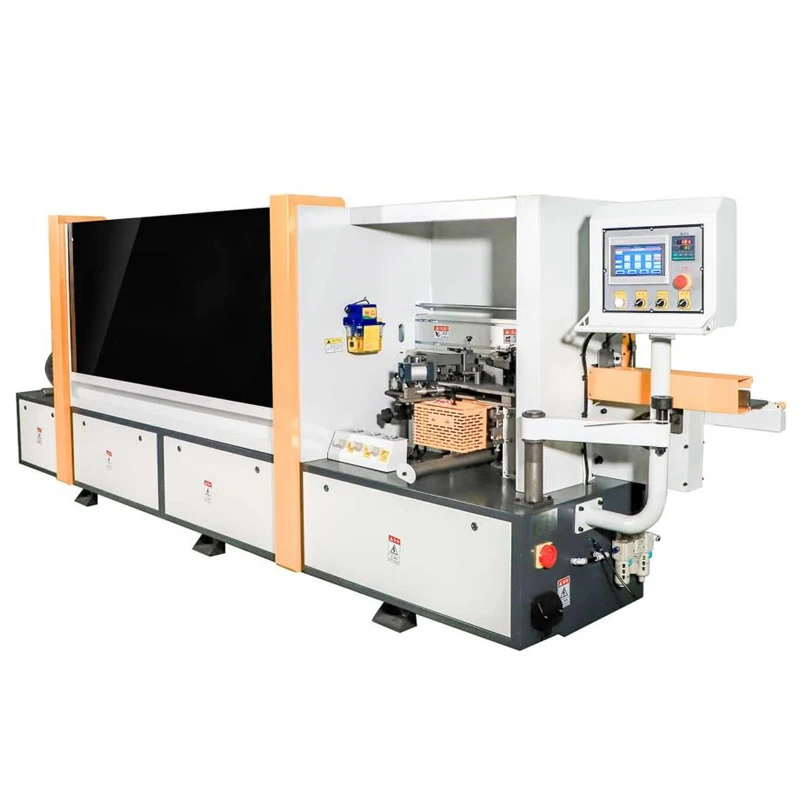
Precision Assembly Protocol — Every ZDS-468J automatic edge banding machine undergoes component-level verification and voltage confirmation before leaving our Shandong facility, ensuring OEM partners receive equipment ready for immediate market deployment.
Technical Specifications
| Parameter |
Value |
| Model |
ZDS-468J |
| Product Type |
Automatic Edge Banding Machine |
| Main Functions |
Pre-milling, Gluing, End trimming, Rough trimming, Fine trimming, Corner rounding, Scraping, Buffing |
| Working Pressure |
0.6 MPa |
| Panel Thickness Range |
10–60 mm |
| Edge Thickness Range |
0.4–3 mm |
| Minimum Panel Size |
300×60 mm / 150×150 mm |
| Voltage |
380V, 3-Phase |
| Total Power |
16 kW |
| Net Weight |
2000 kg |
| Overall Dimensions (L×W×H) |
6600×900×1600 mm |
| Key Features |
Eight-station configuration, CE declaration of conformity, ISO 9001 certified manufacturing |
Application Suitability
| Application |
Material or Output |
| Panel furniture manufacturing |
MDF, particleboard, plywood with PVC edge banding |
| Custom cabinet production |
Veneer edge strips on solid wood panels and engineered boards |
| Joinery workshop automation |
Mixed substrate edge finishing for small-to-medium batch runs |
| OEM private label integration |
Full-function edge banding for turnkey production line packages |
Why Voltage Verification Must Happen Before Crating
Electrical mismatch discovered at destination costs weeks of downtime and transformer procurement delays.
I remember a shipment of automatic edge banding machines destined for the Middle East where the purchase order specified 380V but the customer’s facility ran on 415V three-phase. The main motor wouldn’t start on arrival. Three weeks passed before they sourced a step-down transformer and got production running. That automatic edge banding machine factory experience changed how we handle every export order — voltage confirmation now travels with the test record, signed off before the crate closes [NEED_CITE: voltage and frequency standards by export market].
Component Sourcing and Assembly Transparency
Distributors evaluating manufacturing depth need visibility into what goes into the machine. The ZDS-468J uses precision-ground components that pass through incoming material inspection before assembly begins. Each station — from pre-milling through buffing — mounts to a machined base that maintains alignment under continuous production loads. This matters when you’re putting your own brand on the equipment and your reputation depends on consistent edge quality across different panel substrates.
Four-Stage Quality Control Process
Our QC protocol covers incoming material verification, in-process assembly inspection, finished product testing, and pre-shipment validation. For OEM partners, this means every automatic edge banding machine ships with documented proof that it performed to specification before leaving the factory floor. We run actual panel stock through all eight stations, check edge adhesion, measure trim quality, and verify that corner rounding produces clean transitions without tear-out [NEED_CITE: CE machinery directive requirements for industrial equipment].
How Station Sequence Affects Edge Quality
The eight-station configuration addresses the complete edge finishing workflow in a single pass. Pre-milling removes saw marks and creates a clean bonding surface on the panel edge, which directly affects glue line visibility — especially critical on light-colored PVC and thin veneer strips. End trimming cuts the banding material flush at panel ends, while rough and fine trimming handle the top and bottom edges in sequence. Corner rounding eliminates the sharp 90-degree intersection that catches during handling and assembly. Scraping removes adhesive residue and tool marks, and buffing produces the final surface finish. Panel thickness range from 10 to 60 mm means this automatic edge banding machine handles everything from thin cabinet shelving to thick worktop substrates without reconfiguration delays.

The Cost of Skipping Pre-Shipment Testing
Machines that arrive with unverified tolerance claims create downstream assembly problems. Panels that don’t fit together because edge build-up wasn’t accounted for during trimming force the furniture factory into manual rework or scrap. When you’re integrating equipment into a production line under your brand name, discovering tolerance issues after installation means your technical team spends weeks troubleshooting instead of training operators [NEED_CITE: edge banding tolerance standards for panel furniture assembly].
Manufacturing Depth for OEM Partners
In-house production means we control the assembly sequence, component specifications, and testing protocol from start to finish. The ZDS-468J supports custom logo placement, control panel language configuration, and voltage adaptation from 110V to 440V based on destination market requirements. Four-stage QC with pre-shipment verification provides the documentation trail that distributors need for their own compliance and customer assurance. Factory visits allow you to inspect precision grinding operations, watch assembly procedures, and test-run equipment before committing to volume orders.
Documentation & Verification
- CE declaration of conformity covering the ZDS-468J eight-station configuration
- ISO 9001 certificate for the manufacturing facility producing this automatic edge banding machine
- Factory test record documenting performance on your specified panel thickness and edge material
- Electrical schematic with voltage confirmation matching your destination market grid standard
- Operation and maintenance manual in your preferred language with spare parts list
Installation, Commissioning & Support
- Foundation requirements based on 2000 kg net weight and 6600×900×1600 mm footprint for stable operation
- Dedicated 380V three-phase circuit with appropriate breaker sizing for 16 kW total power draw
- 0.6 MPa compressed air supply with filtration for pneumatic actuators across all eight stations
- Initial parameter setup for your specific panel thickness range from 10 to 60 mm and edge material type
- Operator training covering station adjustment procedures for different PVC and veneer thickness from 0.4 to 3 mm
- Spare parts inventory recommendation based on wear components in trimming, scraping, and buffing stations
Moving Forward With Your Specification
To provide an accurate configuration for your market, we need your local voltage and frequency standards, target panel materials and thickness distribution, preferred control panel language, and whether you require private label branding on the equipment. If you’re evaluating multiple units for a regional distribution network, let us know your territory coverage and we can discuss model mix strategy and spare parts backup planning.
Frequently Asked Questions
Q: What customization options are available for OEM and private label orders?
A: The ZDS-468J supports custom logo placement on machine panels, control interface language configuration for your operator base, voltage adaptation from 110V to 440V for different export markets, and color options to match your brand identity. We provide engineering consultation to align specifications with your target customer requirements and production volume expectations.
Q: How does the four-stage QC process work before shipment?
A: Incoming material inspection verifies component quality before assembly begins. In-process checks confirm station alignment and mechanical precision during build. Finished product testing runs actual panel stock through all eight stations to validate edge quality. Pre-shipment verification documents performance metrics and includes voltage confirmation specific to your order requirements.
Q: What documentation ships with the machine for customs and compliance?
A: Each automatic edge banding machine includes CE declaration of conformity, ISO 9001 facility certificate, electrical schematic with voltage specification, factory test record, operation manual in your agreed language, spare parts list, packing photographs, and customs documentation support to facilitate smooth import clearance at your destination port.
Q: How do you support distributors with technical training and spare parts?
A: We provide technical training for your service team covering station adjustment, troubleshooting procedures, and preventive maintenance protocols. Spare parts supply includes wear components for trimming blades, scraping tools, buffing wheels, and pneumatic elements. We maintain inventory to support your regional customer base with reasonable lead times for replacement parts.
Q: Can we visit the factory to inspect production before placing orders?
A: Factory visits are welcome and encouraged for OEM partners and distributors. You can inspect precision grinding operations, observe assembly procedures, review QC checkpoint documentation, and test-run the ZDS-468J with your specific panel materials to verify edge quality meets your market standards before finalizing your order commitment.