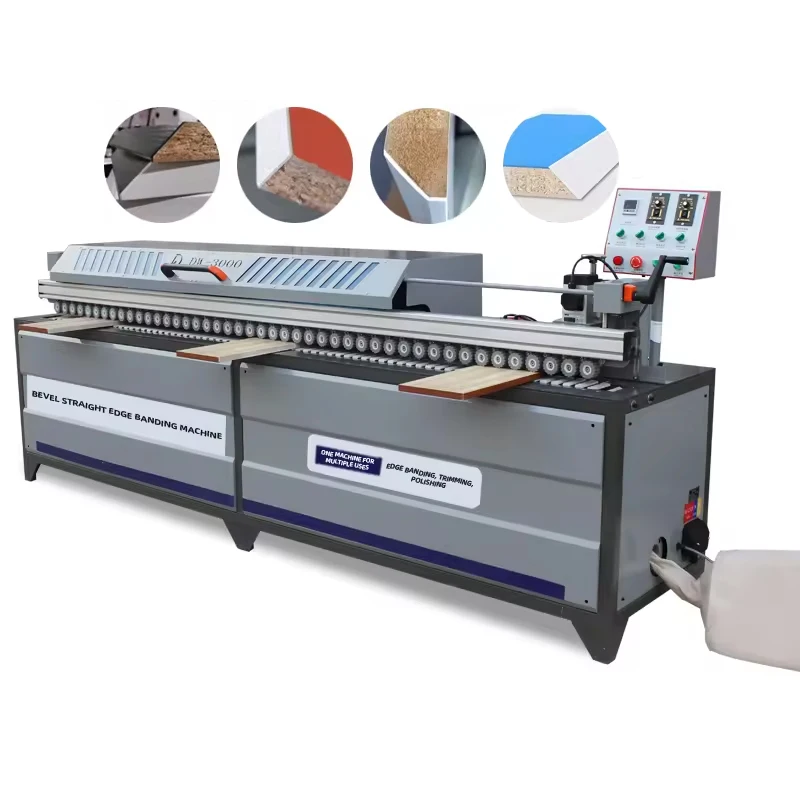
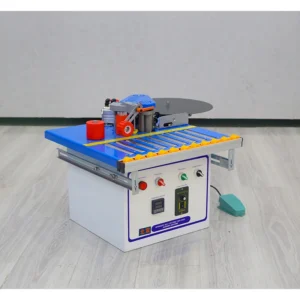
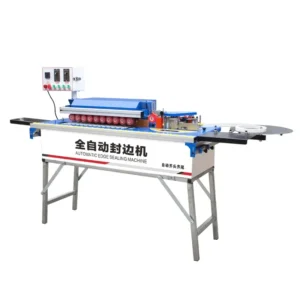
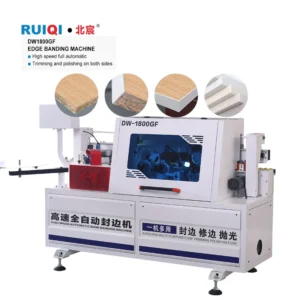
DW3000 Straight and Bevel Edge Banding Machine — OEM Manufacturing, Four-Stage QC, Patented Mechanisms
Precision-ground components — Every DW3000 straight and bevel edge banding machine undergoes a four-stage quality control protocol covering incoming material inspection through pre-shipment verification, ensuring documented tolerance before dispatch to OEM partners and distributors.
Technical Specifications
| Parameter |
Value |
| Model |
DW3000 |
| Product Type |
Straight and Bevel Edge Banding Machine |
| Total Power |
11 kW |
| Voltage |
380V/415V (configurable from 110V to 440V) |
| Pre-milled Motor |
2.2 kW |
| Heating Power |
2.2 kW × 2 (double heat gun design) |
| Trimming Motor |
2.2 kW × 2 (spindle trimming motor, 3 spindle motors total) |
| Polishing Motor |
0.4 kW × 2 |
| Vacuum Power |
550 W |
| Feed Speed |
0–12 m/min |
| Transmission Speed |
0–12 m/min |
| Edge Banding Height |
0–50 mm |
| Edge Banding Thickness |
0.3–3 mm |
| Minimum Sheet Length |
30 cm |
| Minimum Sheet Width |
15 cm |
| Glue Pot Capacity |
4000 ml |
| Air Source Pressure |
0.5–0.7 MPa |
| Bevel Angle Range |
30–90° (8 groups of adjustable oblique pressure wheels) |
| Product Size |
299 × 65 × 130 cm |
| Product Weight |
430 kg |
| Control Panel Language |
Chinese and English (customizable to Spanish or other languages) |
| Plug Options |
EU / USA / AU / UK |
| Standard Functions |
Plate milling, 30–90° edge banding, trimming, scraping, polishing, high-power vacuuming, edge band slotting |
| Certification |
CE, ISO 9001 |
Application Suitability
| Application |
Material or Output |
| Cabinet door production requiring both 45° bevel and 90° straight edge banding |
MDF, particleboard, plywood with PVC and veneer edge banding |
| Panel furniture manufacturing at moderate feed volumes |
Standard substrate panels with edge thickness 0.3–3 mm |
| Custom furniture factories scaling edge finishing operations |
Solid wood panels and composite boards within 50 mm height range |
| OEM and private-label production for regional distributors |
Branded equipment with localized control panels and voltage configurations |
Why the Voltage Question Should Come Before the Price on Any Edge Banding Machine Factory Order
Electrical mismatch at the job site halts commissioning and delays production for weeks, not days.
I once shipped a 45-degree bevel edge bander to a Middle East customer without repeatedly confirming their local supply. The machine was configured for 380V three-phase, but their facility ran on 440V. A transformer had to be air-freighted, and the entire installation stalled for three weeks. Since then, I personally review the electrical schematic for every unit and walk through a line-by-line voltage confirmation with the buyer over video before the machine is crated [NEED_CITE: voltage and frequency standards by export market]. When evaluating an edge banding machine factory, the depth of their pre-shipment electrical verification process tells you more about their reliability than any catalog claim.

Component Sourcing Depth Behind the DW3000 Build
The DW3000 uses an in-house manufactured cutting mechanism with proprietary patents that hold tolerance to ±0.02 mm across both straight and bevel passes. The trimming station employs three spindle motors rather than the standard 800W silent trimming motors found on lighter configurations, which matters when running 3 mm PVC banding on high-density particleboard where chatter marks become visible under angled light. This is the kind of component decision an OEM edge banding machine partner needs to verify during a factory audit, not discover after the first production run.
How Four-Stage QC Catches Tolerance Drift Before Crating
Incoming material inspection checks raw castings and linear guides for flatness deviation before they enter the assembly line. In-process verification measures carriage alignment at each station — pre-milling, glue application, pressure zone, trimming, scraping, and polishing — individually, not just at the final output. Finished product testing runs sample panels through the complete cycle, and the pre-shipment verification step documents measured results on the actual board thickness and edge band material the buyer will use in production [NEED_CITE: CE machinery directive requirements for industrial equipment]. This is where claimed tolerance becomes verified tolerance, recorded on a factory test sheet that ships with the machine.
What the Specs Actually Mean for Panel Output Quality
The double heat gun design at 2.2 kW × 2 ensures consistent glue activation whether you are running thin 0.3 mm veneer or thick 3 mm PVC — a single heat source struggles to maintain uniform melt temperature across that range, causing visible glue lines on some substrates. The eight groups of adjustable oblique pressure wheels allow angle changes from 30° to 90° without tooling swaps, which directly affects how tightly the banding conforms to the panel edge on bevel cuts. The 4000 ml glue pot capacity supports longer continuous runs without refill interruption, and the integrated edge band slotting device handles complex profile compliance that a basic trimming-only station cannot manage.
The Hidden Cost of Specifying a Single-Purpose Machine for a Dual-Purpose Job
Buying a straight-only edge bander and then encountering a cabinet door order that requires 45-degree bevel edges forces a choice: outsource the bevel work at a margin loss, or attempt a manual workaround that introduces visible inconsistency across the batch. The reverse is equally costly — a bevel-dedicated machine sitting idle when standard 90-degree panel runs come through represents underutilized capital [NEED_CITE: production line throughput matching between edge processing stations]. The DW3000’s 30–90° adjustable range addresses this by keeping both capabilities within one machine footprint, which matters when floor space in a growing workshop is already constrained.
Why OEM Partners and Distributors Source This Line
In-house manufacturing with patented cutting mechanisms means critical spare parts remain available without dependence on third-party supply chains. The full voltage customization range from 110V to 440V is treated as standard configuration, not a special-order exception, which eliminates the transformer scenario described earlier. Multilingual control panel options — Spanish, English, and others — are confirmed during the quotation stage so operators can read the interface from day one. Four-stage QC documentation ships with every unit, providing the paper trail that regional distributors need when presenting equipment to their own end buyers. Factory visits are welcomed at any production stage, with the assembly line, precision grinding area, and testing station open for on-site audit.
Documentation & Verification
- CE declaration of conformity covering the DW3000’s full electrical and mechanical scope
- ISO 9001 certificate tied to the manufacturing quality management system
- Factory test record measured on buyer-specified panel thickness and edge band material
- Electrical schematic with voltage confirmation sheet signed off before crating
- Operation and maintenance manual produced in the buyer’s agreed language
- Spare parts list identifying consumable and wear components with part numbers
Installation, Commissioning & Support
- The 11 kW total power draw requires a dedicated 380V/415V three-phase circuit with appropriate breaker rating
- Machine footprint of 299 × 65 cm plus operator clearance needs minimum 4-meter length allocation
- Arrives partially assembled; trimming and polishing stations require on-site alignment calibration
- First-run commissioning includes setting feed speed, glue temperature, and pressure wheel angles for local material
- Air source at 0.5–0.7 MPa must be filtered and regulated at the machine inlet
- Spare trimming cutters and polishing wheels included in the initial shipment package
What We Need From You to Configure the Right Unit
Share your primary panel substrate — MDF, particleboard, plywood, or solid wood — along with the edge banding material and thickness range you run most frequently. Confirm your facility’s supply voltage and frequency, as this determines the motor and transformer configuration built into your machine. If you are evaluating the DW3000 as an OEM partner or distributor, let us know your branding requirements, preferred control panel language, and whether you need a sample unit for pretest before committing to a production run.
Frequently Asked Questions
Q: What is included in OEM private-label scope for the DW3000?
A: OEM customization covers logo placement on the machine body, control panel language selection, voltage and plug configuration for the target market, and branded documentation. Minimum order quantities for private-label production runs are confirmed during the quotation stage, and single-unit samples with full branding are available for distributor evaluation before bulk commitment.
Q: How can I verify the claimed ±0.02 mm tolerance before the machine ships?
A: The pre-shipment verification stage of our four-stage QC protocol runs sample panels using your specified material and documents measured edge accuracy on a factory test record. This record, along with photographs of the test panels, is shared with the buyer before crating. On-site factory visits to witness live testing are also welcomed at any point during production.
Q: Which critical components are manufactured in-house versus externally sourced?
A: The cutting mechanism, carriage assemblies, and pressure wheel groups are manufactured and assembled in-house under proprietary patents. Electrical motors, PLC components, and pneumatic elements are sourced from established industrial suppliers with documented supply chains. This structure ensures both precision control over critical tolerance points and reliable spare part availability through standard industrial distribution channels.
Q: What is the process for ordering a sample unit before committing to a distributor stock order?
A: A single sample unit can be ordered with full production specifications, including your chosen voltage, language, and branding configuration. The sample goes through the same four-stage QC and pre-shipment testing as production units. After evaluation, specifications can be adjusted before the bulk order enters production, and the sample lead time is confirmed during the initial quotation.
Q: How does production lead time differ between OEM orders and standard catalog units?
A: Standard catalog configurations move through production on the standard schedule with typical multi-week lead times. OEM orders involving custom voltage, language panels, and branding require additional confirmation steps during the specification stage, which adds to the overall timeline. Capacity allocation for both order types is confirmed at quotation, and production progress updates are provided at key milestones.