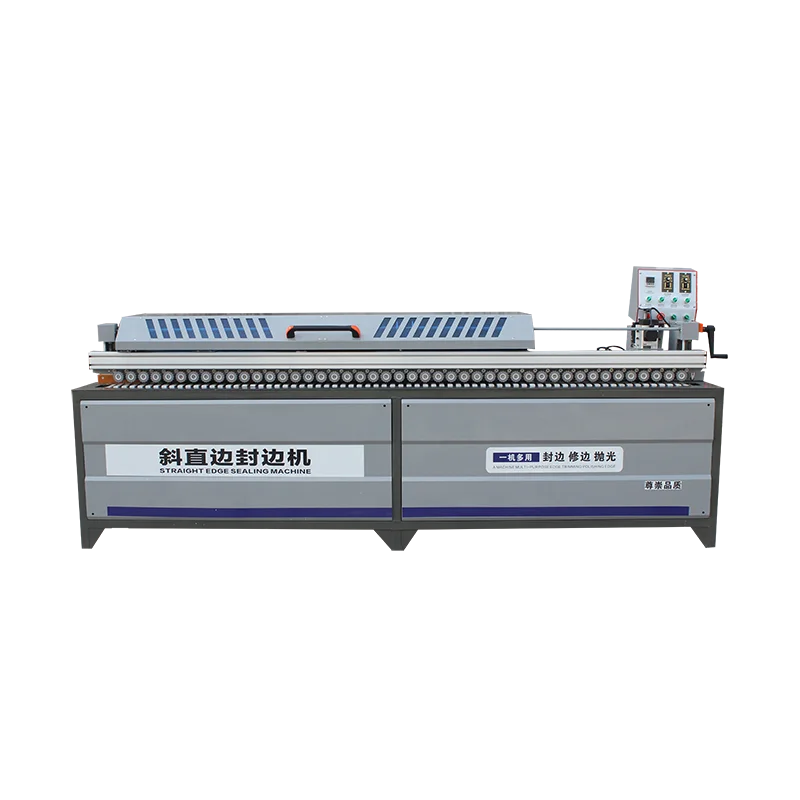
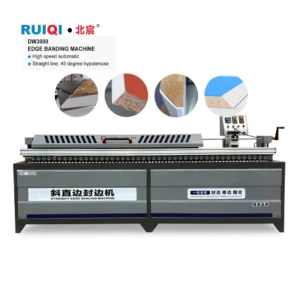
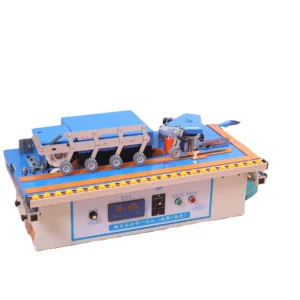
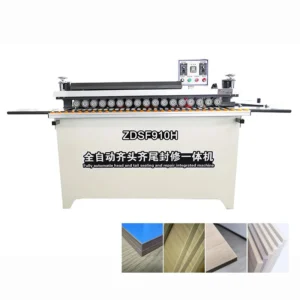
Precision-built oblique edge banding — Eight-group bevel pressing with 30°–90° adjustability and full OEM customization, manufactured in-house to verified tolerances for distributor and private-label partners.
Technical Specifications
| Parameter |
Value |
| Model |
ZDSDW3000 |
| Product Type |
Oblique Straight Edge Banding Machine |
| Pre-milling |
Yes, integrated pre-milling motor station |
| Trimming Functions |
Rough Trimming, Fine Trimming, End Trimming |
| Scraping & Buffing |
Scraping station, dual-motor up/down buffing |
| Bevel Pressing System |
8 groups, angle adjustable 30°–90° |
| Pressure Beam Adjustment |
Digital display, multi-thickness compatibility |
| Gluing Device |
Enhanced contact mechanism for edge-to-panel adhesion |
| Dust Extraction |
Large-diameter suction tube |
| Overall Dimensions (L×W×H) |
2990 × 650 × 1300 mm |
| Feed Speed |
(basis to be confirmed) |
| Panel Thickness Range |
(basis to be confirmed) |
| Rated Power |
(basis to be confirmed) |
| Voltage & Frequency |
Configurable from 110V to 440V |
| Control System Language |
Multilingual options available |
| Certification |
CE, ISO 9001 |
Application Suitability
| Application |
Material or Output |
| Custom furniture panel edge banding |
MDF, plywood, particleboard with PVC and veneer edge banding |
| Cabinet door and carcass production |
Solid wood panels and composite substrates |
| Oblique and straight edge profiling |
Angled panel edges for decorative and structural joinery |
| Panel processing plant integration |
Upstream saw output and downstream boring station feed |
Why Substrate Specs Must Precede the Quotation
Edge banding adhesion fails on the factory floor, not on the showroom sample.
I spent years watching machines perform perfectly on MDF test pieces during commissioning, only to see glue adhesion collapse when the customer switched to high-moisture particleboard the following week. One buyer received an edge bander configured for standard substrates, and nearly half the panels showed visible glue line separation before the first month ended. The machine itself was sound — the configuration was wrong for the actual material in the shop. [NEED_CITE: substrate moisture content and edge banding adhesion performance] When an oblique straight edge banding machine leaves the factory without confirmed substrate data, the cost of rework quickly overtakes any savings from a fast order cycle. Distributors who skip this step inherit the problem when their end users file warranty claims on machines that were never misbuilt — just misapplied.

Bevel Pressing Mechanism: Component Precision at the Core
The 8-group bevel pressing system on the ZDSDW3000 is not an off-the-shelf assembly. Each pressing group is machined in-house, with precision-ground contact surfaces that maintain consistent pressure across the full 30° to 90° adjustment range. For an OEM edge bander manufacturer, this means the mechanism performs reliably whether the end user is running standard 90° carcass panels or decorative oblique edges for custom furniture. The angle adjustment mechanism itself uses hardened guide rails to prevent drift during continuous production runs.
Gluing System Integration and Multi-Substrate Compatibility
The gluing device on this oblique straight edge banding machine is designed to maximize contact area between the edge band and the panel surface, which matters considerably when switching between PVC, veneer, and melamine banding materials. The pre-milling motor station works upstream of the glue application, removing saw marks and micro-fractures from the panel edge so the adhesive bonds to a clean, flat surface. [NEED_CITE: pre-milling effect on edge banding glue adhesion] For distributors sourcing private-label equipment, this integrated pre-milling and gluing combination reduces the number of field complaints related to delamination on particleboard and MDF substrates of varying density.
How Specification Choices Affect Downstream Assembly
The digital display pressure beam height adjustment allows operators to switch between panel thicknesses without manual calibration guesswork. In a workshop running both 16mm shelving stock and 25mm countertop panels, this reduces changeover time and eliminates the inconsistent feed pressure that causes trimming stations to leave chatter marks. The dual-motor buffing station finishes the edge with up and down polishing heads, removing residual adhesive and smoothing the band-to-panel transition to a level that meets furniture-grade surface expectations. Large-diameter dust extraction connects to the shop’s central collection system, keeping the buffing and scraping zones clear of particulate that would otherwise embed in the freshly glued edge. Tolerance at the trimming stations directly affects whether panels fit into dowel or confirmat assemblies without force — a concern that compound when oblique edges introduce angular variables beyond standard 90° joints. [NEED_CITE: edge trimming tolerance and panel assembly fit]
The Hidden Cost of Skipping Factory Verification
Distributors who commit to a territory partnership without inspecting component sourcing and assembly processes inherit risks that do not surface until machines are in the field. A pressure beam that drifts under continuous load, a bevel pressing group that loses angular accuracy after weeks of vibration, or a buffing motor that overheats in tropical ambient temperatures — none of these appear in a catalog specification sheet. [NEED_CITE: industrial machinery field failure causes in export markets] Buyers who skip the factory audit stage often discover these issues through warranty claims from their own customers, long after the initial shipment has cleared customs.
Why Distributors Source This Machine From Our Production Line
In-house manufacturing means every component from the bevel pressing groups to the buffing motors is traceable to our own machining and assembly processes, not outsourced to unidentified subcontractors. Four-stage quality control covers incoming material inspection, in-process dimensional checks, finished product functional testing, and pre-shipment verification with documented test records. OEM partners receive full private-label capability including custom logo placement, voltage configuration from 110V to 440V, and control panel language matching the destination market. Engineer-led configuration ensures the machine leaves the factory matched to the substrates and production volumes the end user will actually run, not a generic baseline specification. [NEED_CITE: OEM machinery manufacturing and quality documentation standards]
Documentation & Verification
- CE declaration of conformity covering the ZDSDW3000 oblique straight edge banding machine
- ISO 9001 certificate for the manufacturing quality management system
- Factory test record on your specified panel thickness range and edge banding material
- Electrical schematic with confirmed voltage and frequency for the destination market
- Operation and maintenance manual in the agreed language with illustrated parts diagrams
Installation, Commissioning & Support
- Overall dimensions of 2990 × 650 × 1300 mm require minimum clearance assessment for workshop door access
- Voltage configurable from 110V to 440V — confirm local supply before production scheduling
- Pre-milling and buffing stations calibrated to your panel material during factory pre-shipment test
- Digital display pressure beam trained to operator level during initial commissioning guidance
- Spare parts list provided covering consumable trimming cutters and buffing wheels
- Dust extraction port sized for connection to existing central collection or standalone unit
What to Prepare Before Requesting a Quotation
To configure the ZDSDW3000 for your market, we need to know the primary substrates your customers process — MDF, particleboard, plywood, or solid wood — along with the edge banding materials they use most frequently. Confirm the local voltage and frequency standard, the preferred control panel language, and whether your end users require oblique edge capability alongside standard straight edge banding. If you are evaluating this machine for a territory distribution agreement, request a sample processing test on your own panel stock before committing to a bulk order.
Frequently Asked Questions
Q: What OEM and private-label customization options are available for this edge banding machine?
A: The ZDSDW3000 supports custom logo application, voltage configuration from 110V to 440V, multilingual control panels, and specification adjustments to match regional market requirements. Private-label partners can order from single evaluation units through to full container production runs with consistent branding across the machine body, documentation, and packaging.
Q: How does the four-stage QC process work, and what records are provided before shipment?
A: Incoming materials undergo dimensional and hardness inspection, in-process stages include assembly verification and alignment checks, finished products run through functional testing on actual panel stock, and pre-shipment verification produces a documented test record. Distributors receive this record alongside the electrical schematic and voltage confirmation before the machine leaves the factory.
Q: Can the factory accommodate custom voltage and frequency for different export markets?
A: Yes. Voltage is configurable across the 110V to 440V range to match destination market electrical standards. Frequency requirements are confirmed during the quotation stage so that motors, control systems, and heating elements are matched to the local supply before production begins.
Q: How can distributors arrange a factory visit or request sample tests before bulk ordering?
A: Factory visits are open for distributors to inspect component sourcing, precision grinding processes, and assembly line operations. Sample processing tests can be run on your own panel materials and edge banding stock to verify output quality before you commit to a territory order.