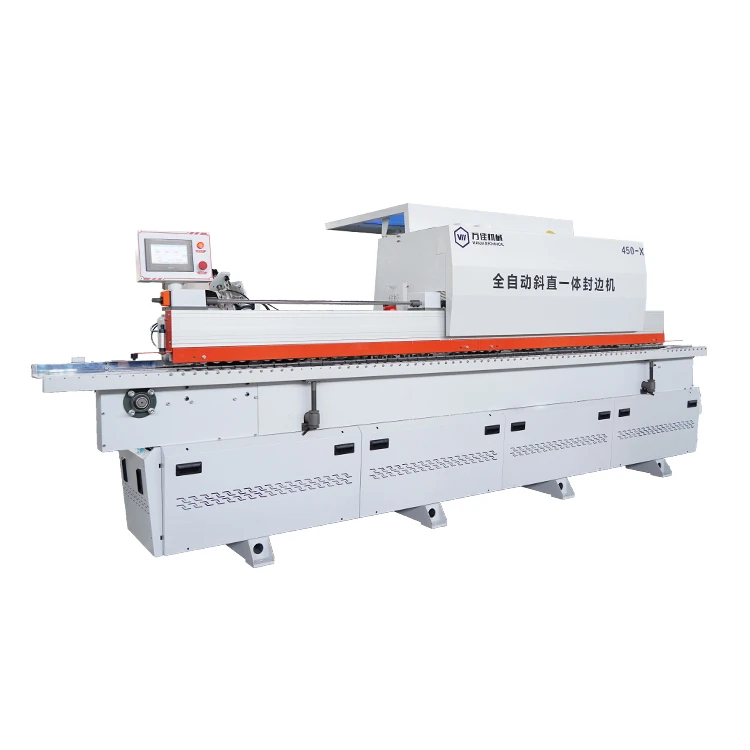
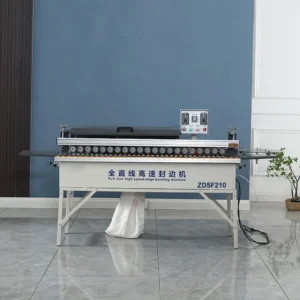
Verified Manufacturing Depth — Four-stage quality control with pre-shipment verification on every automatic edge banding machine, built for distributors who need documented proof before the crate leaves Shandong.
Technical Specifications
| Parameter |
Value |
| Product Type |
Automatic Edge Banding Machine with Pre-Milling and Curve Trimming |
| Overall Dimensions (L×W×H) |
435×92×165 cm |
| Total Power |
17.5 kW |
| Voltage & Frequency |
380V / three-phase five-wire / 50Hz |
| Conveying Motor |
380V 2.2 kW (with frequency converter) |
| Feed Speed |
0–12 m/min (variable, straight and inclined edge) |
| Panel Width Range |
>100 mm |
| Panel Length Range |
>250 mm |
| Panel Thickness Range |
18 / 22 / 25 mm |
| Edge Banding Width |
20–50 mm |
| Edge Banding Thickness |
up to 1.2 mm (material dependent) |
| Edge Banding Type |
PVC |
| Glue Pot Capacity |
2000 ml |
| Glue Pot Heating Power |
1.2 kW |
| Glue Pot Operating Temperature |
150–170°C |
| Heat Gun Power |
2 kW |
| Pre-Milling Motor |
380V 3.5 kW |
| Selection Motor |
380V 4 kW |
| Trimming Motor |
380V 0.75 kW × 2 |
| End Trimming Motor |
380V 0.37 kW × 2 |
| Edge Motor |
380V 0.18 kW (with inverter) |
| Polishing Motor |
380V 0.37 kW × 2 |
| Slotted Motor |
220V 0.8 kW |
| Lifting Motor |
380V 0.25 kW (with inverter) |
| Air Source Pressure |
0.6–0.8 MPa |
| Air Storage Tank Volume |
5 L |
| External Suction Port |
diameter 100 mm |
| Control System |
Xinjie industrial touch screen with Xinjie industrial inverter |
| Tolerance |
±0.02 mm |
| Standards |
CE, ISO 9001 |
Application Suitability
| Application |
Material or Output |
| Straight and curved edge banding for cabinet doors |
MDF and particleboard with PVC edging |
| Custom furniture panel finishing |
Plywood panels with curved or slanted profiles |
| Wardrobe and shelving component edging |
Particleboard substrates up to 25 mm thickness |
| Panel furniture batch production |
MDF boards requiring pre-milled edge preparation |
Why Voltage Confirmation Belongs in the First Email, Not the Last
Every Automatic Edge Banding Machine factory OEM order must lock electrical specifications before steel is cut.
I watched a Middle Eastern customer lose three weeks of production because a 440V machine arrived at a 380V workshop. The main board burned on first power-up, and the replacement parts shipment took the entire downtime window to arrive. That failure had nothing to do with engineering quality and everything to do with a missing line on the purchase order [NEED_CITE: voltage and frequency standards by export market]. For an Automatic Edge Banding Machine factory OEM partner, the electrical schematic is not optional paperwork — it is the difference between a machine that runs and a machine that sits under a tarp.

Sourcing Components for Distributor-Level Serviceability
When your service team opens a control cabinet overseas, they need to recognize what they see. This machine uses Xinjie industrial-grade touch screens and inverters as standard control components. For an Automatic Edge Banding Machine factory OEM arrangement, that means your technicians are not learning an obscure proprietary interface — they are working with industrial automation hardware that has established distribution channels in most regional markets. Spare parts stocking becomes a conversation about standard catalog numbers rather than custom fabrications.
In-House Manufacturing Means Real Customization, Not Sticker Swaps
Private label on woodworking equipment often stops at a logo decal on the sheet metal. The manufacturing depth here extends to precision-ground components, a patented cutting mechanism, and configurable specifications across the entire machine. Voltage can be set from 110V to 440V, control panels can display your customer’s local language, and the machine body color can match your brand palette. This is what separates an Automatic Edge Banding Machine factory OEM engagement from a simple resale agreement [NEED_CITE: CE machinery directive requirements for industrial equipment].
Reading the Spec Sheet Against the Production Floor
The 3.5 kW pre-milling motor removes saw marks from panel edges before the glue roller makes contact — this directly determines whether PVC edging bonds cleanly or shows visible glue lines on MDF and particleboard substrates. Feed speed runs from 0 to 12 m/min under inverter control, meaning operators can dial down for curved slanted profiles without losing glue pot temperature stability. The ±0.02 mm tolerance matters downstream: when edge-trimmed panels go into cabinet assembly, even small deviations compound across a full carcass and prevent square fitting. The 100 mm dust extraction port must connect to a central collection system rated for continuous fine-particle capture, or the trimming station will recirculate debris onto polished surfaces.
The Cost of Skipping Factory Verification
Distributors who commit to bulk orders without visiting the production floor often discover tolerance claims only after panels fail assembly at the end customer’s site. The ±0.02 mm specification is measurable, but only if you request the factory test record tied to your specific serial number. Machines quoted without confirming local voltage arrive unusable and sit idle while replacement components cross international shipping lanes [NEED_CITE: common causes of woodworking machinery commissioning failure]. A single unverified order can cost more in reputational damage than a plane ticket to Shandong.
What Manufacturing Depth Actually Looks Like
The patented cutting mechanism is built in-house, not sourced from a third-party spindle supplier and rebranded. Four-stage quality control covers incoming material inspection, in-process checks during assembly, finished product verification, and pre-shipment testing — each stage generates documentation that ships with the crate. Component sourcing is traceable, and precision grinding on critical mating surfaces is done on the factory floor rather than outsourced. For distributor partners, this means the machine you sell under your label carries verifiable manufacturing provenance, not just a certificate hanging on the wall.
Documentation & Verification
- Factory test record run on your specified panel thickness range before dispatch
- Electrical schematic with confirmed voltage and frequency for your target market
- CE declaration of conformity and ISO 9001 certificate in the documentation package
- Operation and maintenance manual translated into the agreed language
- Spare parts list with catalog numbers for Xinjie control components
Installation, Commissioning & Support
- Requires a dedicated 17.5 kW three-phase circuit matching confirmed voltage and frequency
- 435 cm length demands clear floor space with 100 mm dust extraction ducting routed to collection
- Compressed air supply must maintain 0.6–0.8 MPa at the 5 L storage tank inlet
- Xinjie touch screen calibration and inverter parameter setup during first commissioning
- Pre-milling and trimming motor alignment verified against your sample panels on-site
What We Need to Build Your Machine
Share the panel substrates you will process, the edge banding materials in your catalog, and the voltage standard in your target territory. If you are evaluating this Automatic Edge Banding Machine for private-label distribution, let us know your branding requirements and preferred control panel language. A factory visit or sample processing test can be arranged before production begins.
Frequently Asked Questions
Q: What OEM and private-label customization options are available for this machine?
A: Custom logo placement on the machine body and packaging, color matching to your brand palette, multilingual control panel configuration on the Xinjie touch screen, and voltage settings from 110V to 440V. All customization is confirmed in writing before production starts, with a formal specification sheet attached to the order.
Q: How do you confirm voltage and frequency before production begins?
A: We request the electrical standard for your target market during the inquiry stage and provide a complete electrical schematic for your review and sign-off. This document specifies voltage, frequency, plug type, and circuit requirements. No machine enters production without written confirmation from the buyer.
Q: What does the four-stage QC process include for each unit?
A: Incoming material inspection on purchased components, in-process checks during mechanical and electrical assembly, finished product testing under operating conditions, and a pre-shipment verification run. Each stage produces records, and the factory test record for your specific unit ships with the documentation package.
Q: Can I visit the factory or request sample processing before ordering?
A: Factory visits are welcomed at any stage — you can inspect precision grinding operations, review the patented cutting mechanism, and witness the four-stage QC process in person. Sample processing tests using your own panel materials and edge banding stock can be arranged to verify output quality before you commit to an order.