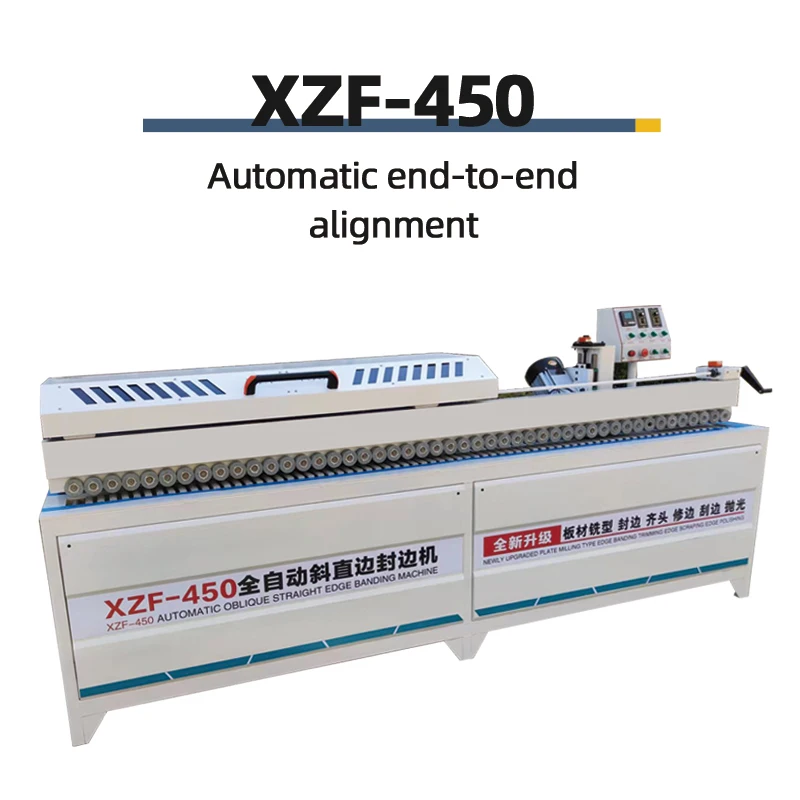
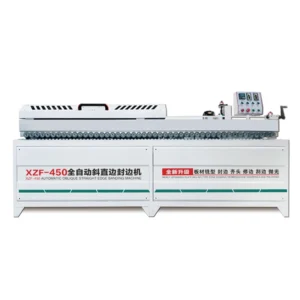
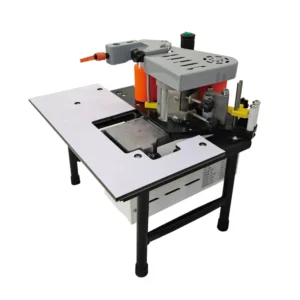
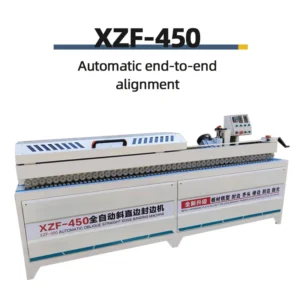
In-house manufacturing with verified tolerance — Every XZF450 edge banding machine is built on our assembly floor with proprietary cutting mechanisms, pre-shipment test records, and documented ±0.02mm precision verification before crating.
Technical Specifications
| Parameter |
Value |
| Model |
XZF-450 |
| Product Type |
Automatic Edge Banding Machine |
| Total Installed Power |
9.5 kW |
| Pre-milling Motor |
4 kW |
| Trimming Stations |
2.2 kW × 2 |
| Polishing Stations |
0.4 kW × 2 |
| Edge Banding Feed Speed |
0–12 m/min (0.16 kW drive) |
| Conveyor Transmission |
180 W, 0–12 m/min |
| Vacuum Extraction |
550 W |
| Voltage Configuration |
380V / 415V (frequency and phase to be confirmed per destination market) |
| Air Supply Requirement |
0.5–0.7 MPa |
| Glue Pot Capacity |
4000 ml |
| Minimum Sheet Length |
30 cm |
| Minimum Sheet Width |
15 cm |
| Edge Banding Height Range |
0–50 mm |
| Edge Banding Thickness Range |
0.3–3 mm |
| Machine Dimensions |
300 × 65 × 135 cm |
| Machine Weight |
430 kg |
| Control Panel Language |
Chinese, English (configurable to Spanish or other languages) |
| Plug Standard Options |
EU, USA, AU, UK |
| Assembly State |
Fully assembled at factory |
| Key Features |
Pre-milling, 30°/45°/60° angled edge banding, trimming, scraping, polishing, high-power vacuum dust collection |
Application Suitability
| Application |
Material or Output |
| Cabinet door and carcass edge finishing |
MDF, melamine-faced board, particleboard |
| Custom furniture panel edge banding |
Plywood, blockboard, solid wood panels |
| Polymer door profile edge treatment |
PVC and polymer composite door skins |
| Angled edge applications for decorative panels |
30°, 45°, and 60° bevel profiles on MDF and plywood |
| Large-format furniture component finishing |
Panels down to 30 cm length and 15 cm width |
Why Voltage Confirmation Must Happen Before Production Starts
A machine built for the wrong grid is a machine that sits idle until a transformer arrives — and that delay falls entirely on the buyer.
I spent years running installations across Shandong and Southeast Asia before I fully understood how often edge banding machine factory orders go wrong at the electrical stage. One Vietnamese cabinet maker ordered a unit rated at 440V, but the workshop only had 220V three-phase supply. The control cabinet could not be rewired on site. That factory waited three weeks for a step-up transformer while production orders backed up. [NEED_CITE: voltage and frequency standards by export market] When sourcing an edge banding machine for OEM or resale distribution, confirming local voltage, frequency, and plug type at the quotation stage — not after production — prevents these dead-on-arrival scenarios.

Component Sourcing and Assembly Depth for OEM Partners
Distributors evaluating an edge banding machine factory need to understand what is actually built in-house versus what is sourced. The XZF450 uses proprietary cutting mechanisms developed on our own production floor, with precision-ground components passing through multi-stage inspection before assembly. This matters for private-label partners because it means tolerance claims can be traced back to specific manufacturing steps, not just final assembly checks. When you put your brand on a machine, you need to know the engineering behind it holds up under scrutiny.
Private-Label Customization Beyond a Logo Decal
Most OEM arrangements stop at a badge swap. For regional distributors, the XZF450 supports deeper customization that affects actual market acceptance. Control panels can be configured in the local operator language — Spanish for Latin American markets, English for Southeast Asia, or other languages on request. Voltage is set to match the destination grid before wiring begins, with electrical schematics provided for local compliance review. Plug standards ship matched to the market: EU, USA, AU, or UK configurations. This level of specification alignment means the machine arrives ready for the end user, not requiring a local electrician to intervene before the first panel is edged. [NEED_CITE: CE machinery directive requirements for industrial equipment]
How Pre-Milling, Trimming, and Polishing Stages Affect Edge Quality
The 4 kW pre-milling motor on the XZF450 removes a thin layer from the panel edge before glue application, which addresses a common problem: saw-cut edges on MDF and particleboard often carry micro-chipping that shows through thin PVC banding. A dedicated pre-mill station produces a clean substrate surface, allowing the adhesive to bond uniformly. Downstream, the dual trimming stations at 2.2 kW each handle both flush and radius trimming in one pass, removing excess banding material above and below the panel. The dual 0.4 kW polishing stations then burnish the trimmed edge to a smooth finish. For angled work — 30°, 45°, or 60° bevels common in decorative cabinet doors — these stations must track non-perpendicular profiles consistently, which depends on both mechanism rigidity and feed speed control across the 0–12 m/min range.
What Happens When Specification Gaps Reach the Workshop Floor
Buying edge banding equipment on catalogue specifications alone creates problems that surface only during installation. A machine quoted without confirmed frequency may run its motors at incorrect RPM, producing chatter marks on trimmed edges. Control panels in an unfamiliar language stall commissioning while the operator guesses at parameter menus. Machines purchased individually without checking conveyor height against upstream saws or downstream stacking equipment create material flow bottlenecks that no amount of operator skill can fix. These are not theoretical failures — they appear regularly in workshops that scaled from manual to automated production without a configuration review. [NEED_CITE: common commissioning failures in imported woodworking machinery]
Why Distributors Source This Platform for Regional Resale
The XZF450 sits within a product family that ranges from entry-level to full-function pre-milling models, so a distributor can offer customers a scaling path without switching suppliers. Four-stage quality control — incoming material, in-process, finished product, and pre-shipment verification — ships with documented test records for every unit. Factory visits are welcomed, allowing distributor teams to inspect precision grinding stations and assembly procedures firsthand. Electrical schematics and voltage confirmation documents are supplied before production begins, not after. Engineer-led configuration recommendations with formal quotations are typically delivered within 24 hours of a complete inquiry.
Documentation & Verification
- CE declaration of conformity covering the XZF450 machine category
- ISO 9001 certificate for the manufacturing quality management system
- Electrical schematic with confirmed voltage and frequency for your market
- Factory test record run on panel thickness within your specified range
- Machine specification sheet with full power breakdown per station
- Operation and maintenance manual in the agreed operator language
Installation, Commissioning & Support
- Requires a dedicated 380V/415V circuit rated for the 9.5 kW total draw with appropriate breaker sizing
- Machine arrives fully assembled at 300 × 65 × 135 cm — verify doorway and corridor clearance before delivery
- Compressed air supply at 0.5–0.7 MPa must be plumbed to the machine inlet before first power-on
- Glue pot filled to the 4000 ml capacity and heated to operating temperature during initial commissioning
- Feed speed calibrated across the 0–12 m/min range using your actual panel stock during setup
- Spare parts list provided with wear-item identification for trimming cutters, polishing wheels, and feed chain components
What We Need to Configure Your XZF450 Correctly
To prepare an accurate configuration and quotation, provide the panel materials you process most frequently, the edge banding thickness range your products require, and your workshop’s confirmed voltage and frequency. If your operators need a control panel in a specific language, indicate that at the inquiry stage. For distributors planning a product line mix, share the market segments you serve so the engineering team can recommend the right station configuration and customization scope.
Frequently Asked Questions
Q: What can be customized under an OEM or private-label arrangement for the XZF450?
A: Customization covers logo and color application, voltage and frequency matching to your destination market, control panel language configuration, plug standard selection, and specification adjustments such as feed speed range or station configuration. Each OEM order includes confirmed electrical schematics and a factory test record before shipment, so the machine arrives aligned with your market requirements.
Q: How is manufacturing precision verified before the machine leaves the factory?
A: The XZF450 passes through four quality control stages: incoming material inspection, in-process checks during assembly, finished product testing, and a pre-shipment verification run. Precision-ground components are measured at multiple points, and a documented test record accompanies each unit. Distributors are welcome to witness the final test during a factory visit.
Q: How do you ensure the machine matches our local electrical standard?
A: Voltage and frequency are confirmed in writing before production begins. The electrical schematic is reviewed with the buyer to verify phase configuration, breaker requirements, and wiring standards for the destination market. This prevents the situation where a machine arrives and cannot be powered on without sourcing an external transformer.
Q: What documentation ships with each XZF450 unit?
A: Every unit ships with a CE declaration of conformity, ISO 9001 certificate, machine specification sheet, confirmed electrical schematic, factory test record, operation and maintenance manual in the agreed language, spare parts list, packing photographs, and customs documentation support for the export shipment.
Q: How is technical backup handled for distributor service teams?
A: Distributors receive a complete spare parts list with wear-item identification and recommended stock quantities. Technical training can be arranged during factory visits, covering station adjustment, troubleshooting procedures, and routine maintenance intervals for the pre-milling, trimming, scraping, and polishing assemblies on the XZF450 platform.