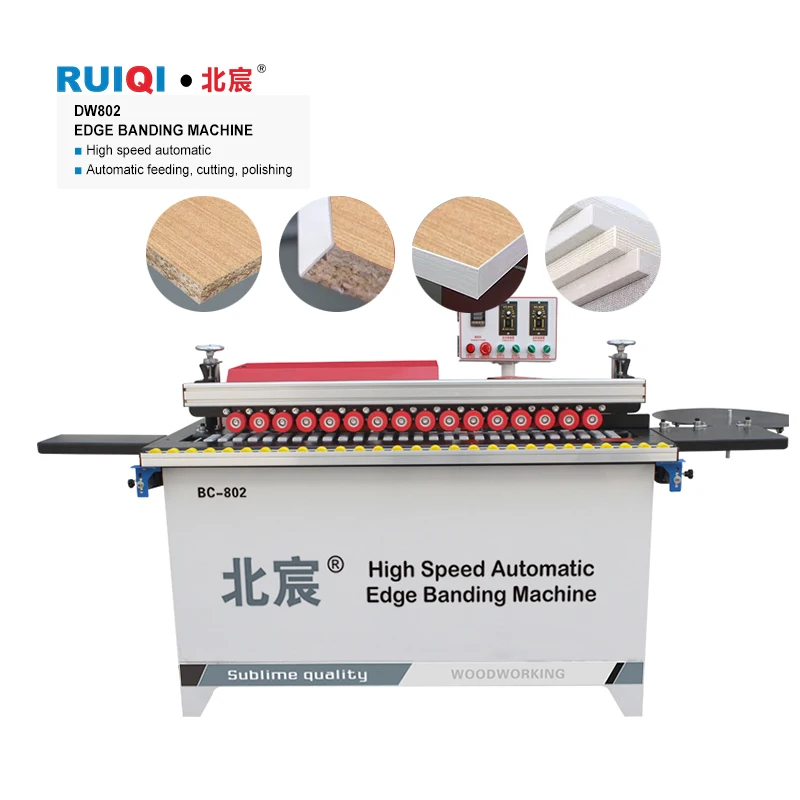
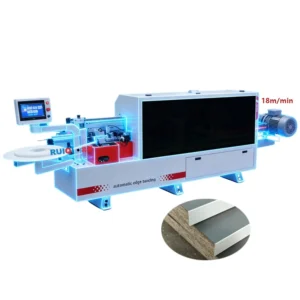
Precision-Ground Manufacturing — every DW802 automatic edge banding machine leaves the facility with a factory test record confirming functional station alignment and verified electrical configuration matching the buyer’s destination market.
Technical Specifications
| Parameter |
Value |
| Model |
DW802 |
| Product Type |
Automatic Edge Banding Machine |
| Total Power |
4200W |
| Voltage & Frequency |
220V / 380V / customizable (frequency to confirm: 50Hz or 60Hz) |
| Overall Dimensions (L×W×H) |
130 × 60 × 95 cm |
| Net Weight |
135 kg |
| Edge Banding Height Range |
0–50 mm |
| Edge Banding Thickness Range |
0.3–3 mm |
| Minimum Sheet Length |
25 cm |
| Minimum Sheet Width |
10 cm |
| Edge Feed Motor Power |
140W |
| Transmission Motor Power |
140W |
| Trimming Motor Power |
800W × 2 |
| Polishing Motor Power |
180W × 2 |
| Vacuum Motor Power |
1200W |
| Air Source Pressure |
0.4–0.8 MPa |
| Glue Pot Capacity |
4000 ml |
| Standard Functions |
Gluing, edge banding, trimming, automatic head-and-tail cutting, polishing, vacuum hold-down |
| Language Options |
Chinese and English standard; other languages customizable |
| Certification |
CE |
Application Suitability
| Application |
Material or Output |
| Custom cabinet door edge sealing |
MDF and particleboard with PVC or melamine banding |
| Wardrobe and shelving panel finishing |
Plywood and ecological board with veneer or ABS edge strips |
| Small-batch furniture production runs |
Solid wood panels requiring glue application and flush trimming |
| Workshop-scale joinery and fit-out work |
Mixed substrate batches in home decoration woodworking |
Why Voltage Confirmation Must Precede the Purchase Order
Machines built without verifying destination voltage and frequency become dead weight on the factory floor. The DW802 automatic edge banding machine factory OEM process requires electrical specification sign-off before the production order is released. I have seen importers receive woodworking equipment wired for a grid that does not exist in their region, leaving the machine sitting idle while electricians attempt rewiring that voids warranty coverage [NEED_CITE: voltage and frequency standards by export market]. The cost is not just the rewiring — it is the commissioning delay, the frustrated operator standing beside an inoperative panel, and the production schedule that slips while the issue gets resolved. When a distributor stocks machines without confirming the target market’s electrical standards, those units can sit in a warehouse for months before finding a buyer whose grid matches the factory default configuration.

How OEM Customization Works on the Production Floor
OEM and private-label orders for the DW802 begin with a configuration sheet that locks every variable the destination market demands. Voltage is set to match the buyer’s local grid — whether that is 220V single-phase for a small joinery shop or 380V three-phase for a higher-volume panel processor. The control panel language is specified at order stage so the operator sees instructions they can read from the first hour of commissioning. This automatic edge banding machine factory OEM workflow ensures the machine arrives ready to run rather than requiring on-site adaptation that delays production.
Private-Label Scope Beyond a Logo Sticker
Private-label partners receive more than a branded nameplate. The DW802 can carry custom color schemes on the machine housing, branded packaging materials sized to the unit’s 130 × 60 × 95 cm footprint, and documentation printed in the distributor’s preferred language [NEED_CITE: CE machinery directive requirements for industrial equipment]. Distributors evaluating manufacturing depth will find that the OEM scope covers control interface customization, electrical schematics reflecting the as-built configuration, and spare parts lists that match the distributor’s own catalog numbering system.
What the Specification Sheet Means for Daily Production
The 4200W total power rating distributes across six functional stations — gluing, banding, dual trimming, dual polishing, and vacuum hold-down — each drawing from dedicated motors sized to their specific load. The dual 800W trimming motors provide enough torque to achieve flush cuts on 0.3–3 mm banding thickness without chatter marks that would require hand finishing. The 4000 ml glue pot capacity supports extended production runs before reloading, reducing interruptions during batch processing of cabinet panels. Vacuum hold-down at 1200W motor power keeps panels flat against the feed bed, which matters when processing warped particleboard or thin MDF sheets that might otherwise lift during trimming. The 0.4–0.8 MPa air source requirement is standard for pneumatic actuators controlling the head-and-tail cutting mechanism — confirm that your workshop compressor can sustain this pressure across the full operating cycle [NEED_CITE: pneumatic pressure standards for woodworking machinery].
The Hidden Cost of Skipping Configuration Verification
When an importer orders edge banding equipment without specifying control panel language, the machine arrives with an interface the operator cannot read. Commissioning stalls while someone translates menu items, and incorrect parameter settings lead to glue temperature errors or feed speed mismatches. I once spent two full days on the phone walking a customer through a control panel that displayed everything in a language their team did not recognize — the machine was mechanically sound, but production could not start until we resolved the interface issue. The same applies to air supply: a workshop compressor that cannot maintain 0.4 MPa minimum pressure causes inconsistent pneumatic actuation, resulting in uneven head-and-tail cuts that show up as visible defects on finished cabinet edges [NEED_CITE: common causes of edge banding defects in panel processing].
Why Sourcing This Machine Directly from the Manufacturing Facility
Every DW802 is assembled and tested in the same facility where its components are precision-ground, meaning the team that builds the machine also validates its output before crating. The four-stage quality control sequence covers incoming material inspection, in-process assembly checks, finished product testing, and pre-shipment verification — with documentation generated at each gate. Voltage and frequency are confirmed against the buyer’s written specification before the machine enters assembly, not after. OEM partners can audit the production process on-site, reviewing component sourcing records and witnessing test runs on their specified panel materials. Factory test records ship with every unit, providing a baseline that the buyer’s technical team can reference during installation and commissioning.
Documentation & Verification
- CE declaration of conformity covering the DW802 automatic edge banding machine safety requirements
- Factory test record documenting functional checks on gluing, trimming, head-tail cutting, and polishing stations
- Electrical schematic reflecting the as-built voltage and frequency configuration for your destination market
- ISO 9001 certificate covering the manufacturing quality management system
- Operation and maintenance manual produced in the control panel language you specified at order stage
- Packing photographs showing crating condition before the shipment leaves the facility
Installation, Commissioning & Support
- Confirm workshop floor space accommodates the 130 × 60 × 95 cm footprint with clearance for panel infeed and outfeed
- Verify electrical supply matches the confirmed voltage and frequency before connecting the 4200W total load
- Ensure workshop compressor delivers sustained 0.4–0.8 MPa air pressure to all pneumatic actuators
- Run initial test panels through all six stations to verify glue temperature, trim alignment, and polish finish
- Review spare parts list covering wear items for the trimming motors, polishing wheels, and glue pot seals
- Schedule periodic inspection of the 1200W vacuum system filter and hold-down pad condition
What to Include in Your Inquiry
Provide your target panel materials and typical sheet dimensions so we can confirm the 0–50 mm banding height range and minimum sheet size compatibility with your production mix. Specify your workshop voltage and frequency, along with the control panel language your operators need. If you are evaluating this automatic edge banding machine for OEM or private-label distribution, include your branding requirements, packaging preferences, and the volume range you plan to order across your first production run.
Frequently Asked Questions
Q: What elements of the DW802 can be customized for private-label or OEM orders?
A: Logo placement on the machine housing, custom color schemes, control panel language, voltage and frequency configuration, branded packaging sized to the unit dimensions, and specification tailoring such as alternative motor ratings or additional station functions. Each customization point is confirmed on the configuration sheet before the production order is released, and the as-built documentation reflects every agreed modification.
Q: How is the correct voltage and frequency confirmed before the machine enters production?
A: The buyer provides written confirmation of the destination market’s electrical standards, including voltage, phase, and frequency. This specification is reviewed by the engineering team and locked into the build order. The electrical schematic generated at the documentation stage reflects the as-built configuration, and the pre-shipment test verifies the machine operates correctly at the specified electrical input before crating.
Q: What does the four-stage QC process cover for each unit?
A: Incoming material inspection verifies component specifications against the bill of materials. In-process checks confirm assembly alignment and pneumatic connections during build. Finished product testing runs the machine through all functional stations under load. Pre-shipment verification repeats the functional test and generates the factory test record that ships with the machine, documenting results across gluing, trimming, head-tail cutting, and polishing.
Q: Can we visit the manufacturing facility to inspect the production process?
A: Factory visits are welcomed at any stage — from initial evaluation through in-production audits and pre-shipment witness testing. Visitors can review component sourcing documentation, observe precision grinding and assembly procedures, and run sample panels through a machine configured to their specifications. Advance scheduling ensures the engineering team is available to walk through the production floor and answer technical questions directly.
Q: How are lead times structured for OEM orders with large production volumes?
A: Lead time depends on order quantity, customization scope, and current production scheduling. Single-unit orders with standard configuration typically move through assembly and testing within a shorter window, while multi-unit OEM runs with custom voltage, language, and branding requirements follow a phased production schedule. The confirmed delivery timeline is provided with the formal quotation and updated at each production milestone.