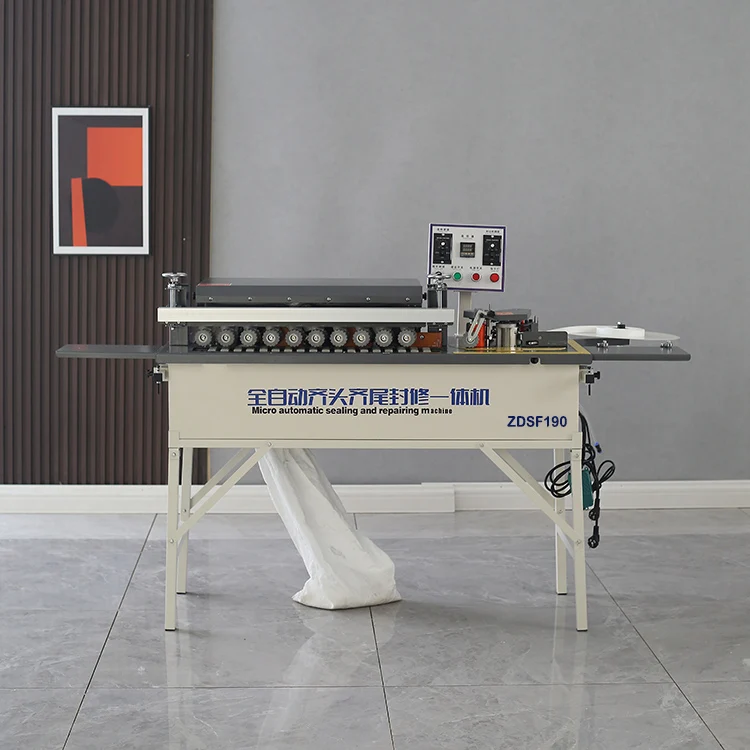
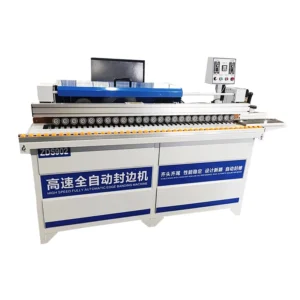
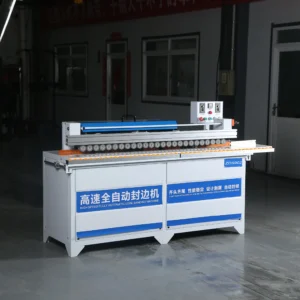
Precision-ground 4-edge alloy trimming mechanism — every ZDSF190 cutter head is machined in-house to hold arc-shaped profiles on both curved and straight panel edges, verified against sample boards before dispatch.
Technical Specifications
| Parameter |
Value |
| Model |
ZDSF190 |
| Product Type |
Automatic Edge Banding Machine |
| Function |
Automatic plate feeding, belt cutting, double-sided gluing, upper/lower trimming, polishing, curved & straight edge banding |
| Edge Type |
Both curved and straight lines |
| Voltage & Frequency |
220V 50Hz (configurable from 110V to 440V for OEM orders) |
| Rated Power |
4 kW |
| Heating Power |
800 W |
| Trimming Power |
800 W × 2 |
| Polishing Power |
180 W × 2 |
| Suction Power |
1200 W |
| Belt Power |
25 W |
| Transmission Power |
120 W |
| Conveyor Belt Speed |
0–14 m/min |
| Sheet Thickness Range |
10–50 mm |
| Strip Thickness Range |
0.5–2.5 mm |
| Glue Capacity |
1000 ml |
| Gluing Method |
Double-sided gluing |
| Trimming Stations |
Upper and lower trimming with 4-edge arc-shaped alloy cutter head |
| Polishing Stations |
Cross polishing up and down |
| Pressure Beam |
Adjustable aluminum alloy pressure beam |
| Feed Mechanism |
Double-row rubber pressure wheels with extended feed plate |
| Cutting Device |
Pneumatically controlled edge strip cutting |
| Dust Extraction |
Large diameter surrounding vacuum |
| Rated Air Pressure |
0.4–0.6 MPa |
| Control Panel |
Multi-function button operation |
| Overall Dimensions |
1900 × 560 × 1300 mm |
| Weight |
120 kg |
| Assembly State |
KD packing, requires assembly with manual or video guidance |
Application Suitability
| Application |
Material or Output |
| Custom furniture panel edge banding |
MDF, plywood, particleboard with PVC strip 0.5–2.5 mm |
| Cabinet door curved edge finishing |
Shaped MDF and plywood components with veneer or PVC banding |
| Small workshop straight-line production |
Solid wood panels and particleboard shelving blanks |
| Prototype and short-run joinery |
Mixed substrates requiring quick changeover between curved and straight profiles |
Why Voltage Confirmation Must Precede the Purchase Order
A 220V 50Hz motor rewound after arrival adds weeks of downtime and cost that no quotation offset can recover.
I have watched an installation crew sit idle next a crated Automatic Edge Banding Machine OEM order because the factory wired 440V three-phase while the destination workshop ran single-phase 220V. The transformer sourcing alone consumed most of the first month. Distributors placing container loads of woodworking machinery often treat voltage as a footnote, yet the rewinding cost and commissioning delay fall entirely on the local dealer’s reputation [NEED_CITE: voltage and frequency standards by export market].

How the ZDSF190 Trimming Mechanism Is Built
The 4-edge arc-shaped alloy cutter head starts as a blank forged from tool-grade alloy steel, then precision-ground on CNC profile grinders to match the radius required for PVC and veneer strip materials. Each cutting edge is inspected under magnification for micro-chipping before assembly into the upper and lower trimming stations. This in-house machining is what allows the factory to offer private-label Automatic Edge Banding Machine OEM partners the option to specify custom edge radii for their regional furniture markets.
Four-Stage Quality Control Before Crating
Incoming alloy blanks are hardness-tested before entering the machining cell. In-process inspection catches dimensional drift on the slide rail feed system and the aluminum alloy pressure beam alignment. Finished units run sample boards through both curved and straight cycles, and the edge finish is checked for glue line visibility and trimming burrs. Pre-shipment verification records the actual conveyor speed stability and dust extraction suction at the trimming zone before the machine is broken down for KD packing [NEED_CITE: CE machinery directive requirements for industrial equipment].
Reading the Specification Sheet Against Real Workshop Conditions
The 10–50 mm sheet thickness range matters because panels below 10 mm tend to chatter against the double-row rubber pressure wheels, leaving micro-marks on melamine surfaces. Feed speed capped at 14 m/min is realistic for a 4 kW total power budget; pushing faster would compromise the 800 W × 2 trimming motors on dense MDF. The 1000 ml glue pot with double-sided application keeps adhesive temperature stable across short runs, while the 1200 W surrounding vacuum at the trimming station prevents dust recirculation that otherwise settles into the glue line and shows under LED cabinet lighting.
The Hidden Cost of Skipping Pre-Shipment Panel Tests
Distributors who approve shipment on spec sheet alone discover edge banding adhesion failures only when their end customers report peeling on particleboard substrates. A curved-edge sample run at the factory would reveal whether the pneumatic cutting device times correctly against the feed plate, and whether the cross polishing stations leave a consistent finish on veneer strips. Catching these issues at the Ningjin facility costs a production hour; catching them at a dealer warehouse overseas costs a service flight and a damaged brand [NEED_CITE: edge banding adhesion failure modes on particleboard substrates].
What Manufacturing Depth Means for OEM Partners
The ZDSF190 is assembled from components ground and tested within the same facility, not bolted together from catalog parts. Private-label partners can specify control panel language, machine color, and logo placement because the electrical schematic and panel layout are designed in-house. Voltage reconfiguration from the standard 220V 50Hz to 110V, 380V, or 440V is handled by rewinding motors on-site rather than outsourcing to a third-party supplier. The factory test record shipped with each unit documents the exact panel thickness and strip material used during verification. Documentation packages include operation manuals in the destination market language, and spare parts lists are structured so distributors can stock trimming cutter heads, rubber pressure wheels, and glue pot elements without guesswork.
Documentation & Verification
- Factory test record showing trimming finish on your specified panel thickness and strip material
- Electrical schematic confirming voltage and frequency rewound to your market standard
- CE declaration of conformity applicable to the ZDSF190 model configuration
- Operation and maintenance manual written in the operator’s working language
- Spare parts list with part numbers for cutter heads, pressure wheels, and glue pot elements
Installation, Commissioning & Support
- KD-packed ZDSF190 requires a level concrete floor and 220V dedicated circuit with 4 kW capacity
- Assembly guided by video or manual; pressure beam alignment verified before first run
- First commissioning includes setting conveyor speed from 0 to 14 m/min against your panel feed rate
- Trimming cutter head radius adjusted to match your PVC or veneer strip thickness between 0.5 and 2.5 mm
- Dust extraction ducting connected to the 1200 W surrounding vacuum port before any production run
- Spare trimming cutter heads and rubber pressure wheels recommended as initial on-site inventory
What We Need to Prepare Your OEM Quotation
Share your target market voltage and frequency, the panel substrates and strip materials your customers run most often, and whether you need control panel text in a language beyond English. If you are evaluating a container-load mix, let us know which other woodworking machinery models you plan to combine so we can match throughput across the line.
Frequently Asked Questions
Q: What can be customized under the OEM and private-label program for the ZDSF190?
A: Logo placement, machine color, control panel language, operation manual language, and voltage configuration from 110V to 440V are all available. Minimum order quantities depend on the scope of customization; a single unit can carry a custom logo, while full color and panel layout changes typically require a small batch commitment.
Q: Which components are manufactured in-house versus sourced externally?
A: The 4-edge arc-shaped alloy trimming cutter heads, the steel rod slide rail feed system, and the aluminum alloy pressure beam are machined and ground on-site. Motors and pneumatic elements are sourced from established suppliers, then incoming-inspected before assembly into the ZDSF190 frame.
Q: How does the four-stage QC process work before the machine ships?
A: Incoming materials are hardness-tested, in-process checks cover pressure beam alignment and feed mechanism tolerance, finished units run sample panels through curved and straight cycles, and pre-shipment verification documents actual trimming finish and conveyor speed stability. Each stage is recorded in the factory test file.
Q: Can the factory reconfigure the ZDSF190 from 220V to a different voltage for my market?
A: Yes. Motors are rewound on-site to match 110V, 380V, or 440V at either 50Hz or 60Hz. The electrical schematic is updated accordingly, and the revised configuration is verified during the pre-shipment test run before the machine is broken down for KD packing.