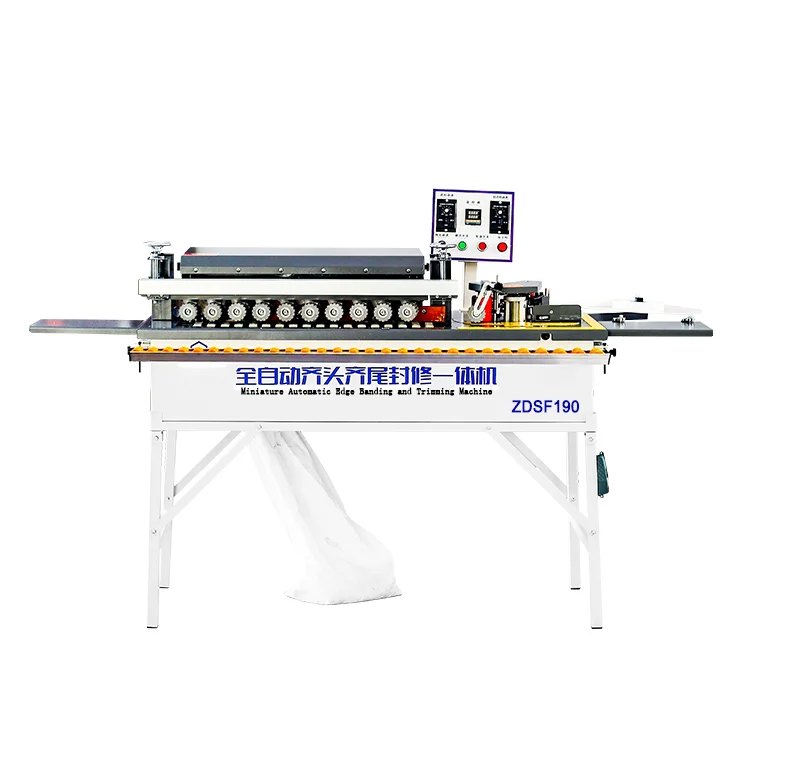
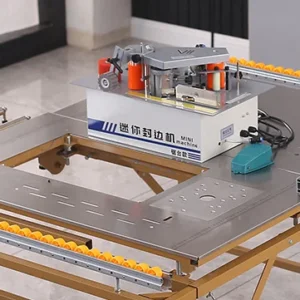
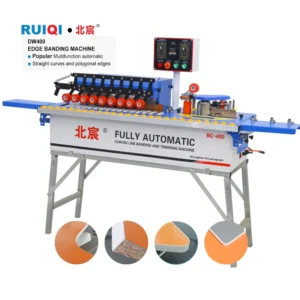
Precision Manufacturing for OEM Partners — The ZDSF190 curved and straight edge banding machine demonstrates factory depth through proprietary square slide rail mechanisms, imported 4-blade alloy cutters, and four-stage quality control designed for distributors evaluating manufacturing capability.
Technical Specifications
| Parameter |
Value |
| Model |
ZDSF190 |
| Product Type |
Curved and Straight Edge Banding Machine |
| Function |
Automatic plate feeding, automatic belt breaking, double-sided gluing, upper and lower trimming and polishing |
| Edge Type |
Both curved and straight lines |
| Voltage & Frequency |
220V 50Hz |
| Rated Power |
4kW |
| Feed Speed |
0-14 m/min |
| Sheet Thickness Range |
10-50 mm |
| Strip Thickness Range |
0.5-2.5 mm |
| Glue Capacity |
1000 ml |
| Rated Air Pressure |
0.4-0.6 MPa |
| Suction Power |
1200W |
| Transmission Type |
Crawler transmission with steel rod slide rails |
| Trimming Stations |
Upper and lower trimming with 4-edge arc-shaped alloy cutter head |
| Dust Extraction |
Large diameter surrounding vacuum, collection effect up to 99% |
| Overall Dimensions (L×W×H) |
1900 × 560 × 1300 mm |
| Net Weight |
105 kg |
| Control System |
Multi-function button operation panel |
| Warranty |
1 year |
Application Suitability
| Application |
Material or Output |
| Custom furniture panel edge banding |
MDF, plywood, particleboard with PVC edge banding |
| Cabinet door curved edge processing |
Solid wood panels and veneer edge banding materials |
| Joinery workshop production runs |
Small to medium batch furniture components requiring both curved and straight edges |
| Retail fixture manufacturing |
Laminated boards with decorative edge finishes |
Why Voltage Verification Matters Before Machine Arrival
Confirming local electrical standards prevents costly production delays and equipment damage.
I once shipped an edge bander without verifying the customer’s local voltage and frequency. The machine arrived, couldn’t power up, and the factory sat idle for three weeks waiting for a transformer. That experience changed how I approach every export order. Now I review electrical schematics against local grid conditions before production begins. Edge banding machine factory operations must account for regional voltage variations, frequency differences, and plug configurations that vary significantly across export markets [NEED_CITE: voltage and frequency standards by export market].
The ZDSF190 edge banding machine supports voltage customization from 110V to 440V, but this must be specified during the quotation phase, not discovered at the loading dock.

Component Sourcing and Manufacturing Transparency
The ZDSF190 demonstrates manufacturing depth through visible component choices that distributors can verify during factory visits. The square slide rail mechanism enables profiling and trimming in a single pass, reducing setup complexity for operators. Steel rod crawler transmission provides stable panel delivery even with large-format workpieces, while double-row rubber pressure wheels maintain consistent feed pressure across varying material thicknesses. These engineering decisions reflect deliberate choices about durability and precision rather than cost-minimization shortcuts.
Private Label and Specification Customization
OEM partners evaluating this edge banding machine factory capability can assess customization depth beyond simple logo application. Control panel language, voltage configuration, safety guarding, and documentation all adapt to regional market requirements. The four-stage quality control process—incoming material inspection, in-process verification, finished product testing, and pre-shipment validation—provides traceability that distributors need when standing behind equipment in their territory. Factory test records and photographic documentation accompany every shipment, giving OEM partners confidence when machines reach end users under their brand.
How Core Specifications Translate to Workshop Performance
The 0-14 m/min variable feed speed allows operators to adjust based on edge banding material and adhesive curing requirements. Thicker PVC strips or veneer materials often benefit from slower feed rates that allow proper glue penetration and bonding time. The 10-50 mm sheet thickness range accommodates everything from thin drawer sides to thick countertop panels, though operators must adjust the aluminum alloy pressure beam accordingly.
Upper and lower trimming stations with 4-edge arc-shaped alloy cutter heads produce clean, radius-profiled edges that eliminate secondary finishing operations. The 800W trimming power per station maintains consistent cutting performance across hardwoods and dense composite materials. Large diameter surrounding vacuum extraction captures trimming debris at the source, keeping the work area clear and preventing chip buildup that could affect subsequent panels [NEED_CITE: dust extraction requirements for woodworking machinery].
The 1000 ml glue capacity supports extended production runs without frequent refilling interruptions, though actual consumption depends on strip width and glue application settings.
The Cost of Skipping Factory Verification
Distributors who commit to regional partnerships without visiting manufacturing facilities often discover quality inconsistencies only after machines reach customers. Tolerance claims that sound impressive in specifications may not translate to verifiable edge quality on actual production panels. Glue line visibility, trimming precision, and feed stability all depend on assembly practices and quality control rigor that vary significantly between factories.
Machines quoted without confirming local electrical requirements create immediate installation problems. Control panels in unfamiliar languages stall commissioning while operators struggle with basic setup procedures. These issues compound when technical support depends on time zone differences and language barriers rather than local distributor capability [NEED_CITE: common causes of industrial equipment installation failures].
Manufacturing Capability You Can Verify
In-house production with patented cutting mechanisms means engineering changes and custom specifications don’t require third-party coordination. The four-stage QC process provides documented verification at each production milestone, not just final inspection. Factory visits allow distributors to observe assembly practices, test run machines with their own materials, and meet the engineering team who will support technical questions.
Voltage and language customization happens as standard practice, not as special requests that delay production. Pre-shipment testing with photographic documentation gives confidence before machines leave the factory floor. CE declaration and ISO 9001 certification provide baseline compliance, while factory test records demonstrate actual performance on specified materials.
Documentation & Verification
- CE declaration of conformity with machinery directive compliance verification
- ISO 9001 certificate covering quality management system for manufacturing processes
- Machine specification sheet with confirmed voltage and frequency for destination market
- Electrical schematic showing power requirements and control circuit details
- Factory test record on actual panel materials and edge banding thickness before dispatch
- Operation and maintenance manual in agreed language with spare parts identification
Installation, Commissioning & Support
- Requires 220V 50Hz dedicated circuit with proper grounding for 4kW total power consumption
- Crawler transmission system arrives partially assembled with assembly video guidance
- Steel rod slide rails require lubrication check before first operation
- Aluminum alloy pressure beam adjustment training for different sheet thickness ranges from 10-50 mm
- Multi-function button operation panel familiarization with language-specific labeling
- Large diameter vacuum extraction connection to workshop dust collection system with 1200W suction requirement
What We Need to Prepare Your Quotation
To provide accurate configuration recommendations, share your typical panel materials and thickness ranges, edge banding materials you plan to process, and daily production volume expectations. Specify your local voltage and frequency, preferred control panel language, and any regional safety or certification requirements. Let us know if you’d like to arrange sample processing tests with your actual materials or schedule a factory visit to observe production and quality control processes firsthand.
Frequently Asked Questions
Q: What OEM and private label customization options are available for the ZDSF190?
A: Customization extends beyond logo application to include control panel language, voltage configuration from 110V to 440V, safety guarding specifications, and documentation in your preferred language. Private label partners receive dedicated engineering support for specification adjustments that align with regional market requirements. Factory test records and pre-shipment verification documentation can be branded to your company standards.
Q: How is manufacturing quality verified before shipment?
A: The four-stage quality control process covers incoming material inspection, in-process assembly verification, finished product testing, and pre-shipment validation. Each ZDSF190 undergoes operational testing with actual panel materials and edge banding strips. Factory test records document trimming precision, feed stability, and glue application quality. Photographic documentation accompanies every shipment for your review before the machine leaves our facility.
Q: Can voltage, control panel language, and specifications be customized for my market?
A: Yes, voltage customization from 110V to 440V is standard practice, configured to match your local electrical grid specifications and frequency requirements. Control panel labeling and operation manuals translate to your preferred language to ensure operators can navigate settings confidently. Additional specification adjustments including safety features and dust extraction configurations adapt to regional standards and workshop environments.
Q: What spare parts supply and technical training support is offered to regional distributors?
A: Distributors receive comprehensive spare parts lists with identification numbers for quick reordering. Technical training covers machine assembly, common troubleshooting procedures, and maintenance schedules specific to the ZDSF190’s crawler transmission and trimming systems. Engineering support remains available for complex technical questions that arise during installation or operation in your territory.