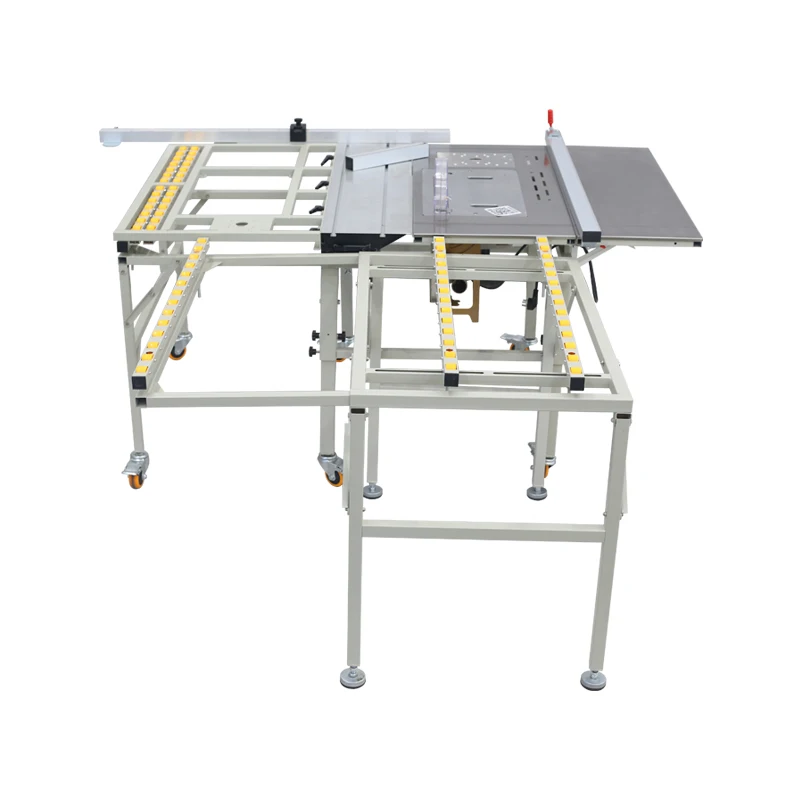
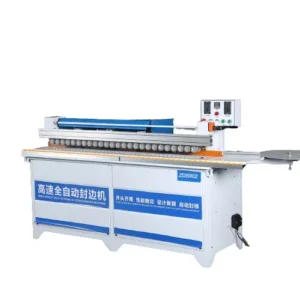
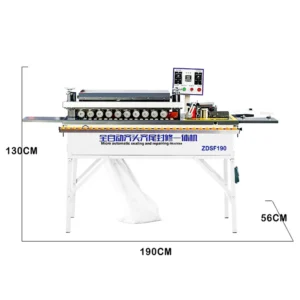
In-House Precision Grinding — every sliding table saw component is machined and verified on our own factory floor before assembly, giving OEM partners full traceability from raw casting to finished unit.
Technical Specifications
| Parameter |
Value |
| Model |
JT-550S |
| Product Type |
Sliding Table Saw |
| Blade Tilt Adjustment |
45° / 90° via aluminum alloy flip plate |
| Saw Configuration |
Integrated sub and master saw with aluminum alloy chip design |
| Motor Type |
Copper wire motor |
| Control System |
Independent switch |
| Dust Extraction |
Integrated dust absorption with protective cover |
| Extension |
Sliding roller extension bracket |
| Assembly State |
Fully assembled bench-type unit |
| Voltage & Frequency |
Customizable from 110V to 440V |
| Plug Options |
EU, USA, AU, UK |
| Language Options |
Chinese and English standard; other languages available |
| Standards |
CE, ISO 9001 |
Application Suitability
| Application |
Material or Output |
| Custom cabinet door sizing |
MDF and melamine-faced particleboard |
| Joinery workshop panel breakdown |
Plywood sheets up to standard thickness |
| Small-batch furniture components |
Solid wood panels and veneered board |
| Interior fit-out cutting |
Laminated chipboard and blockboard |
Why the Voltage Question Should Come Before the Price
Confirming destination voltage and frequency before production starts prevents the most expensive mistake in cross-border machinery trade.
A sliding table saw factory build means nothing if the motor burns out on first start-up because the local grid runs at 240V/50Hz while the machine was wired for 380V/50Hz. I watched this happen in East Africa — a distributor lost three weeks of production waiting for a step-down transformer that should have been specified at the order stage. Every JT-550S destined for export carries a voltage confirmation sheet matched to the buyer’s grid specification before the motor is wired [NEED_CITE: voltage and frequency standards by export market]. The copper wire motor is wound to the confirmed voltage, not a generic default.

Component Sourcing and Assembly Depth
Distributors evaluating a Sliding Table Saw OEM partner need to see beyond the nameplate. The JT-550S uses an integrated sub and master saw assembly where the aluminum alloy chip design is machined in-house rather than sourced as a complete third-party cartridge. This matters for private-label buyers because it means the cutting geometry and saw alignment are set on our own grinding equipment, and replacement parts remain available regardless of upstream supplier changes.
Precision Grinding and Tolerance Control
The 45° / 90° tilt mechanism relies on an aluminum alloy flip plate that holds both angles without manual recalibration between cuts. Achieving this requires the pivot bore and plate seating surface to be ground to a tight fit after heat treatment. When the flip plate is machined off-site, the assembler has no control over the contact surface finish, and angle drift appears within the first year of service [NEED_CITE: precision grinding standards for woodworking saw assemblies]. Our four-stage QC catches this at the in-process inspection point, before the saw head is mounted to the frame.
How the Specification Sheet Translates to Workshop Results
The integrated dust absorption with protective cover is not just a safety feature — it directly affects cut quality. Sawdust trapped between the sliding carriage and the guide rail creates micro-lift on the panel, producing a stepped edge that fails during edge banding downstream. The copper wire motor maintains consistent torque under continuous load, which matters when a workshop runs nested cuts on MDF for several hours. The sliding roller extension bracket expands the support surface so larger panels do not sag past the table edge, reducing the chipping that occurs when unsupported board vibrates at the cut line.
What Happens When OEM Customization Gets Skipped
A distributor who accepts a generic voltage and a Chinese-only control panel to save lead time will face returns from end-users who cannot commission the machine. Operators in non-Chinese-speaking markets stall at the independent switch labels, and service calls increase for issues that are actually language misunderstandings. Panels cut on a mis-wired motor run hotter, dulling blades faster and producing burn marks that the distributor’s customer blames on the saw itself [NEED_CITE: CE machinery directive requirements for industrial equipment]. These failures do not show up in the factory test — they appear six months into field use.
Why Distributors Source This Line Here
The JT-550S sits within a product family that ranges from entry-level bench saws to full-production sliding table saws, so a regional catalog can cover multiple market segments from one Sliding Table Saw factory. OEM branding is applied to the frame, control panel, and packaging — not just a sticker on the guard. Voltage, plug type, and language are confirmed on the quotation, not left to assumption. Pre-shipment test records include cut samples on the buyer’s specified panel material, so the distributor can show verifiable accuracy to end-users before the container ships. Factory visits are scheduled around the buyer’s itinerary, with live assembly line access.
Documentation & Verification
- CE declaration of conformity matched to the JT-550S configuration shipped
- Electrical schematic with confirmed voltage and wiring diagram for destination grid
- Factory test record showing cut samples on buyer-specified panel material
- Operation manual in the agreed language covering tilt plate adjustment and dust extraction setup
- Spare parts list with OEM part numbers for sub saw, master saw, and flip plate components
Installation, Commissioning & Support
- Bench-type unit arrives fully assembled; requires level floor and dedicated circuit matching confirmed voltage
- Independent switch panel labeled in agreed language for immediate operator familiarization
- Dust extraction port connected to workshop central system or standalone collector at commissioning
- Sliding roller extension bracket adjusted to panel sizes specified by the distributor’s end-user base
- Flip plate angle check performed on-site using calibrated square to verify transport integrity
What We Need From You to Quote Accurately
To configure a JT-550S for your market, we need your destination voltage and frequency, the plug standard your customers expect, and the language for the switch labels and manual. Tell us which panel materials your end-users cut most often so the pre-shipment test uses relevant stock. If you are building a regional catalog across multiple saw models, share your expected annual volume mix so we can align production scheduling.
Frequently Asked Questions
Q: How is cut tolerance verified before the JT-550S leaves the factory?
A: Each unit runs a test cut on panel material matching the buyer’s specification. The resulting samples are measured and photographed, and the record ships with the machine. The four-stage QC process includes an in-process check on the flip plate seating and a pre-shipment verification of both 45° and 90° cuts.
Q: What OEM customization is available on the JT-550S for distributors?
A: Distributors can specify their own logo on the frame and packaging, select voltage from 110V to 440V, choose plug type from EU, USA, AU, or UK standards, and request control panel labels and manuals in a local language beyond Chinese and English.
Q: Can I visit the factory or request a sample cut before placing a bulk order?
A: Factory visits are welcomed and can be scheduled around your travel plans. If a visit is not possible, we run a live sample processing test on your specified panel material and send the cut samples along with video documentation before you commit to volume.
Q: How are spare parts supplied to distributors for regional after-sales support?
A: The JT-550S spare parts list includes OEM-numbered components for the sub and master saw, flip plate, sliding carriage bearings, and motor brushes. Distributors stock a recommended kit based on regional service volume, and replenishment orders are fulfilled from factory inventory.
Q: What is the typical lead time for an OEM order versus a standard build?
A: Standard JT-550S builds ship from ready inventory when available. OEM orders with custom voltage, language, and branding follow a production schedule confirmed at quotation, typically requiring additional time for panel material sourcing and extended pre-shipment testing.