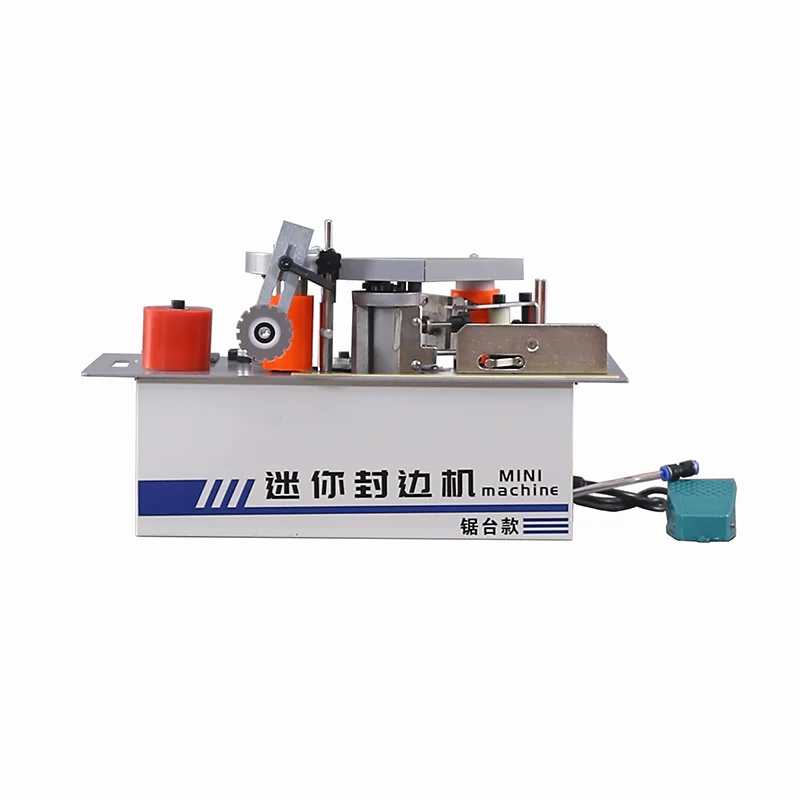
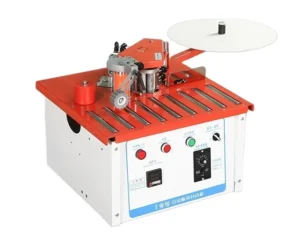
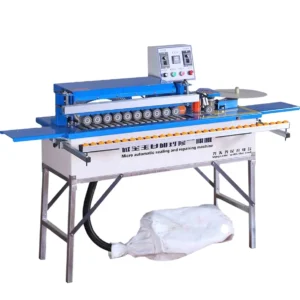
Precision-Built Components — Every portable edge banding machine leaves our Ningjin facility with proprietary cutting mechanisms and a factory test record matched to your voltage grid.
Technical Specifications
| Parameter |
Value |
| Product Type |
Portable Edge Banding Machine |
| Voltage |
220V (configurable from 110V to 440V) |
| Rated Power |
825W |
| Heating Time |
5–10 min |
| Air Pressure Requirement |
0.4–0.6 MPa |
| Glue Pot Capacity |
1000 ml |
| Edge Banding Speed |
0–10 m/min |
| Edge Pattern Capability |
Curves, straight lines, special-shaped lines |
| Overall Dimensions (L×W×H) |
50×30×27 cm |
| Net Weight |
13.5 kg |
| Control System |
Manual operation |
| Warranty |
1 year |
Application Suitability
| Application |
Material or Output |
| Small-batch cabinet production |
MDF, plywood, particleboard panels |
| Custom furniture repair and on-site banding |
Solid wood panels with curved or shaped edges |
| Joinery workshop short-run edge finishing |
PVC and veneer edge banding on straight and curved profiles |
| Mobile job-site trim and edge touch-up |
Pre-cut panels requiring fast, localized banding |
Why Voltage Confirmation Must Precede the Purchase Order
A portable edge banding machine is only as useful as the grid it plugs into.
I remember a shipment we sent to a workshop in Southeast Asia — a compact edge bander, crated and dispatched within days. When it arrived, the customer’s facility ran on a 220V single-phase supply, but the unit had been built for a 380V three-phase line. The machine sat on the dock for over two weeks while a step-down transformer was sourced locally. [NEED_CITE: voltage and frequency standards by export market] That delay cost the customer more than the transformer itself — it stalled commissioning, pushed back operator training, and eroded the trust we had worked to build. Since then, every order I handle starts with an electrical schematic review before anything enters production. For OEM partners and distributors stocking a portable edge banding machine factory inventory, confirming voltage at the quotation stage eliminates dockside surprises and keeps end-users running from day one.

Sourcing Depth That Distributors Can Verify
When you evaluate a portable edge banding machine factory, the question is not just what the machine does on the bench — it is whether the manufacturing process behind it can be traced and validated. Our facility runs a four-stage QC protocol: incoming material inspection, in-process checks during assembly, finished-product functional testing, and pre-shipment verification with photographic evidence. Each unit is tested under the voltage and frequency conditions specified for its destination market. Distributors receive the factory test record alongside the shipment, providing a documented chain of custody from the assembly floor in Ningjin to the customer’s workshop.
OEM and Private-Label Readiness for Regional Markets
Private-label distribution requires more than printing a logo on a nameplate. The customization extends to control panel language, packaging format, plug type, and documentation language — all configured before the unit enters the production queue. [NEED_CITE: CE machinery directive requirements for industrial equipment] For a regional distributor adding a compact edge bander to an existing woodworking catalog, this means the machine arrives ready for the end-user without additional rework. Voltage adaptation from 110V to 440V is treated as a standard configuration step, not an afterthought. The result is a portable edge banding machine that fits the local market from the moment the crate is opened.
Reading the Specs That Matter in the Field
The 825W rated power reflects what the unit draws under sustained banding conditions, covering both the glue pot heater and the feed mechanism simultaneously. In practice, this means the machine can run from a standard single-phase workshop outlet without requiring a dedicated high-current circuit — an important consideration for small joinery shops and mobile job-site setups where power availability is limited. The 0–10 m/min banding speed range gives operators control over feed pace when working curves and special-shaped profiles, where pushing too fast causes the banding to lift at the radius. The 1000 ml glue pot capacity supports sustained runs on small to medium panel batches without frequent refills, reducing interruptions during a production session. The 0.4–0.6 MPa air pressure range aligns with standard workshop compressor output, so no auxiliary boosting equipment is needed.
The Hidden Cost of Skipping Configuration Alignment
A portable bander that arrives with the wrong plug type or an unreadable control panel label does not just delay one job — it damages the distributor’s reputation with the end-user. [NEED_CITE: common causes of commissioning delays in imported woodworking machinery] When a small workshop buys a machine based on catalog specifications that were never matched to their actual site conditions, the fault is rarely blamed on the buyer’s oversight. The distributor absorbs the complaint. Machines specified without confirming panel thickness compatibility or edge banding material type can also underperform on the substrates the customer actually processes, leading to visible glue lines and callbacks.
What Manufacturing Accountability Looks Like Here
Our in-house machining capability covers the core components of the banding mechanism, meaning replacement parts are produced on the same equipment as the original assembly rather than outsourced to a secondary supplier. The four-stage QC process generates a test record for every unit — not a batch sample — and pre-shipment photographs document the machine in running condition before crating. Voltage confirmation is completed at the quotation stage, documented in the electrical schematic, and verified again during the pre-shipment test. For OEM partners, this means the machine carrying your brand name has been validated to the same standard as our own branded units.
Documentation & Verification
- CE declaration of conformity covering electrical safety and machinery directives for this portable unit
- Factory test record showing glue heating cycle and banding run at your specified voltage
- Electrical schematic with voltage and plug-type confirmation locked before production starts
- Operation and maintenance manual supplied in the language your end-users read
- Pre-shipment verification photographs of the unit running under test conditions
Installation, Commissioning & Support
- 220V single-phase power connection with a standard 10A circuit breaker, matching the 825W rated draw
- Compact 50×30×27 cm footprint allows benchtop placement in workshops with limited floor area
- Partially assembled on arrival; glue pot and feed mechanism require final mounting per the manual
- 5–10 minute heating cycle before first banding pass; temperature verified with test piece
- 0.4–0.6 MPa compressed air connection via standard quick-release fitting from shop compressor
- One-year warranty covering manufacturing defects on all mechanical and electrical components
Preparing a Configuration Brief for Quotation
To ensure the portable edge banding machine is built for your market, we need the destination voltage and frequency, the plug standard in your territory, and the language required for the operation manual. If you are an OEM or distributor, include your branding specifications and packaging format preferences. For sample processing tests, send us representative panel offcuts and the edge banding material you plan to stock, so we can verify adhesion and feed behavior before the production run begins.
Frequently Asked Questions
Q: What OEM and private-label customization is available for this portable edge bander?
A: We configure custom logo placement, packaging design, plug type, and control panel language to match your market. Voltage is adapted from 110V to 440V as a standard step, not a special request. Every customization detail is documented in the quotation and confirmed before production begins.
Q: How do you confirm voltage and frequency before the machine ships?
A: We request your local voltage, frequency, and plug standard at the inquiry stage. An electrical schematic is prepared and sent for your approval before assembly. The unit is then tested at the confirmed voltage during the pre-shipment verification run.
Q: Can distributors verify the factory QC process before placing a bulk order?
A: Yes. We provide factory test records, pre-shipment photographs, and CE and ISO 9001 documentation with each order. Distributors are also welcome to arrange a factory visit to observe the four-stage QC process and assembly line directly.
Q: What spare parts are included and how are reorders handled?
A: Each shipment includes a spare parts list covering wear items specific to the portable edge bander. Distributors can reorder parts by referencing the part numbers in the manual. We maintain production capability for replacement components in-house to support ongoing availability.
Q: Can we send panel samples for a test run before committing to a production order?
A: Yes. Send us the panel materials and edge banding stock you plan to offer in your market. We run a processing test on the portable unit at your specified voltage, then share the results and photographs before you finalize the order.