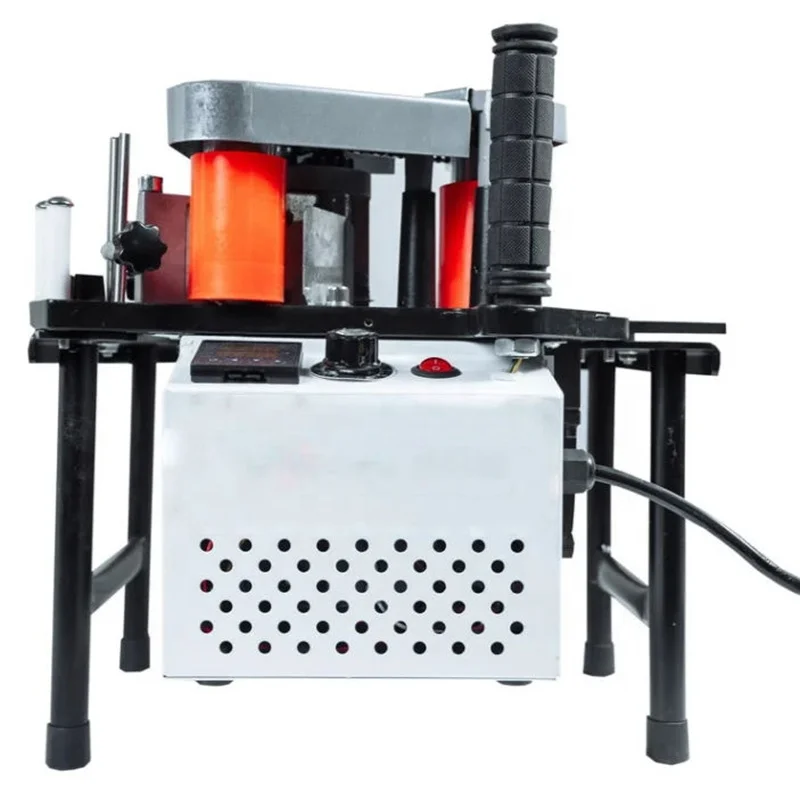
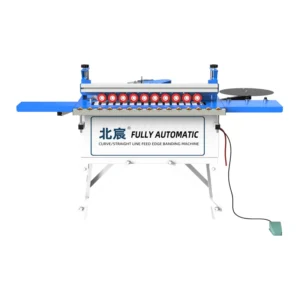
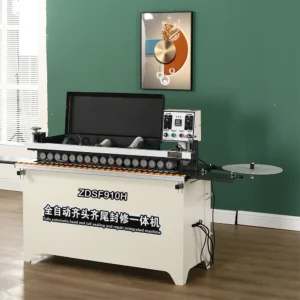
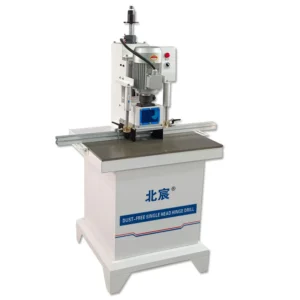
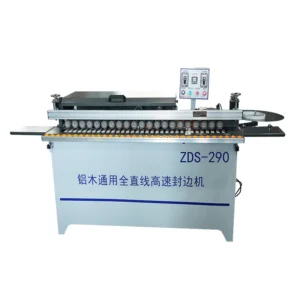
Precision Assembly & Verified Tolerance — Our portable edge bander undergoes the same four-stage QC protocol as our industrial lineup, with pre-shipment electrical testing ensuring every unit meets its destination market’s voltage requirements before it leaves the factory floor.
Technical Specifications
| Parameter |
Value |
| Product Type |
Portable Edge Banding Machine |
| Shape of Edge-banding Plates |
Curved, straight and special-shaped sheet |
| Edge Thickness Range |
0.3–3 mm |
| Edge Sealing Speed |
0–6 m/min |
| Panel Thickness Range |
7–60 mm |
| Gluing Method |
Double-sided gluing |
| Glue Pot Volume |
1000 ml |
| Machine Weight |
14 kg |
| Feed Speed |
0–6 m/min |
| Voltage & Frequency |
Configurable per destination market (basis not stated in source — confirm local voltage/frequency before order) |
| Rated Power |
To be confirmed per voltage configuration |
| Warranty |
1 year |
Application Suitability
| Application |
Material or Output |
| Small workshop edge banding |
MDF, particleboard and plywood panels |
| On-site joinery and installation work |
Solid wood panels requiring curved edge profiles |
| Repair and rework of damaged edges |
PVC and melamine edge banding strips 0.3–3 mm |
| Low-volume custom furniture production |
Veneer banding on special-shaped cabinet components |
| Prototype and sample fabrication |
Mixed substrates where full-size automatic edge bander is not justified |
Why Voltage Confirmation Must Happen Before the Portable Edge Banding Machine Ships
Every electrical specification is verified against the destination country’s grid standard before production begins, not after the crate arrives.
I still remember the call from a Middle East buyer two years ago. A compact edge bander — much smaller than this 14 kg portable model — arrived at their workshop completely dead. The local supply was 220V/60Hz, but the machine had been built for 380V/50Hz. They spent weeks sourcing a step-up transformer while their production schedule fell apart. That failure had nothing to do with the machine itself and everything to do with a skipped conversation. Since then, I have treated voltage confirmation as the first step of every order, whether it is a full production line or a portable unit [NEED_CITE: voltage and frequency standards by export market].

How We Build OEM and Private-Label Portable Edge Banders
Distributors and regional importers evaluating a portable edge banding machine need more than a catalog listing. They need a manufacturing partner who can apply a private label, configure plug types for EU, AU, UK, USA, or CN markets, and translate operation manuals into the language the end-user actually speaks. Our in-house assembly line handles these variations as standard production options, not as afterthoughts.
Manufacturing Depth Behind a Compact Machine
What separates a factory-built portable edge bander from a trading company resell is traceable assembly. Each unit passes through incoming material inspection, in-process assembly checks, finished product testing, and pre-shipment verification. The double-sided gluing mechanism is calibrated during assembly, and the 1000 ml glue pot is pressure-tested before the machine is packed [NEED_CITE: CE machinery directive requirements for industrial equipment]. Distributors who visit our facility see the same precision grinding stations and QC checkpoints that service our full-size industrial range.
Reading the Specs That Actually Matter in the Workshop
The 0.3–3 mm edge thickness range determines which banding materials the portable edge banding machine can handle in practice. Below 0.3 mm, thin veneer strips tend to fracture under feed pressure; above 3 mm, the glue penetration depth becomes insufficient for reliable adhesion on MDF substrates. The 7–60 mm panel thickness range covers standard cabinet board and thicker worktop materials, though operators should note that feed stability decreases at the upper limit on curved profiles. Double-sided gluing applies adhesive to both the panel edge and the banding strip simultaneously, which produces a more consistent bond line than single-sided application on porous substrates like particleboard. The 0–6 m/min feed speed is variable, letting operators slow down for tight curves and accelerate on long straight runs without compromising glue transfer [NEED_CITE: edge banding adhesion standards for wood-based panels].
The Hidden Cost of Skipping Configuration Verification
When a distributor orders portable machines without confirming the plug type and voltage for their territory, the consequences compound quickly. End-users receive equipment they cannot power on, support tickets pile up, and the distributor’s service team spends time on electrical troubleshooting instead of building customer relationships. I have seen regional importers lose entire selling seasons because a batch of machines sat in warehouses waiting for adapter solutions. A ten-minute specification conversation before the purchase order eliminates this entirely [NEED_CITE: common import equipment commissioning failures].
What Manufacturing Traceability Means for Your Order
Our in-house production means every portable edge banding machine is assembled by technicians who also build our industrial pre-milling models — the same hands, the same calibration standards. Four-stage QC runs from incoming material inspection through pre-shipment verification, documented with photographs you receive before the crate is sealed. OEM branding, custom packaging, and multilingual manuals are integrated into the production schedule rather than added externally. Engineer-led configuration ensures the voltage, plug type, and documentation match your market before metal is cut. Factory visits are open to any buyer who wants to verify these claims in person.
Documentation & Verification
- Electrical schematic confirming voltage and frequency for your specific market before production
- Factory test record photographing the glue pot heating cycle and feed motor operation on your panel thickness
- Operation and maintenance manual translated into the language your end-users read
- Spare parts list with part numbers matching the unit serial number shipped
- Packing photographs showing the machine secured and accessories counted before crate closure
- Customs documentation support including HS code and certificate of origin preparation
Installation, Commissioning & Support
- Compact 440×410×450 mm package requires no special rigging — standard pallet delivery to workshop door
- Single-phase power connection per confirmed voltage; dedicated circuit recommended for glue pot heating element
- Arrives fully assembled; operator mounts the glue pot and loads banding material before first run
- Initial calibration of feed speed and glue temperature conducted via phone or video with our technical team
- One-year warranty covers feed motor, glue pot assembly, and control components
- Consumable spare parts including glue pot seals and feed rollers available for reorder with territory-specific plug configurations
What to Include in Your Inquiry
To configure a portable edge banding machine that arrives ready for your market, share your target country’s voltage and frequency standard, the plug type your end-users expect, and the primary banding materials they work with — PVC, melamine, or veneer. If you are a distributor building a product range, let us know your territory and whether you need OEM branding, custom packaging, or a mixed order across our machine lineup. Sample processing tests can be arranged before bulk commitment.
Frequently Asked Questions
Q: What does the OEM and private-label scope include for this portable edge bander?
A: We apply your logo to the machine body and packaging, produce manuals in your chosen language, configure plug types for your market, and customize the carton design. Each of these is confirmed in writing before production starts, and samples of branded elements are provided for approval.
Q: How do you confirm voltage and frequency before the machine is built?
A: During the quotation stage, we request your destination country and city. Our engineer cross-references local grid standards, confirms the specification with you in writing, and locks it into the production order. The electrical schematic reflecting that configuration is included in your documentation package.
Q: What QC stages does the portable model go through at the factory?
A: The same four stages as our industrial machines: incoming material inspection, in-process assembly checks, finished product functional testing, and pre-shipment verification with photographic records. The glue pot heating cycle and feed motor are tested under load before packing.
Q: Can I source this portable edge bander alongside other machines for my distributor territory?
A: Yes. We configure mixed orders across our portable, entry-level, and full-function edge bander ranges under a single production schedule. Each model is matched to the production volume segment it serves in your market, and spare parts are consolidated per territory.
Q: What spare parts backup and training are available for my service team?
A: We supply a spare parts list mapped to your order’s serial numbers, offer remote technical training via video for your service staff, and maintain stock of consumable components like glue pot seals and feed rollers for reorder. On-site training at our factory is available for distributor teams.