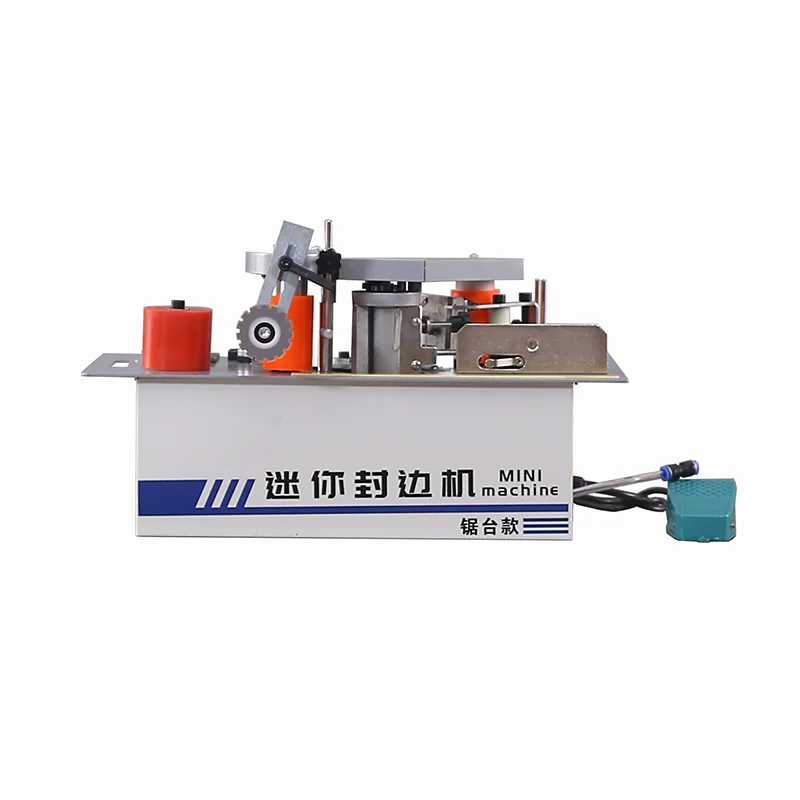
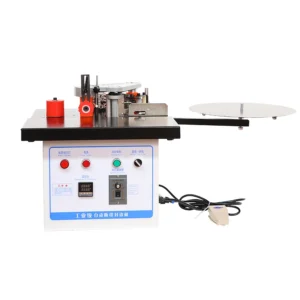
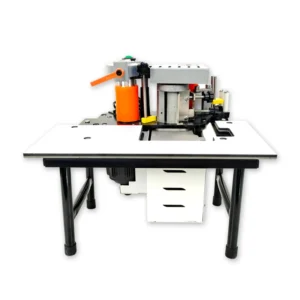
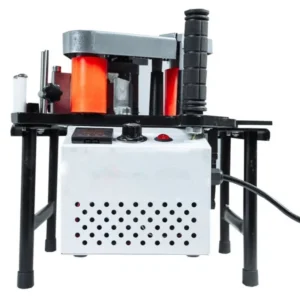
Voltage-First Engineering — every portable edge bander ships with an electrical schematic matched to your grid before a single component is assembled.
Technical Specifications
| Parameter |
Value |
| Product Type |
Portable Automatic Edge Banding Machine |
| Voltage |
220V (configurable from 110V to 440V based on buyer market) |
| Rated Power |
825 W |
| Heating Time |
5–10 min |
| Air Pressure |
0.4–0.6 MPa |
| Glue Pot Capacity |
1000 ml |
| Edge Banding Speed |
0–10 m/min |
| Feed Speed |
0–10 m/min |
| Edge Pattern |
Curves, straight lines, special shaped profiles |
| Trimming Stations |
Corner trimming |
| Overall Size |
50 × 30 × 27 cm |
| Warranty |
One year |
Application Suitability
| Application |
Material or Output |
| Furniture panel edge banding |
MDF, particleboard, plywood with PVC or veneer edge banding |
| Curved and shaped panel edging |
Radius cuts on cabinet doors and contoured shelving |
| Small-batch joinery production |
Solid wood panels and melamine-faced boards |
| On-site corner trimming |
Installed cabinetry and field-fitted countertops |
Why the Voltage Question Must Come Before the Price
A portable edge banding machine factory that does not confirm your grid before quoting is building for a warehouse, not your workshop.
I have watched entire commissioning schedules collapse because a portable edge bander arrived wired for 380V three-phase into a single-phase 220V shop. The rewiring took weeks, and the production line sat idle while electricians sorted it out. Confirming voltage, phase, and frequency at the quotation stage is not paperwork — it is the difference between plugging in on day one and halting production before it starts. [NEED_CITE: voltage and frequency standards by export market]

Component Sourcing That Matches the Spec Sheet
The components inside a portable edge banding machine factory build are only as reliable as the incoming inspection behind them. Our four-stage QC process begins at the receiving dock: motors are bench-tested for amperage draw, heating elements are verified against the rated 825 W, and pneumatic fittings are pressure-checked beyond the 0.6 MPa operating ceiling. This matters because a portable edge bander works in varied environments — from humid coastal workshops to dry, dusty panel shops — and component tolerance drift shows up first on curved edge runs where feed consistency is hardest to maintain.
OEM and Private-Label Readiness
Distributors evaluating a portable edge banding machine factory need to see past the sample unit on the showroom floor. We support full private-label builds: custom logo placement on the housing, multilingual control panel overlays, and electrical schematics printed in the destination market’s language. A regional reseller stocking portable edge banders for local furniture makers needs documentation their customers can actually read, and that starts with operation manuals translated before the crate leaves the loading bay. [NEED_CITE: CE machinery directive requirements for industrial equipment]
What the Numbers on the Spec Sheet Actually Mean
The 1000 ml glue pot capacity is sized for sustained small-batch runs — enough adhesive to edge-band a full stack of cabinet panels without stopping for a refill, yet small enough that the 5–10 minute heating cycle brings the entire volume to working temperature quickly. The 0–10 m/min feed speed range matters most on curves: slowing the feed to 2–3 m/min on tight radii gives the glue adequate open time before the banding sets, while straight runs can push toward the upper limit. Air pressure at 0.4–0.6 MPa drives the pressure rollers that seat PVC and veneer banding into the adhesive layer, and any drop below that range shows up as visible glue lines on particleboard edges. The corner trimming station handles the end cuts that a straight-line bander cannot, which is why this portable automatic edge banding machine is specified for shaped furniture components rather than flat panel-only production.
The Hidden Cost of Skipping Configuration
A portable edge bander bought on price alone often reveals its real cost on the second day of production. PVC banding on particleboard demands different glue pot temperatures and roller pressures than veneer on solid wood, and a machine configured for one material will struggle on the other. I have seen workshops buy a second unit within months because the first could not hold tolerance on curves. The downtime, wasted banding stock, and rejected panels add up fast. [NEED_CITE: material-specific edge banding tolerance requirements]
Why Source This Machine Here
Patented cutting mechanisms hold edge trimming tolerance on both straight and curved profiles, verified through pre-shipment test runs on the buyer’s specified panel material. Voltage and frequency are locked in at quotation, not after production starts, so the machine arrives ready to connect. Four-stage QC covers incoming materials through final dispatch, with factory test records included in the shipping documentation. OEM partners receive full branding support — logo, panel graphics, and translated controls — built into the production run rather than added afterward. The entire product family, from entry-level to full-function banders, comes from one facility, so a distributor can expand the range without qualifying a second factory.
Documentation & Verification
- Factory test record run on your specified panel thickness and edge banding material before dispatch
- Electrical schematic confirming voltage, phase, and frequency matched to your local grid
- CE declaration of conformity and ISO 9001 certificate included with shipping documents
- Operation and maintenance manual supplied in the buyer’s agreed language
- Packing photographs documenting machine condition at the point of crating
Installation, Commissioning & Support
- 825 W rated power requires a dedicated 220V circuit; confirm amperage at your panel before delivery
- Compact 50 × 30 × 27 cm footprint fits a standard workbench — no floor anchoring required
- Pneumatic supply must deliver stable 0.4–0.6 MPa; install a regulator and filter upstream
- Glue pot first heat cycle should run 10 minutes minimum before feeding banding material
- Corner trimming station alignment checked at factory; verify with a test piece on arrival
- Spare wear parts list included covering pressure rollers, trimming blades, and heating elements
What We Need to Quote Accurately
Provide the panel materials and thickness range you plan to edge-band, along with the type of banding stock — PVC, ABS, or veneer. Confirm your workshop voltage, phase, and frequency so the electrical build matches your supply. If you are a distributor planning a batch order, let us know any branding or documentation requirements for your market.
Frequently Asked Questions
Q: What customization is available for OEM and private-label orders?
A: We configure custom logos on the machine housing, multilingual control panel labels, voltage settings from 110V to 440V, and operation manuals in your target market language. Specification tailoring covers glue pot capacity, trimming station additions, and feed speed calibration to match the panel materials your customers process most frequently.
Q: How do you prevent voltage mismatches before shipping?
A: Voltage, phase, and frequency are confirmed in writing before production begins. The electrical schematic reflecting your exact grid specification is reviewed and approved, then built into the machine. A pre-shipment test runs the unit at the confirmed voltage to verify heating cycle and motor performance under real conditions.
Q: Can this portable bander handle both curved and straight edge work?
A: Yes. The feed speed range from 0–10 m/min allows operators to slow down for tight curves and increase speed on straight runs. The corner trimming station handles end cuts on shaped profiles. Glue pot temperature and roller pressure should be adjusted based on the banding material and panel substrate.
Q: What spare parts support is available for distributors?
A: Each unit ships with a spare parts list covering high-wear items including trimming blades, pressure rollers, and heating elements. Distributors receive technical training materials so their local service teams can perform routine maintenance and component replacement without returning the machine to the factory.
Q: What is the typical lead time for a batch OEM order?
A: Lead time depends on order quantity and the scope of customization required. Standard voltage configurations with logo and manual translation follow typical multi-week production schedules. We provide a confirmed dispatch date at the quotation stage, and progress updates are shared through each QC milestone.