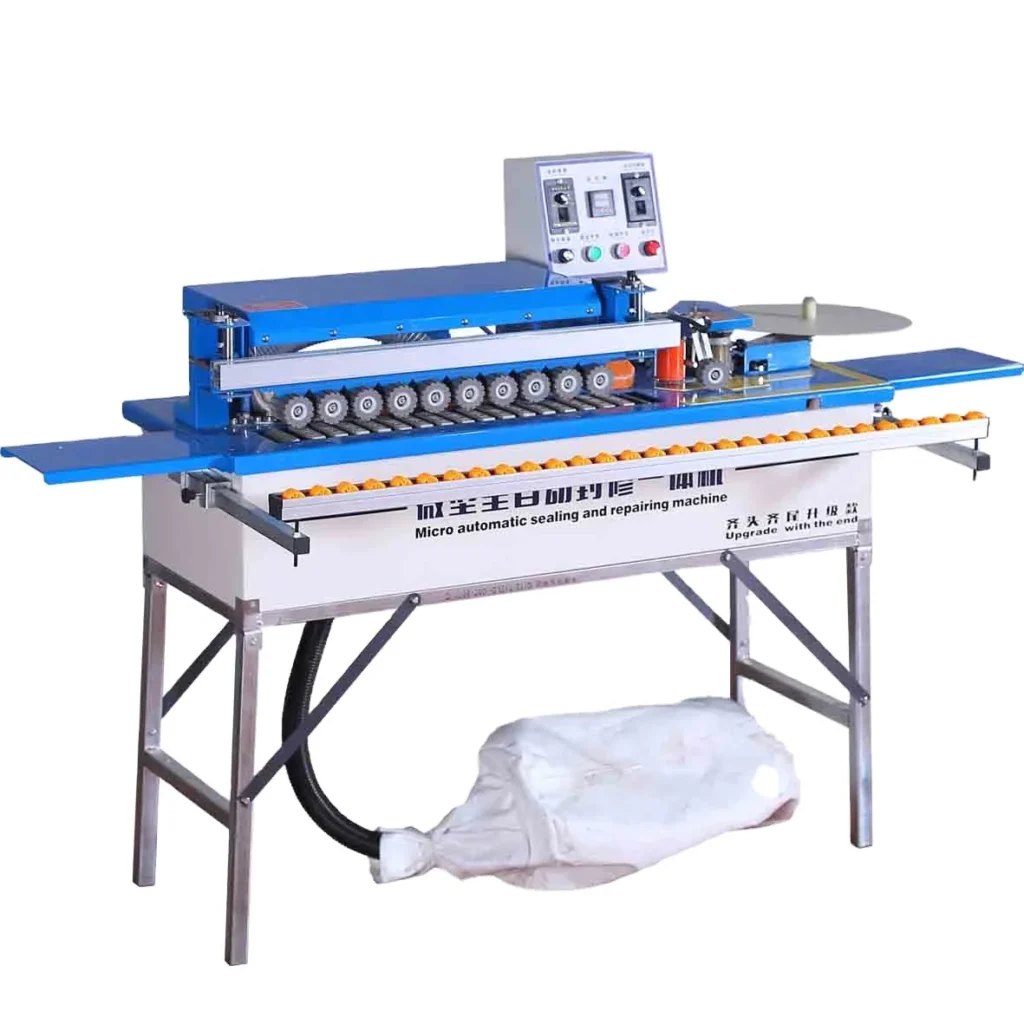
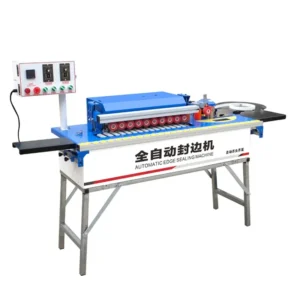
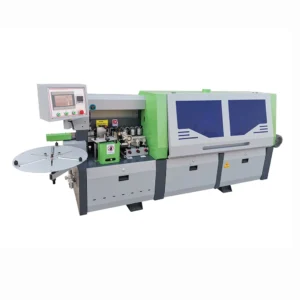
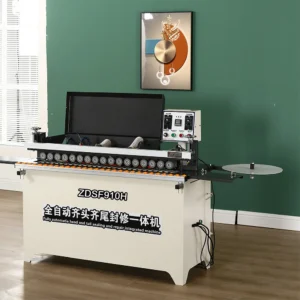
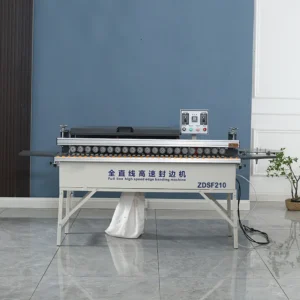
Four-Stage Quality Verification — every edge bander undergoes incoming material, in-process, finished product, and pre-shipment inspection before leaving the Ningjin facility.
Technical Specifications
| Parameter |
Value |
| Product Type |
Automatic Edge Bander Machine |
| Voltage |
220V (configurable from 110V to 440V) |
| Suction Power |
1200W |
| Transmission Power |
60W |
| Belt Power |
25W |
| Polishing Power |
180W × 2 |
| Trimming Power |
800W × 2 |
| Conveying Speed |
0–15 m/min |
| Edging Speed |
0–6 m/min |
| Edge Height Range |
10–60 mm |
| Edge Thickness Range |
0.6–2 mm |
| Gluing Method |
Double-sided adhesive application |
| Gluing Device Rotation |
180° for curved edge banding |
| Board Feeding |
Automatic, double-row rubber pressure wheels |
| Control Panel |
Individual function control, separate switches |
| Dust Extraction |
Integrated vacuuming system at trimming stations |
| Trimming Stations |
Up and down trimming with dust suction |
| Polishing Stations |
Up and down cross polishing |
Application Suitability
| Application |
Material or Output |
| Custom furniture panel edging |
MDF, particleboard, plywood with PVC or veneer banding |
| Cabinet door and carcass production |
Solid wood panels with curved or straight edge profiles |
| Small-batch joinery and prototyping |
Mixed substrate runs requiring frequent banding changes |
| Workshop-scale edge finishing |
Low-to-medium volume production with dual-purpose straight and curved capability |
Why the Voltage Question Must Come Before the Machine Selection
Specifying local voltage and frequency at the inquiry stage prevents costly commissioning failures at the installation site.
Distributors who have sourced woodworking equipment from multiple suppliers know the pattern: a machine arrives at a regional warehouse, gets forwarded to a customer, and then sits idle because the motor was wound for a grid that does not match the local supply. The Edge Bander Machine factory OEM conversation should always begin with the destination market’s electrical standards. When voltage adaptation is treated as an afterthought rather than a configuration parameter, the downstream cost of rewinding motors or replacing control transformers quickly erases any margin advantage gained during negotiation [NEED_CITE: voltage and frequency standards by export market].

Manufacturing Depth Behind Private-Label Edge Banders
When a regional distributor evaluates an Edge Bander Machine factory OEM partner, the question is not simply whether a logo can be printed on the side panel. The real assessment concerns component sourcing transparency and whether the factory controls its own precision grinding operations. This edge bander is built from the frame up within a single facility, meaning that a distributor requesting modified feed wheel geometry or a different polishing motor specification can negotiate directly with the production floor rather than through a trading intermediary.
Four-Stage Quality Control as a Distributor Selling Point
Distributors face warranty claims that originate from assembly inconsistencies they never witnessed. The four-stage QC process on this edge bander — incoming material inspection, in-process dimensional checks, finished product functional testing, and pre-shipment verification — generates a documented trail that a distributor can present to their own customers. Each stage produces a record that travels with the machine, giving the regional partner a defensible quality narrative rather than an unsupported claim [NEED_CITE: ISO 9001 quality management documentation requirements].
How Trimming and Polishing Stations Affect Edge Finish Quality
The dual 800W trimming motors handle both up-cut and down-cut operations in a single pass, which determines whether the PVC or veneer banding leaves a clean edge or requires secondary hand-trimming. For workshops processing particleboard with visible core layers, the trimming station’s precision directly dictates whether the finished panel is acceptable for visible cabinet surfaces or gets downgraded to internal carcass use. The two 180W cross-polishing motors then address the micro-surface left by trimming, bringing the edge band flush and smooth without a separate buffing step. The 180° gluing device rotation extends the machine’s capability from flat panel runs to curved profile work, meaning a distributor stocking this platform can serve both straight-line cabinet producers and custom furniture workshops that shape curved components.
The Hidden Cost of Specifying the Wrong Feed Mechanism
When feed wheels cannot maintain consistent pressure across a warped particleboard sheet, the panel drifts during trimming and the edge band ends up offset from the panel face. Workshops then spend labor hours hand-correcting edges that should have been finished by the machine. The double-row rubber pressure wheels on this edge bander are designed to maintain grip across minor substrate irregularities, but if a distributor sources a cheaper alternative with single-row steel wheels, the consequence surfaces as customer complaints about edge alignment rather than as a machine failure that triggers a warranty claim [NEED_CITE: woodworking machinery feed mechanism comparison standards].
Why Regional Distributors Source From This Facility
In-house patented cutting mechanisms mean that the trimming precision is controlled by proprietary tooling rather than generic off-the-shelf components that any competitor can replicate. The voltage adaptation range from 110V to 440V allows a single product platform to cover markets from Southeast Asian 220V grids to South American 440V industrial supplies without maintaining separate model inventories. Multilingual control panel options eliminate the commissioning delay that occurs when a local operator cannot read the machine interface. The factory welcomes distributor visits to inspect precision grinding operations and assembly lines before committing to volume orders, providing the transparency that trading companies cannot offer. Private-label packaging, custom logos, and specification tailoring are available from single-unit sample orders through to container-load production runs.
Documentation & Verification
- CE declaration of conformity matched to the edge bander’s electrical and mechanical configuration
- ISO 9001 certificate covering the manufacturing process for this product family
- Electrical schematic confirming voltage, frequency, and circuit protection for the destination market
- Factory test record documenting trimming tolerance and feed stability on your specified panel thickness
- Operation and maintenance manual translated into the operator’s working language
- Spare parts list with OEM part numbers for local inventory planning
Installation, Commissioning & Support
- Dedicated 220V circuit with appropriate breaker rating to handle the combined 1200W suction and trimming motor loads
- Level concrete floor with sufficient clearance around the 120×54×72cm footprint for panel infeed and operator access
- Machine ships partially assembled; feed wheel alignment and trimming station calibration completed during on-site commissioning
- First-run parameter setting includes feed speed adjustment and trimming depth calibration on your actual panel stock
- Double-row rubber pressure wheels inspected and tension adjusted during initial operator training session
- Dust extraction port connected to workshop central system or standalone collector using the integrated 1200W vacuum unit
Preparing Your Specification Inquiry
When requesting a quotation for OEM or private-label volume, include the destination market voltage and frequency, the control panel language requirement, and the edge banding materials your customers most commonly process. Specify whether your market requires curved-edge capability, as the 180° gluing device rotation is a configuration option that affects lead time. Providing your target panel thickness range allows the factory to pre-set trimming station parameters and include a matching test record with the shipment documentation.
Frequently Asked Questions
Q: What OEM customization is available for private-label distributors?
A: Logo placement on the machine body, private-label packaging, voltage adaptation from 110V to 440V, and multilingual control panels are all configurable. Customization applies from single-unit sample orders through full container production runs, with packaging designed to meet the distributor’s brand guidelines and retail presentation requirements.
Q: How does the four-stage QC process work for each machine?
A: Incoming material inspection verifies component specifications before assembly begins. In-process checks confirm dimensional accuracy during build. Finished product testing runs the edge bander under load with actual panel stock. Pre-shipment verification documents trimming tolerance, feed stability, and electrical safety before crating.
Q: Can distributors visit the factory before placing volume orders?
A: Factory visits are welcomed and encouraged. Distributors can inspect precision grinding operations, component sourcing records, assembly line practices, and test-run facilities. The visit typically includes a live demonstration using the distributor’s specified panel material and edge banding type.
Q: What certifications and documentation ship with each machine?
A: Each unit ships with a CE declaration of conformity, ISO 9001 manufacturing certificate, electrical schematic matched to the ordered voltage, factory test record, translated operation manual, and itemized spare parts list. Additional documentation for specific import market requirements can be arranged during the quotation stage.
Q: How does the spare parts supply chain support regional distributors?
A: The factory maintains an inventory of wear components including trimming blades, feed wheels, and polishing pads. Distributors receive technical training materials covering common service procedures, enabling their local teams to handle routine maintenance and parts replacement without factory technician dispatch.