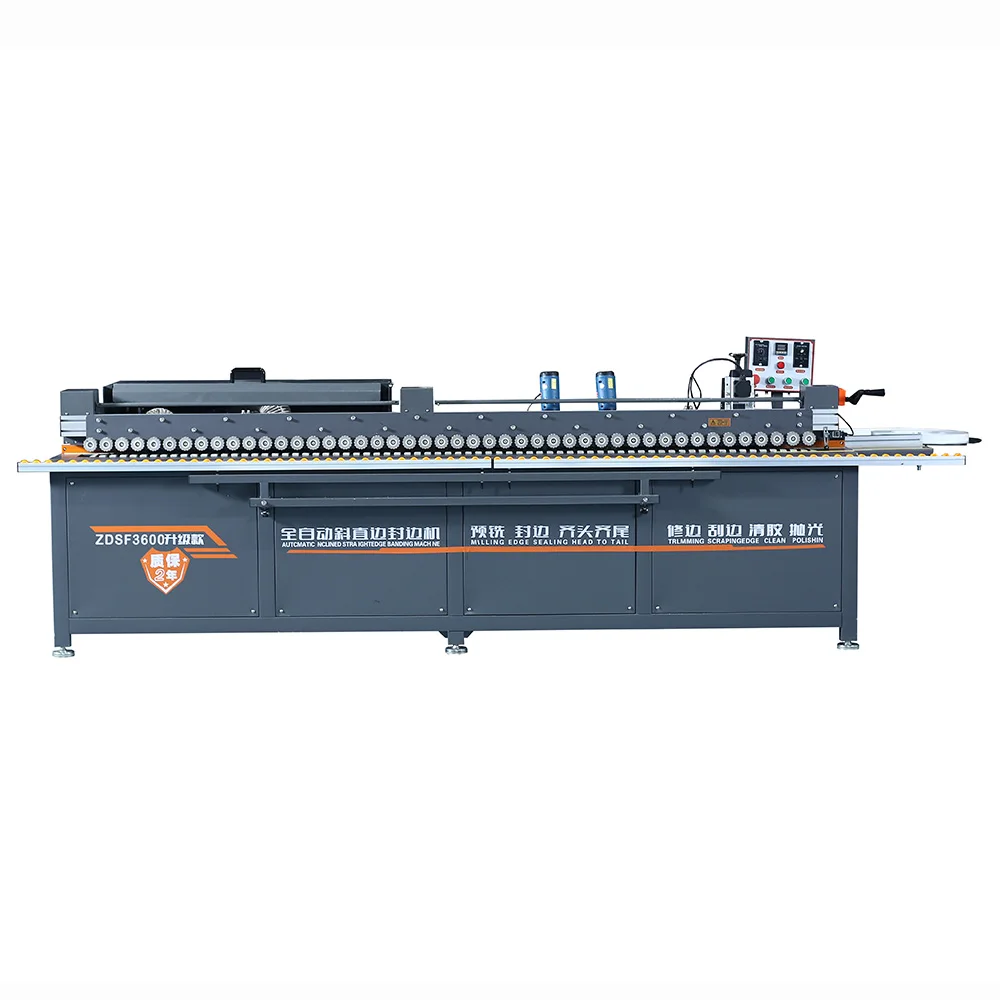
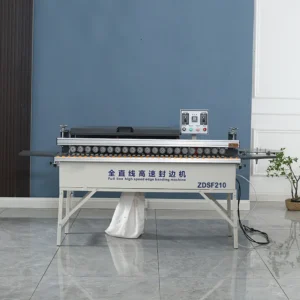
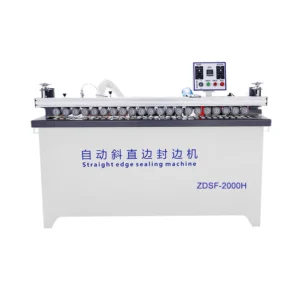
OEM Configuration Depth — Every ZDS-3600 bevel-straight edge bander is validated against target-market voltage and frequency before the first component enters the assembly line, ensuring arriving equipment powers up on day one.
Technical Specifications
| Parameter |
Value |
| Model |
ZDS-3600 |
| Product Type |
Full Auto Bevel-Straight Edge Banding Machine |
| Edge Speed |
0–12 m/min |
| Edge Banding Sheet Thickness |
18–45 mm |
| Bevel Angle Range |
30°–90° |
| Voltage |
380 V |
| Rated Power |
8.9 kW |
| Working Pressure |
0.5–0.7 MPa |
| Glue Pot Capacity |
4000 ml |
| Glue Pot Heating |
2 kW |
| Oven Lamp Heating |
2 kW × 2 |
| Edge Motor |
0.12 kW |
| Slotting Motor |
65 W |
| Trimming Motor |
2.2 kW × 2 |
| Milling Motor |
2.2 kW |
| Polishing Motor |
0.37 kW × 2 |
| Overall Dimensions |
3320 × 650 × 1180 mm |
| Net Weight |
450 kg |
| Control System |
PLC control, panel operation |
| Pressure Beam |
One-piece aluminum alloy lift with digital display height adjustment |
| Trimming Configuration |
Dual high-speed motors with 4-edged alloy cutter heads |
| Function Stations |
Milling shape, edge strip slotting, hot air secondary heating, head and tail cutting, fine trimming, scraping, buffing |
| Assembly State |
Requires assembly with user manual or video guidance |
Application Suitability
| Application |
Material or Output |
| Custom cabinet door bevel-edge finishing |
MDF and plywood panels with PVC or veneer banding |
| Angled furniture component edge treatment |
Particleboard and melamine-faced board at 30°–90° bevels |
| Straight-edge panel processing runs |
Solid wood panels requiring pre-milling and polishing |
| Mixed-angle production batches |
Furniture factories alternating between straight and beveled profiles |
Why Voltage Confirmation Must Precede Every Edge Bander Order
Machines quoted without confirming local voltage and frequency arrive unusable — our pre-order engineering confirmation prevents this failure mode for every bevel edge banding machine manufacturer order.
I spent years running equipment installations across Latin America before moving into technical sales. One order I configured involved a 45-degree bevel-straight edge bander shipped to a workshop that ran on 220 V three-phase. The machine was rated for 380 V, nobody caught the mismatch during the quotation phase, and the customer lost three weeks of production while sourcing and installing a step-up transformer. That failure mode repeats across export markets more often than equipment buyers realize [NEED_CITE: voltage and frequency standards by export market]. The ZDS-3600 ships with confirmed voltage specifications — 380 V as standard, configurable for target regions — and the electrical schematic is validated against the buyer’s facility power supply before production begins.

Precision Component Sourcing and Patented Mechanisms
The ZDS-3600 integrates proprietary cutting mechanisms developed in-house, achieving verified tolerance on bevel and straight-edge profiles. Every bevel edge banding machine manufacturer order begins with component-level inspection: bearings, motors, and cutter heads are sourced against defined specifications, not substituted based on spot-market pricing. The dual 2.2 kW trimming motors paired with four-edged alloy cutter heads deliver consistent material removal across MDF, plywood, and particleboard without chatter marks on the finished edge.
Four-Stage Quality Control Before Dispatch
Incoming material inspection catches sub-standard alloy stocks and undersized electrical components before they enter the assembly floor. In-process checks verify pressure beam alignment and digital display calibration on the one-piece aluminum alloy lift mechanism. Finished-product testing runs actual panel stock through the full process sequence — pre-milling, gluing, bevel trimming, scraping, and polishing — under production-simulated feed rates. Pre-shipment verification generates a factory test record specific to the buyer’s panel thickness range and banding material [NEED_CITE: CE machinery directive requirements for industrial equipment].
How Feed Speed, Bevel Angle, and Motor Configuration Shape Output Quality
The 0–12 m/min variable feed speed directly determines how aggressively the trimming and scraping stations remove excess banding material. Running at higher feed rates on 45 mm thick panels demands more from the dual trimming motors, while slower speeds on 18 mm stock yield cleaner fine-trim finishes. The 30°–90° bevel range is controlled through the pressure beam height and guide-rail geometry — the digital display allows operators to dial in exact plate thickness without trial-and-error test pieces. The two 2 kW oven lamps provide hot-air-assisted secondary heating between the glue pot and the pressing zone, maintaining adhesive viscosity on beveled profiles where contact surface area changes with the angle. Dust extraction through the large-diameter suction tube keeps trimming debris away from the polishing wheels, which run dual 0.37 kW motors for simultaneous upper and lower surface finishing.
The Hidden Cost of Skipping Configuration Verification
Distributors who purchase edge banders without confirming the full specification package — voltage, control panel language, pressure beam travel, and glue pot type — absorb the cost of field modifications. A control panel printed in a language the operator cannot read stalls commissioning until replacement overlays are fabricated and shipped. Pressure beams with insufficient travel cannot accommodate thicker solid-wood panels, forcing the buyer to either limit production to thinner stock or invest in a second machine. These failures are not manufacturing defects; they are configuration gaps that surface only after installation [NEED_CITE: industrial machinery commissioning failure modes].
Manufacturing Depth That Supports Real OEM Partnerships
The ZDS-3600 is built entirely in-house, meaning OEM partners receive consistent build quality across private-label production runs rather than assembled-from-sourced units with variable component origins. Voltage customization from 110 V to 440 V is engineered into the electrical architecture, not added as an aftermarket transformer. Multilingual control panels are configured at the PLC level before shipment, not applied as adhesive labels. The CE declaration of conformity and ISO 9001 certification are maintained across all configuration variants, so distributors carry documentation that holds up in any import jurisdiction. Factory visits and sample processing tests on buyer-supplied panel stock are available before order commitment, removing speculation from the evaluation process.
Documentation & Verification
- CE declaration of conformity covering the ZDS-3600 bevel and straight-edge configuration
- ISO 9001 certificate for the manufacturing facility producing this edge bander
- Electrical schematic with voltage confirmation matching your facility power supply
- Factory test record on your specified panel thickness and banding material
- Machine specification sheet with verified bevel angle and trimming tolerance data
Installation, Commissioning & Support
- Requires a dedicated 380 V circuit with capacity for 8.9 kW continuous draw
- Overall dimensions of 3320 × 650 × 1180 mm demand minimum 4-meter clear floor length
- Arrives partially disassembled; assembly follows included manual or video guidance
- Working pressure of 0.5–0.7 MPa requires a stable compressed-air supply at the inlet
- Digital display height adjustment must be calibrated to your thinnest and thickest panel stock
- Dual polishing motors and trimming cutter heads require scheduled replacement intervals
Requesting a Configuration Quote
Distributors and OEM partners evaluating the ZDS-3600 should provide target-market voltage and frequency, the control panel language required for operators, the panel materials and thickness range in daily production, and whether private-label branding applies to the machine body, packaging, or documentation. Confirming these variables at the inquiry stage enables an engineer-led configuration proposal within 24 hours rather than a generic quotation that misses site-specific requirements.
Frequently Asked Questions
Q: What OEM customization options are available for the ZDS-3600?
A: The ZDS-3600 supports custom logo application on the machine body and packaging, voltage configuration from 110 V to 440 V, multilingual PLC control panels, and color selection for sheet-metal components. Each customization is engineered into the build specification before production, not applied post-assembly, ensuring private-label units carry the same compliance documentation as standard models.
Q: How does the four-stage QC process verify bevel trimming tolerance?
A: Incoming materials are inspected for alloy hardness and dimensional accuracy. In-process checks confirm pressure beam parallelism and trimming motor alignment. Finished-product testing runs buyer-specified panel stock through the full bevel and straight-edge sequence. Pre-shipment verification documents measured tolerances against the specification sheet, and the factory test record travels with the machine.
Q: What documentation is provided for customs clearance in my market?
A: Each shipment includes the CE declaration of conformity, ISO 9001 certificate, electrical schematic with confirmed voltage, packing photographs, and customs documentation support tailored to the destination country’s import requirements. Machine specification sheets and operation manuals are provided in the agreed language to satisfy local regulatory review.
Q: Can we arrange a factory visit before committing to a distributor order?
A: Factory visits are welcomed at any stage of evaluation. Buyers can request sample processing tests using their own panel stock, banding material, and bevel angle requirements. The test confirms edge quality, glue-line visibility, and trimming finish under conditions that match actual production, removing uncertainty from the purchasing decision.
Q: How is spare part availability structured for regional distributors?
A: A spare parts list covering wear items — trimming cutter heads, polishing wheels, glue pot elements, and slotting blades — is included with every machine. Distributors can stock critical spares locally based on projected service volume. Replacement parts are manufactured or sourced through the same supply chain as production components, maintaining fit and performance consistency.