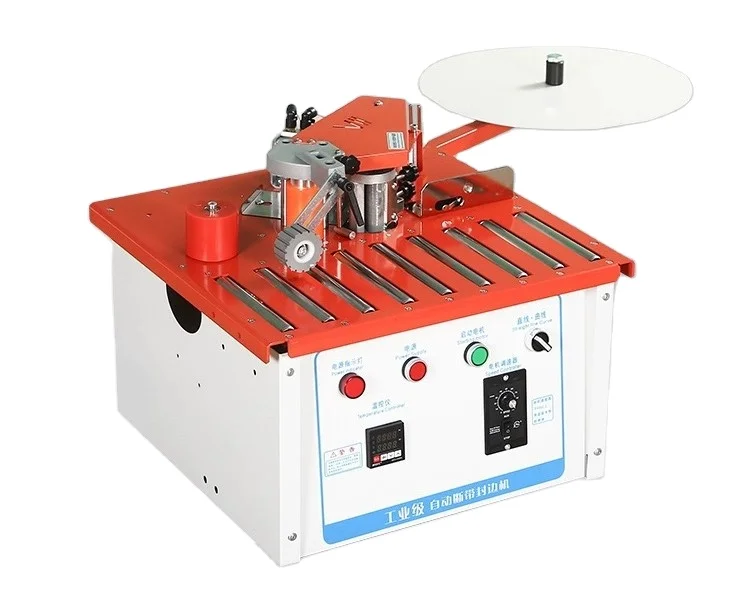
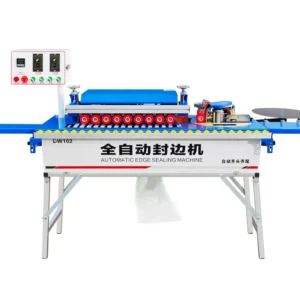
Precision Build & Traceable QC — Every ZDSF50+ mini portable edge banding machine leaves our Ningjin facility with a four-stage inspection record, OEM-ready packaging, and voltage configuration verified against the buyer’s actual site supply.
Technical Specifications
| Parameter |
Value |
| Model |
ZDSF50+ |
| Product Type |
Mini Portable Edge Banding Machine |
| Rated Voltage |
220V (configurable 110V–440V for OEM orders) |
| Rated Power |
1.2 kW |
| Rated Air Pressure |
0.4–0.6 MPa |
| Strip Thickness Range |
0.5–1.5 mm |
| Sheet Thickness Range |
10–60 mm |
| Glue Pot Capacity |
1000 ml |
| Heating Configuration |
4 heating tubes |
| Heating Time |
5–10 min |
| Edge Banding Speed |
0–6 m/min (variable, basis not stated in source) |
| Glue Application |
Double-sided gluing via glue-coated rollers |
| Tape Breaking |
Pneumatic control; foot switch for curves, travel switch for straight lines |
| Pressure Rollers |
Rubber material, adjustable to board thickness |
| Edge Strip Transport |
Adjustable bayonet based on edge strip height |
| Overall Dimensions |
54 × 54 × 56 cm |
| Net Weight |
28 kg |
| Assembly State |
Portable unit, no assembly required |
| Control System |
Manual operation with pneumatic assist |
| Standards |
CE, ISO 9001 |
Application Suitability
| Application |
Material or Output |
| Small joinery workshop edge finishing |
MDF, plywood, and particleboard panels with PVC or veneer edge banding |
| Custom furniture on-site curved edge work |
Solid wood panels and shaped components with 0.5–1.5 mm strip |
| Cabinet maker sample and prototype runs |
Melamine-faced chipboard and MDF cabinet parts |
| Startup workshop transitioning from manual banding |
Plywood and blockboard furniture blanks requiring double-sided glue coverage |
Why the Voltage Question Must Come Before the Factory Floor
Every Mini Portable Edge Banding Machine factory OEM order we ship leaves with a signed voltage confirmation sheet — because a 220V unit dropped onto a 440V three-phase supply is not a machine, it is scrap metal.
I learned this the hard way last year. We sent an edge bander to a custom furniture plant in the Middle East. The voltage confirmation step was not locked down tightly enough on my end. The machine arrived wired for 380V; their facility ran 440V. They sat idle for three weeks waiting on a step-down transformer, production halted, and the phone calls were not pleasant. Now, before any ZDSF50+ unit enters final assembly, I require a photo of the buyer’s actual supply panel and a written frequency confirmation. [NEED_CITE: voltage and frequency standards by export market]
This is not a courtesy step — it is a manufacturing checkpoint. The heating tubes, motor winding, and pneumatic solenoid valves are all selected to match the confirmed electrical specification. Swap one without recalculating the others and you compromise the glue pot thermal stability and the tape-breaking pneumatic response.

Component Sourcing and Incoming Material Inspection
The reliability of a Mini Portable Edge Banding Machine factory OEM build starts before the first bolt is tightened. Every batch of pneumatic cylinders, rubber pressing rollers, and heating elements that enters our Ningjin facility goes through incoming material inspection. We verify shore hardness on the rubber rollers, wattage tolerance on the heating tubes, and seal integrity on the pneumatic fittings before they are released to the assembly bench.
Distributors evaluating us as a private-label partner can request the incoming inspection record for their specific production batch. This is not a generic quality certificate — it is a traceable document showing which supplier lot the components came from and what test values were recorded at receiving.
Four-Stage Quality Control Across the Production Run
Our QC process for the ZDSF50+ runs through four gates: incoming material, in-process assembly, finished product functional test, and pre-shipment verification. At the in-process stage, technicians check the alignment of the adjustable bayonet, the runout of the glue-coated rollers, and the seal of the 1000 ml glue pot under pressure. The finished product test runs actual MDF and plywood panels with PVC banding through both straight and curved paths, verifying that the double-sided gluing mechanism delivers even coverage and that the pneumatic tape-breaking device triggers cleanly at the travel switch. [NEED_CITE: CE machinery directive requirements for industrial equipment]
For OEM partners placing container-load orders, pre-shipment verification includes a documented electrical safety test at the confirmed voltage, a photographic record of each unit, and a packing audit. Every unit in the container must pass — not just a statistical sample.
How the ZDSF50+ Specs Translate on the Workshop Floor
The 10–60 mm sheet thickness range covers the span most small joinery shops actually work with, from 10 mm MDF shelving up to 60 mm solid wood worktops. The adjustable pressure rollers and bayonet make switching between these thicknesses a manual setting rather than a tooling change, which matters when a custom furniture maker runs a batch of cabinet sides in the morning and solid-wood tabletops in the afternoon.
The 4-tube heating configuration inside the 1000 ml glue pot is designed to bring the adhesive to working temperature within 5–10 minutes. For a one-person workshop, that means the machine can be powered up while the operator prepares panels, rather than losing a full cycle waiting for the glue to melt. The double-sided gluing through coated rollers applies adhesive to both the panel edge and the strip simultaneously, reducing the chance of starved glue joints that later fail during assembly.
The 0.4–0.6 MPa air pressure range is standard for workshop compressors, and the pneumatic tape-breaking system — activated by a foot switch on curves and a travel switch on straight runs — removes the need for the operator to manually cut the strip mid-feed.
What Happens When Configuration Details Get Overlooked
When a distributor imports a compact edge bander without confirming the control panel language, the machine arrives and the operator cannot read the heating cycle indicators. Commissioning stalls. When the voltage is assumed rather than confirmed, a heating tube rated for 220V on a 110V supply runs cold, the glue never reaches flow temperature, and the banding peels off within hours. These are not warranty issues — they are configuration failures that happen before the machine ever leaves the factory. [NEED_CITE: common causes of edge banding adhesion failure in field installations]
Why Distributors Source This Line From Our Facility
In-house manufacturing with patented cutting and feed mechanisms means we control the tolerance chain from grinding to assembly — not a trading company reselling someone else’s output. The ZDSF50+ sits within a full product family, so a distributor can offer their market everything from this portable unit to a full-function pre-milling edge bander under one supplier relationship and one OEM branding agreement.
Voltage adaptation from 110V to 440V, multilingual control panels, and custom logo application on both the machine and packaging are handled on our own production line, not outsourced after the fact. Four-stage QC with pre-shipment verification means the container that arrives matches the sample the buyer approved. An engineer reviews every order configuration and issues a formal quotation within 24 hours, so the distributor is not guessing at lead times or specification compatibility.
Documentation & Verification
- CE declaration of conformity covering the ZDSF50+ portable unit and its pneumatic and electrical subsystems
- ISO 9001 certificate documenting the quality management system under which each batch is produced
- Machine specification sheet confirming voltage, frequency, and plug type as built for the target market
- Factory test record showing actual panel edge banding results on the buyer’s specified material and thickness range
- Electrical schematic and voltage confirmation document signed off before assembly begins
- Operation and maintenance manual in the agreed language with illustrated pneumatic circuit and glue pot service procedure
Installation, Commissioning & Support
- Portable 28 kg unit requires no foundation; place on a stable 54 × 54 cm bench surface with adequate clearance for panel feed
- Connect to a dedicated 220V single-phase circuit (or confirmed OEM voltage) with proper grounding and a 10A breaker
- Arrives fully assembled — attach the compressed air supply at 0.4–0.6 MPa and perform a dry-cycle test before first glue run
- First commissioning includes setting pressure roller gap to the target 10–60 mm board thickness and adjusting the bayonet for 0.5–1.5 mm strip height
- Glue pot heating cycle verification at the confirmed voltage to confirm 5–10 minute warm-up reaches working temperature
- Spare parts list covering heating tubes, rubber pressing rollers, and pneumatic seals provided with each shipment
Preparing Your Inquiry
When requesting a quotation for OEM or distributor orders, include your target market’s standard voltage and frequency so we can confirm the winding and heating tube specification from the start. Let us know the panel materials and edge strip thickness range your customers primarily work with, and whether you need the control panel and manual in a specific language. If you are evaluating a private-label arrangement, specify your branding requirements — logo placement, packaging format, and any color preferences — so we can include those in the initial configuration proposal.
Frequently Asked Questions
Q: What is the OEM and private label scope for this mini edge banding machine?
A: We apply your logo to the machine body, control panel overlay, and shipping carton. Voltage, plug type, control panel language, and documentation language are all configurable per order. The ZDSF50+ can be shipped under your brand with no Ruiqi markings visible to the end user. Tooling and setup for custom branding are handled in-house at our facility.
Q: How does the four-stage QC process apply to each production batch?
A: Every ZDSF50+ unit passes incoming component inspection, in-process assembly checks, a finished-product functional test running actual panel stock, and a pre-shipment electrical and visual verification. Each gate generates a record that can be shared with the distributor or OEM partner for their own audit trail. No unit ships without passing all four stages.
Q: Can voltage, frequency, and plug type be customized per target market at the factory level?
A: Yes. The ZDSF50+ is configurable from 110V to 440V, and we adapt the motor winding, heating tube rating, and pneumatic solenoid specifications to match. We require written confirmation of the destination site’s actual voltage and frequency before assembly starts, along with a photo of the supply panel when possible.
Q: What is the minimum order quantity for OEM branding versus standard stock units?
A: Standard units ship from stock individually. OEM branding with custom logo, packaging, and documentation typically requires a minimum batch to justify the setup, but we keep this accessible for distributors starting a new territory. Contact our engineering team with your market details for the exact threshold.
Q: How are component sourcing and incoming material inspections documented for distributor audit purposes?
A: Each production batch is linked to incoming inspection records for critical components — heating tubes, pneumatic cylinders, rubber rollers, and electrical elements. Distributors conducting factory audits or requesting remote verification can review these records, including supplier lot numbers and measured test values, before their order ships.