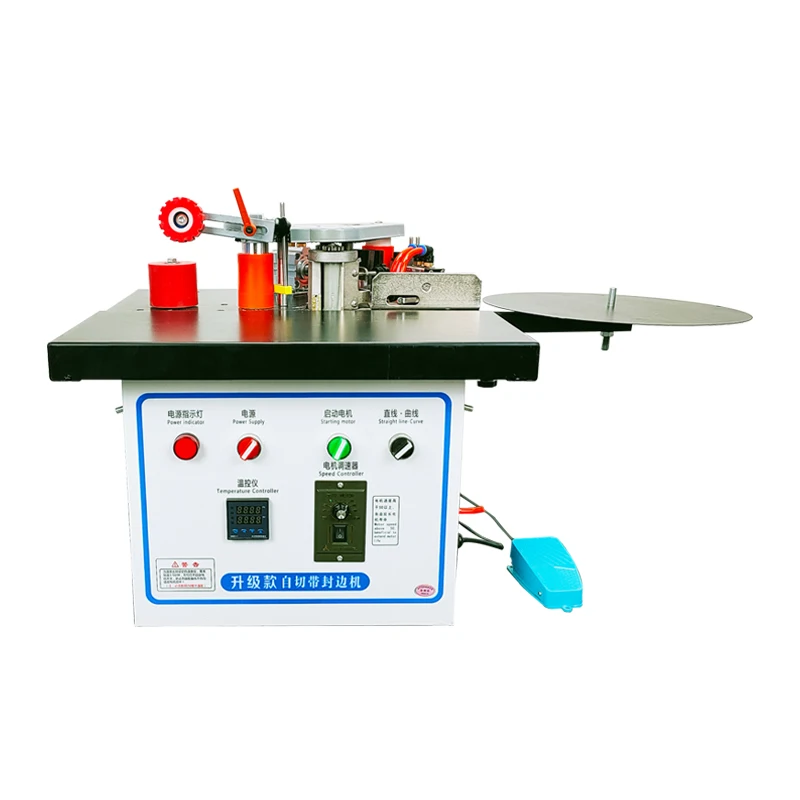
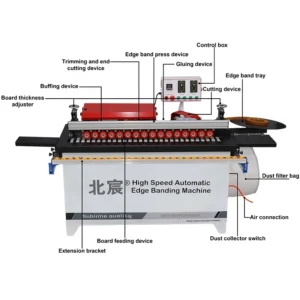
Verified Tolerance at Source — Every ST-50 manual edge bander leaves our facility with a factory test record confirming edge output on your specified panel material and thickness, so the ±0.3–3mm banding range you quote is the range your operators actually see on day one.
Technical Specifications
| Parameter |
Value |
| Model |
ST-50 |
| Product Type |
Manual Edge Banding Machine |
| Total Power |
1000W |
| Voltage Options |
220V / 380V / Custom |
| Plug Configurations |
EU, USA, AU, UK |
| Edge Banding Thickness Range |
0.3–3 mm |
| Edge Banding Height Range |
0–50 mm |
| Minimum Sheet Length |
25 cm |
| Minimum Sheet Width |
3 cm |
| Glue Pot Capacity |
1000 ml |
| Edge Trimming Power |
20W |
| Air Source Pressure |
0.5–0.8 MPa |
| Machine Dimensions |
50 × 50 × 47 cm |
| Machine Weight |
22 kg |
| Control Panel Language |
Chinese, English (other languages customizable) |
| Edge Profile Capability |
Curved and Straight |
| Standards |
Export-grade build (CE documentation available on request) |
Application Suitability
| Application |
Material or Output |
| Small-batch furniture panel edging |
MDF and particleboard up to 50 mm thickness |
| Curved cabinet door and drawer front banding |
Plywood and ecological board with radii |
| On-site furniture repair and modification |
Solid wood board with PVC or veneer tape |
| Home decoration custom panel finishing |
Melamine-faced particleboard and MDF |
| Workshop transition from hand banding |
Mixed substrate batches in joinery startups |
Why the Voltage Question Must Come Before the Quotation
Machines that arrive electrically incompatible cost more in return freight than they ever saved on the purchase price.
I once supported a shipment of a compact edge bander to a small cabinet shop where the local grid ran at a frequency the machine was never configured for. The glue pot heater cycled irregularly, the banding adhesive never reached proper flow temperature, and the operator blamed the machine for what was fundamentally a specification gap. A Manual Edge Banding Machine OEM should confirm destination voltage and frequency before production begins, not after the crate is opened. When a 1000W unit designed for 220V/50Hz lands on a 60Hz circuit without adjustment, thermal behavior shifts and glue viscosity control degrades [NEED_CITE: voltage and frequency standards by export market]. The ST-50 ships with electrical configuration locked to the buyer’s confirmed supply, documented on the schematic before the machine enters assembly.

How a 22 kg Footprint Changes Workshop Layout
At 50 × 50 × 47 cm, the ST-50 occupies roughly the same bench space as a standard workstation monitor. For a joinery shop moving from hand-applied edge tape to machine-assisted banding, this means the unit sits directly beside the panel saw or routing table rather than requiring a dedicated floor zone. The compact footprint matters most in workshops where curved edge work — cabinet doors, rounded shelf fronts, custom reception desks — happens at the same bench where panels are cut. Operators feed, band, and trim without moving the workpiece across the shop floor, reducing handling damage on freshly cut substrates.
What OEM Branding Actually Covers Beyond a Logo Stamp
Private-label equipment sourcing often stops at a silk-screened nameplate, leaving the manual, control panel, and packaging in the factory’s default language and color. The ST-50 OEM scope extends to control panel language selection, plug type matched to the destination market, custom color on the housing, and branded packaging with the distributor’s artwork. For a regional importer stocking manual edge banders for local woodworkers, having the operator manual printed in the local language and the control interface labeled in familiar terminology reduces commissioning calls and returns. The factory test record, electrical schematic, and spare parts list can all carry co-branded documentation headers so the end buyer sees a single consistent brand from unboxing through first production run [NEED_CITE: CE machinery directive requirements for industrial equipment].
Reading the Specs That Determine Edge Quality on Curved Profiles
The 0.3–3 mm banding thickness range covers the full spectrum of PVC, ABS, and wood veneer tapes used on furniture-grade panels. Thinner veneer tapes around 0.4 mm require lower feed pressure and careful glue temperature control to prevent bleed-through, while 3 mm PVC on a curved radius demands consistent heat across the glue pot to maintain adhesion through the bend. The 1000 ml glue pot capacity supports sustained small-batch runs without frequent refills, which matters when an operator is working through a set of matching cabinet doors and cannot afford a temperature drop mid-sequence. The 0–50 mm banding height range accommodates standard 18 mm furniture board as well as thicker worktop and shelving stock. Air pressure at 0.5–0.8 MPa drives the edge trimming mechanism; insufficient pressure produces ragged trim lines on curved profiles, while excessive pressure can crush softer veneer tapes against the panel edge.
The Hidden Cost of Skipping the Pre-Shipment Panel Test
When a distributor orders a batch of manual edge banders without requesting a sample test on the specific panel materials their customers use, the first indication of a glue adhesion problem comes from an end user in the field. MDF, particleboard, and plywood each absorb heat from the glue pot differently, and a machine tuned on one substrate at the factory may underperform on another. A Manual Edge Banding Machine OEM that runs pre-shipment tests on the buyer’s specified material and ships the test samples alongside the machine eliminates this discovery-in-the-field pattern [NEED_CITE: substrate thermal absorption differences in edge banding]. The cost is a few hours of factory time; the alternative is a warranty claim from a furniture maker whose curved cabinet fronts are delaminating after two weeks in a humid kitchen.
What Manufacturing Depth Means for This Machine Class
In-house production of the ST-50 means the glue pot casting, feed mechanism, and trimming assembly are built under one roof rather than sourced from three separate vendors and bolted together at final assembly. Four-stage quality control — incoming material inspection, in-process verification, finished product testing, and pre-shipment validation — applies to a 22 kg manual bander with the same rigor as a full production-line machine. Voltage and plug configuration are confirmed against the buyer’s electrical specification before the unit enters the wiring stage, not adjusted as an afterthought. The factory welcomes distributor visits to observe assembly and run sample panels, which is the only reliable way to evaluate whether an OEM partner’s claimed capabilities match their shop floor reality. Every unit ships with a documented test record, not a generic pass sticker.
Documentation & Verification
- Factory test record with edge banding samples on your specified panel material and thickness
- Electrical schematic with confirmed voltage, frequency, and plug type for your destination market
- Operation and maintenance manual in the agreed language with illustrated troubleshooting section
- Spare parts list with part numbers matching the specific ST-50 configuration shipped
- Packing photographs showing machine securing and crate condition before container loading
Installation, Commissioning & Support
- Bench-mount on a stable surface rated for the 22 kg machine weight plus operator feed pressure
- Dedicated 220V or 380V circuit matching the confirmed plug type, with proper grounding verified before first power-on
- Glue pot initial fill and heat cycle to operating temperature before first banding pass on scrap material
- Air supply connection at 0.5–0.8 MPa with inline moisture filter to protect the trimming mechanism
- Control panel language verification at first boot, with operator walkthrough of all interface functions
- Recommended spare glue pot heating element and trimming blades included in first-shipment spare parts kit
What We Need to Configure Your ST-50 Correctly
To prepare an accurate quotation and machine configuration, share the panel materials and thicknesses your operators will band most frequently, along with whether curved profiles are a regular requirement or an occasional need. Confirm the local voltage and frequency at the installation site so the electrical build matches your grid. Specify the control panel language and plug type required, and indicate whether OEM branding on the machine housing, manual, and packaging is part of your distribution plan.
Frequently Asked Questions
Q: What does OEM customization include beyond logo printing on the ST-50?
A: OEM scope covers custom housing color, branded packaging with your artwork, control panel language in your market’s primary language, plug type matched to local standards, and co-branded documentation including the operation manual and spare parts list. Logo placement is one element of a broader private-label configuration that ensures the end user sees a single consistent brand from unboxing through daily operation.
Q: How is the correct voltage and plug type confirmed before the ST-50 enters production?
A: The buyer provides the destination market’s voltage, frequency, and plug standard during the inquiry stage. This information is recorded on the electrical schematic and confirmed in writing before wiring begins. The ST-50 supports 220V, 380V, or custom voltage with EU, USA, AU, or UK plug configurations, and the final specification is verified against the factory test record before dispatch.
Q: Can the control panel be supplied in languages other than Chinese and English?
A: Yes. The ST-50 control interface supports Chinese and English as standard, with additional languages configurable for OEM orders. The operation manual is also produced in the agreed language, ensuring that the operator reading the panel labels has matching documentation for setup, daily use, and basic troubleshooting without requiring translation support on the shop floor.
Q: How can a distributor evaluate the manufacturing process before placing a bulk order?
A: The factory welcomes on-site visits where distributors can observe ST-50 assembly, inspect component sourcing, and run sample panels through the machine on their own specified materials. For buyers unable to travel, pre-shipment test records with photographic evidence and sample edge-banded panels shipped alongside the first order provide equivalent verification of manufacturing depth and output quality.
Q: What spare parts should a regional stockist keep on hand for the ST-50?
A: Recommended distributor stock includes replacement glue pot heating elements, edge trimming blades, feed roller assemblies, and air valve seals. The spare parts list shipped with each ST-50 includes part numbers specific to the configuration supplied, enabling accurate reordering. A regional stockist carrying these high-wear items can support end users without waiting for international shipment on routine maintenance needs.