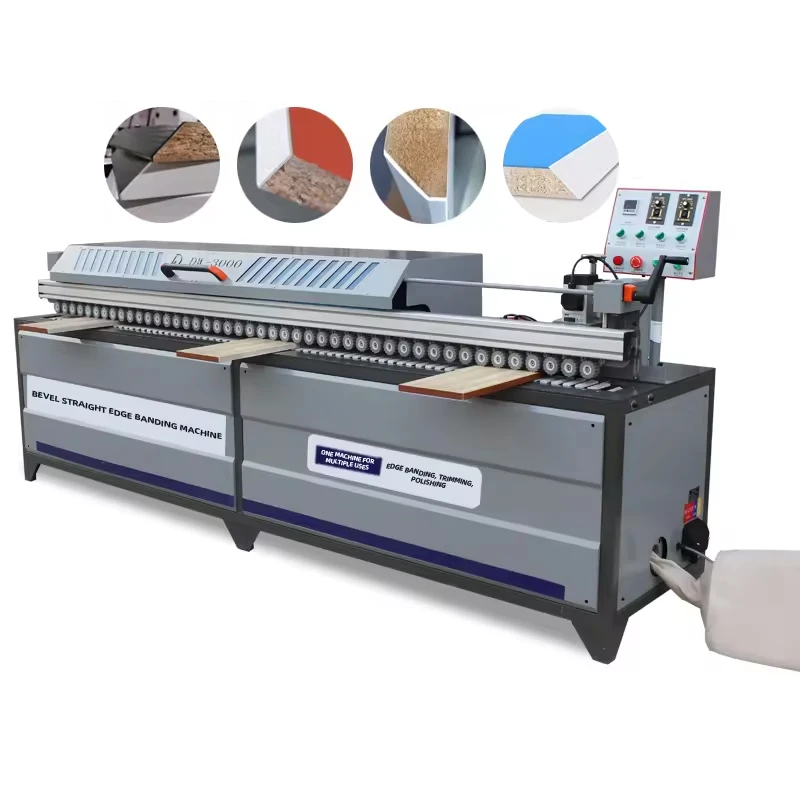
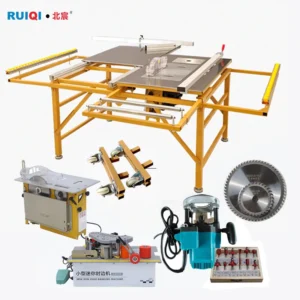
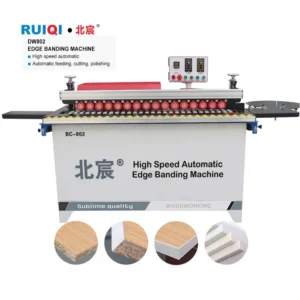
In-house precision machining — DW3000 edge banding components are ground on-site to verified tolerances before assembly, eliminating third-party variance in critical cutting stations.
Technical Specifications
| Parameter |
Value |
| Model |
DW3000 |
| Product Type |
Fully Automatic 45 Degree Bevel and Straight Edge Banding Machine |
| Total Power |
11 kW |
| Voltage |
380V / 415V (frequency and regional configuration to be confirmed) |
| Overall Dimensions (L×W×H) |
299 × 65 × 130 cm |
| Net Weight |
430 kg |
| Feed Speed |
0–12 m/min |
| Edge Banding Thickness Range |
0.3–3 mm |
| Edge Banding Height Range |
0–50 mm |
| Minimum Sheet Length |
30 cm |
| Minimum Sheet Width |
15 cm |
| Pre-milling Motor |
2.2 kW |
| Trimming Motor |
2.2 kW × 2 (3 spindle motors total on machine) |
| Polishing Motor |
0.4 kW × 2 |
| Heating Power |
2.2 kW × 2 (double heat gun design) |
| Glue Pot Capacity |
4000 ml |
| Vacuum Power |
550 W |
| Air Source Pressure |
0.5–0.7 MPa |
| Bevel Angle Range |
30–90 degrees |
| Control System |
Standard panel with language customization (English, Chinese, Spanish, or other) |
| Trimming Stations |
Pre-milling, edge trimming, scraping, polishing, high-power vacuuming |
| Feeding Mechanism |
Double cylinder feeding belt with auxiliary slide and automatic alignment |
| Edge Band Slotting |
Yes, adjustable slotting height |
Application Suitability
| Application |
Material or Output |
| Custom cabinet panel edge banding |
MDF and particleboard with PVC or ABS banding |
| Plywood furniture component finishing |
Plywood panels with wood veneer or PVC edge strips |
| Bevel and straight edge processing |
Solid wood panels requiring 30°–90° angled edge profiles |
| Mid-volume production line integration |
Panel processing with pre-milling, slotting, and polishing in one pass |
Why Voltage Confirmation Must Precede the Machine Build
A 380V machine shipped to a 415V/60Hz market will trip breakers on day one or burn out the glue pot heaters within weeks.
I spent years on the assembly floor before moving to technical sales, and the most frustrating calls we get are from buyers whose machines arrived electrically incompatible with their workshop supply. The DW3000 edge banding machine OEM manufacturer configuration process locks voltage, frequency, and plug type before production starts — not after the crate is nailed shut. Regional electrical standards vary enough that assuming a default configuration creates real commissioning delays [NEED_CITE: voltage and frequency standards by export market]. We treat the electrical schematic as a build document, not an afterthought.

Component Sourcing Transparency for Distributors
When you commit to representing an edge banding machine OEM manufacturer in your territory, you need to know which critical components are produced in-house versus sourced externally. The DW3000 uses proprietary cutting mechanisms manufactured on our own precision grinding lines, giving distributors confidence that replacement spindles and trimmer heads will match original tolerances. The three-spindle motor configuration and double heat gun assembly are built and tested at this facility before integration into the main frame.
OEM and Private-Label Manufacturing Scope
Private-label partners need more than a logo swap — the control panel language, electrical documentation, and safety labeling must match the destination market from day one. The DW3000 supports custom branding across the machine body, operation manuals in the agreed language, and region-specific electrical schematics included in every shipment. Whether the order is a single evaluation unit or a batch for regional stocking, the OEM scope is confirmed in writing before any component is cut [NEED_CITE: CE machinery directive requirements for industrial equipment].
How Core Parameters Affect Panel Output Quality
The 0–12 m/min variable feed speed lets operators match throughput to the edge banding material in use — PVC at standard speeds, slower feeds for thicker ABS or real wood veneer that needs longer glue contact time. The double heat gun design (2.2 kW × 2) maintains consistent glue activation temperature across the full 4000 ml pot, preventing the cold-start glue lines that plague single-heater machines on thick substrates. With eight groups of adjustable oblique pressure wheels covering 30° to 90°, the bevel edge banding mechanism holds the strip firmly against angled panel edges without the chatter marks that appear when pressure is uneven. The pre-milling station (2.2 kW) removes saw marks from the panel edge before the glue is applied, which is what allows the downstream trimming and scraping stations to produce a clean, near-invisible glue line on MDF and particleboard.
What Happens When Material Specs Are Skipped at Quotation
The most common rework scenario I have seen involves a customer who tested the machine on standard PVC, approved the sample, then ran 2 mm ABS in production without adjusting glue temperature or feed speed. The result was visible glue lines on every panel for the first two weeks, and the operator blamed the machine. This is why we now require the buyer to confirm edge banding material type, thickness range, and substrate before the quotation is finalized. Sending a physical sample of the intended banding material to our facility for a trial run removes the guesswork entirely [NEED_CITE: ABS versus PVC edge banding adhesion requirements].
Manufacturing Depth You Can Audit On-Site
The DW3000 is built on a facility where precision grinding, assembly, and four-stage quality control all happen under one roof, meaning a visiting distributor can trace a component from raw stock to finished machine. Patented cutting mechanisms are produced in-house rather than sourced from generic suppliers, giving OEM partners a defensible product story in their local market. Voltage and language customization are standard production options, not special engineering requests that add lead time. Pre-shipment testing runs the machine on the buyer’s specified panel material and edge banding stock before crating. Every unit ships with the documentation a regional service team needs: electrical schematics, spare parts lists, and factory test records.
Documentation & Verification
- CE declaration of conformity matched to the DW3000 configuration shipped
- ISO 9001 certificate covering the manufacturing and QC process
- Electrical schematic and voltage confirmation document for the destination market
- Factory test record on buyer-specified panel thickness and banding material
- Operation and maintenance manual in the agreed language
- Spare parts list with part numbers matching in-house manufactured components
Installation, Commissioning & Support
- Requires a level concrete floor to support the 430 kg frame and 299 cm length without deflection
- Dedicated 380V/415V circuit with rated capacity above 11 kW total draw recommended
- Ships fully assembled; position and connect air supply at 0.5–0.7 MPa before first run
- Glue pot and double heat gun require initial temperature calibration to the specific banding material
- Control panel language set to operator preference before dispatch to avoid commissioning delays
- High-power vacuuming port (550 W) connects to existing dust extraction or standalone collector
What We Need to Configure Your DW3000 Correctly
To prepare an accurate quotation, share the edge banding material types and thicknesses you run most often, along with the substrate (MDF, particleboard, plywood, or solid wood). Confirm your workshop supply voltage and frequency so the electrical configuration is locked before build. Let us know the control panel language your operators require and whether you need OEM branding on the machine body and documentation.
Frequently Asked Questions
Q: What can be customized under the OEM and private-label arrangement?
A: Custom logo placement on the machine body, control panel language (English, Chinese, Spanish, or others), voltage configuration from 110V to 440V, and tailored mechanical specifications are all confirmed before production. Electrical schematics and documentation are updated to reflect every custom element so your local service team has accurate records.
Q: Which critical components are manufactured in-house versus sourced externally?
A: The proprietary cutting mechanisms, precision-ground trimming spindles, and pressure wheel assemblies are produced on our own machining lines. Motors, electrical components, and pneumatic parts are sourced from established suppliers. Every incoming component passes incoming material inspection before entering the assembly process.
Q: What does the four-stage QC process cover on this machine?
A: Incoming material inspection verifies raw components against tolerance specifications. In-process checks confirm assembly alignment and motor integration. Finished product inspection tests all stations under load. Pre-shipment verification runs the DW3000 on the buyer’s specified panel and banding material before crating.
Q: How is electrical configuration confirmed for my market before the build begins?
A: We request your local voltage, frequency, and plug standard at the quotation stage. The electrical schematic is then generated specifically for that configuration and included with the shipping documentation. This prevents the common problem of machines arriving incompatible with the workshop power supply.
Q: What spare parts and training support is available for distributor service teams?
A: Every DW3000 ships with a spare parts list referencing in-house manufactured components. Distributors can order backup spindles, pressure wheels, and scraper blades in batch. Technical training on maintenance procedures and common fault diagnosis is available at the factory or via remote session for your service engineers.