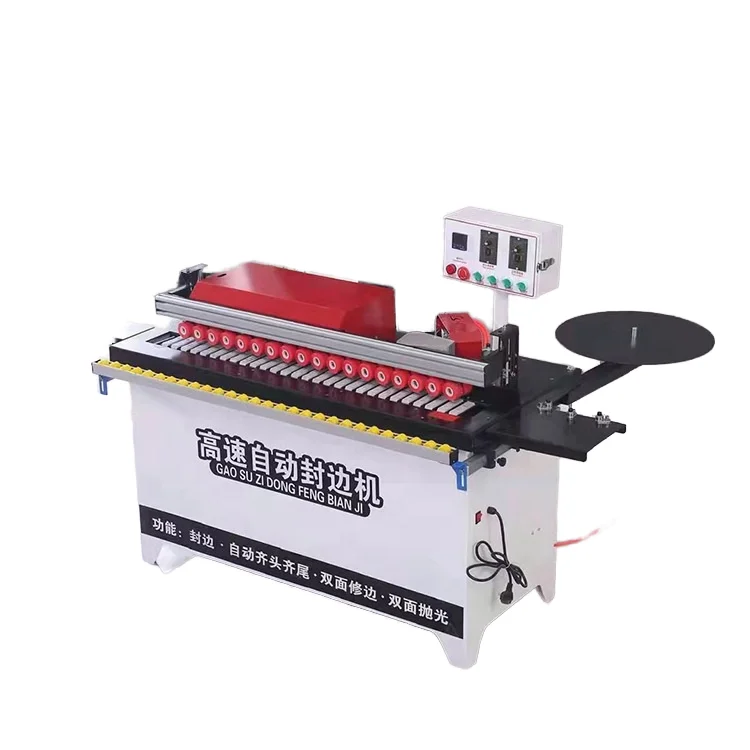
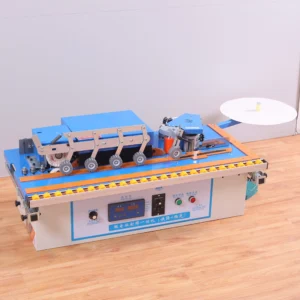
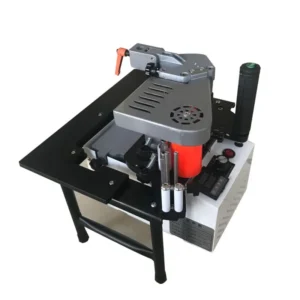
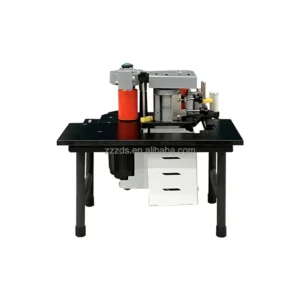
Four-Stage QC Protocol — Every Model 802 ships with a factory test record documenting actual edge finish and trimming accuracy on your specified panel material before it leaves the floor.
Technical Specifications
| Parameter |
Value |
| Model |
802 |
| Product Type |
Semi Automatic Edge Banding Machine |
| Function |
Automatic plate feeding, end cutting, upper and lower polishing, head and tail trimming, integrated dust collector |
| Edge Type |
Straight line |
| Rated Voltage |
220V (configurable from 110V to 440V) |
| Rated Power |
4 kW |
| Heating Power |
1000 W (5–10 min warm-up) |
| Trimming Power |
800 W × 2 |
| Polishing Power |
180 W × 2 |
| Suction Power |
1200 W |
| Glue Pot Capacity |
4000 ml |
| Glue Pot Temperature Display |
Digital |
| Feed Speed |
0–10 m/min |
| Conveyor Belt Speed |
0–10 m/min |
| Conveyor Belt Material |
Silicone |
| Pressure Beam |
One-piece, double rows of pressure wheels |
| Strip Thickness Range |
0.5–2.5 mm |
| Sheet Thickness Range |
10–50 mm |
| Rated Air Pressure |
0.4–0.6 MPa |
| Belt Breaking Method |
Pneumatically controlled |
| Extendable Support |
Fluent strips for large plate sealing |
| Overall Dimensions (L×W×H) |
130 × 65 × 75 cm |
| Machine Weight |
150 kg |
| Control Panel |
Independent switch, digital display |
| Warranty |
One year |
Application Suitability
| Application |
Material or Output |
| Custom cabinet door edge finishing |
MDF, particleboard, and melamine-faced panels with PVC or melamine edge banding |
| Small-batch furniture workshop production |
Plywood and blockboard panels with 0.5–2.5 mm veneer or PVC strips |
| Semi-automated joinery scaling from manual |
Straight-line edge sealing on board stock up to 50 mm thick |
| Regional distributor demo and showroom units |
Pre-configured sample machines for customer panel testing |
Why Voltage Confirmation Must Precede Every Semi Automatic Edge Banding Machine Order
A mismatched voltage rating is the single most common reason a newly arrived machine refuses to start on the production floor.
I once shipped an edge bander to a workshop in Vietnam where the local supply was 415V three-phase, but the machine had been built for 380V. The main motor would not engage, and the glue heater could never reach operating temperature. The operator pulled the banding strip and it came off clean — no adhesion at all. The line sat idle for three weeks waiting for a step-down transformer. Since then, I match every electrical schematic against the buyer’s actual distribution board photograph before production begins. A Semi Automatic Edge Banding Machine configured for 220V single-phase is standard, but the OEM manufacturing floor can wind motors and size heating elements for 110V through 440V. Confirming this before the build avoids costly delays and protects component life [NEED_CITE: voltage and frequency standards by export market].

OEM Build Depth and Private-Label Capability
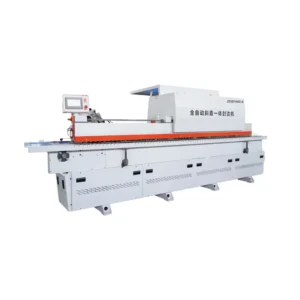
Distributors evaluating a Semi Automatic Edge Banding Machine for regional resale need to verify that the factory controls its own assembly, not just its brand label. This model is built on a production floor that also manufactures full-function automatic edge banders with patented cutting mechanisms, meaning the component sourcing channels, precision-grinding standards, and assembly discipline carry through to this semi-auto tier. Custom logo application, color matching, and branded packaging are integrated into the production schedule rather than added as an afterthought.
Multilingual Panels and Market-Specific Configuration
Control panels in a language the operator cannot read stall commissioning the moment the crate is opened. The factory configures digital displays, switch labels, and operation manuals in the target market language as a standard part of the build order. For OEM partners, this extends to private-label documentation sets and co-branded wiring diagrams that list local service contacts instead of the original manufacturer [NEED_CITE: CE machinery directive requirements for industrial equipment].
Glue Pot, Trimming, and Feed Mechanics Explained
The 4000 ml glue pot is sized to sustain continuous batch runs through an entire work shift without manual refilling, reducing thermal cycling that degrades adhesive consistency. The digital temperature display and 1000 W heater bring the pot to working temperature within five to ten minutes, which matters when processing temperature-sensitive PVC banding that scorches above its rated range. Two 800 W trimming motors handle head and tail cuts, followed by 180 W upper and lower polishing wheels that remove residual burrs — a sequence that directly affects whether the finished panel passes visual inspection or requires hand rework. The one-piece pressure beam with double rows of silicone conveyor wheels keeps the panel flat and scratch-free across the full 10–50 mm thickness range, and the pneumatically controlled belt breaker delivers repeatable end cuts without manual scoring.
The Hidden Cost of Skipping Factory Verification
Buyers who specify a semi-auto edge bander on price alone often discover tolerance issues only when panels fail assembly downstream — joints that should seat flush show visible gaps because the trimmed edge was never measured against the stated specification. Without a documented factory test record, there is no baseline to compare against the output on your workshop floor. Pneumatic systems sized below 0.4 MPa produce inconsistent belt breaks, and under-rated suction leaves dust on the glue roller that contaminates every subsequent panel [NEED_CITE: woodworking dust extraction standards for edge banding].
Manufacturing Accountability at This Tier
This Semi Automatic Edge Banding Machine is produced in a facility that operates a four-stage QC process covering incoming material inspection, in-process assembly checks, finished-product functional testing, and pre-shipment verification — each stage generating documentation that ships with the unit. The factory holds ISO 9001 certification and CE declaration of conformity for its machinery range, and welcomes on-site visits or video-audited sample runs. Voltage adaptation from 110V to 440V is engineered at the motor and heater level, not achieved through external transformers. OEM partners receive full private-label support including custom tooling plates, branded electrical schematics, and territory-specific spare parts lists.
Documentation & Verification
- CE declaration of conformity covering this semi-auto model range
- Factory test record on buyer-specified panel thickness and strip material before dispatch
- Electrical schematic confirming wound motor voltage and heater element rating
- ISO 9001 quality management certificate available for distributor compliance files
- Packing photographs documenting crate condition and accessory count before sealing
Installation, Commissioning & Support
- Requires a dedicated 4 kW single-phase circuit matching the confirmed voltage and frequency
- Overall footprint of 130 × 65 cm allows placement against a workshop wall with rear access clearance
- Pneumatic supply must deliver 0.4–0.6 MPa clean dry air to the belt-breaking cylinder
- Integrated 1200 W dust collector connects to the onboard shroud, reducing external ductwork
- Fluent-strip extendable supports must be leveled to the conveyor height before large-plate runs
- Silicone conveyor belt inspected and tensioned at the factory; spare belt included in the parts kit
What to Include in Your Inquiry
To receive an accurate configuration and build quotation, share the panel materials and thickness range you process most frequently, the edge banding strip types and thicknesses in regular use, and the voltage and frequency available at your workshop or your end customer’s facility. If you are an OEM or distributor, specify the target market languages for the control panel and manual set, along with any branding or packaging requirements.
Frequently Asked Questions
Q: What OEM and private-label options are available for this model?
A: The factory applies custom logos to the machine body, electrical cabinet, and packaging. Control panels and digital display labels are produced in the buyer’s target language. Voltage, heater element rating, and motor winding are configured to match the destination market, and co-branded documentation sets including wiring diagrams and spare parts lists ship with each unit.
Q: How does the four-stage QC process apply to this semi-auto machine?
A: Incoming materials are inspected before assembly. In-process checks verify pressure beam alignment and pneumatic cylinder function. Finished-product testing runs actual panels through the full feed-trim-polish cycle. A pre-shipment verification records glue temperature stability, trimming accuracy, and dust collector suction before the crate is sealed.
Q: Can the voltage be adapted for markets with 110V or 440V supply?
A: Yes. The motor winding, heater element, and control transformer are all specified at the build stage to match the buyer’s confirmed voltage and frequency. The factory requires a photograph of the destination site’s distribution board or a written utility specification before winding begins, ensuring the machine powers up correctly on arrival.
Q: What is the process for a factory visit or sample test before bulk ordering?
A: Distributors and OEM partners can visit the production floor to observe assembly and QC stages. For remote buyers, the factory runs a video-audited sample test using panel stock and edge banding shipped by the buyer or sourced locally to the buyer’s specification, with results documented and shared before order confirmation.
Q: How are spare parts and service training handled for regional distributors?
A: Each machine ships with a territory-specific spare parts list identifying wear items such as trimming blades, polishing wheels, and silicone belt sections. The factory provides technical training sessions — on-site or via video — covering pneumatic adjustment, glue pot maintenance, and belt replacement for the distributor’s own service team.