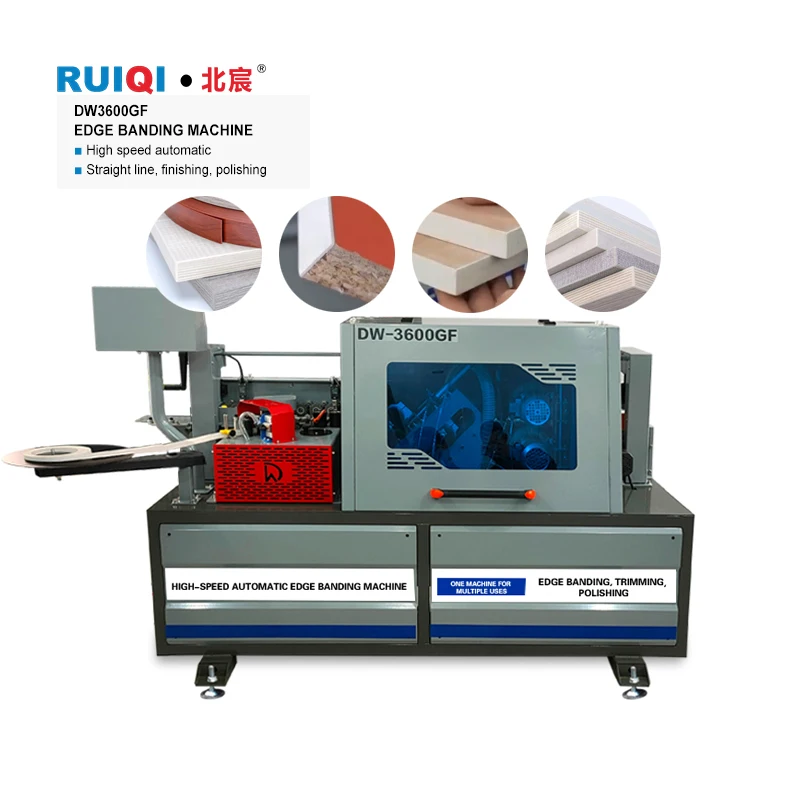
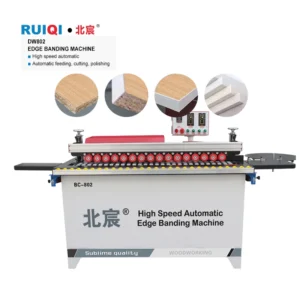
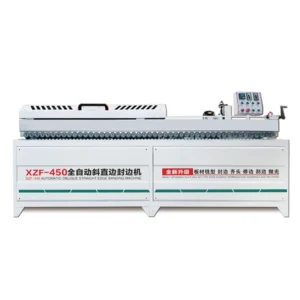
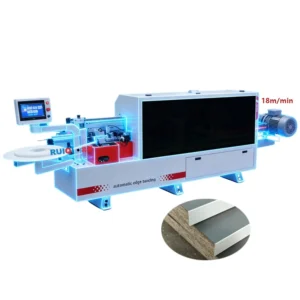
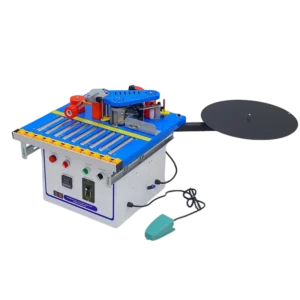
In-House Precision Build — DW-3600GF units are assembled on our Ningjin line under a four-stage QC protocol, giving OEM partners full traceability from component grinding to pre-shipment test.
Technical Specifications
| Parameter |
Value |
| Model |
DW-3600GF |
| Product Type |
Fully Automatic Edge Banding Machine |
| Voltage & Frequency |
380V three-phase four-wire (confirm 50Hz/60Hz for target market) |
| Total Power |
4.9 kW |
| Equipment Size (L×W×H) |
2200 × 650 × 1250 mm |
| Total Weight |
320 kg |
| Edge Banding Type |
Straight edge banding |
| Edge Band Height Range |
0–50 mm |
| Edge Band Thickness Range |
0.3–3 mm |
| Minimum Panel Length |
200 mm |
| Edge Banding Power |
160 W |
| Transmission Power |
180 W |
| Trimming Power |
800 W × 2 (24000 r/min) |
| Polishing Power |
400 W × 2 |
| Feed Speed |
0–14 m/min (basis not stated in source — confirm against panel format, material and thickness) |
| Transmission Speed |
0–14 m/min (basis not stated in source — confirm against panel format, material and thickness) |
| Equipment Air Pressure |
0.4–0.6 MPa |
| Standard Functions |
Gluing, trimming, front and rear trimming, scraping, polishing, vacuuming |
| Language Options |
Chinese / English default; Spanish and other languages available by customization |
| Certification |
CE; ISO 9001 |
Application Suitability
| Application |
Material or Output |
| Custom cabinet door edging |
MDF panels with 0.4–2 mm PVC edge band |
| Wardrobe and shelving production |
Particleboard with melamine or PVC banding |
| Plywood furniture components |
Plywood panels with veneer or PVC edge band |
| Joinery workshop semi-automated lines |
Straight-edge panels from panel saws feeding downstream boring stations |
| Regional distributor stock mix |
Compact straight-edge unit for markets with mixed substrate availability |
Why Voltage Confirmation Must Precede the Purchase Order
Sending a 380V/50Hz machine into a 60Hz market silently cuts motor speed and shortens spindle life.
I watched a shipment of edge banders sit on a dock in Jeddah for three weeks because the local grid ran 60Hz and the nameplate read 50Hz. The buyer had compared price and feed speed but never asked about frequency. Every three-phase motor on that automatic edge banding machine factory batch would have run hot within the first month. The fix was a full rewinding job on site [NEED_CITE: voltage and frequency standards by export market]. Since that project, my first question on any inquiry is the buyer’s local supply spec — before we discuss feed speed or glue pot options.
What OEM Partners Actually Evaluate on the Factory Floor
When a regional distributor audits a manufacturing partner for an automatic edge banding machine factory relationship, the first area to inspect is the spindle and trimming assembly. The DW-3600GF runs dual 800 W trimming heads at 24000 r/min, and those spindles are precision-ground in-house rather than sourced as catalog parts. This matters because an OEM partner committing to private-label units needs confidence that the core mechanism will hold tolerance across production runs, not just on the sample shown during a factory visit.
How the Assembly Line Scales from Single-Unit to Container Load
Private-label projects often start with one evaluation unit and scale to mixed-model containers once the distributor validates after-sales response time. Our assembly line is structured so the same four-stage QC — incoming material check, in-process inspection, finished-product test and pre-shipment verification — applies whether the batch is one DW-3600GF or twenty units with different voltage and language configurations [NEED_CITE: CE machinery directive requirements for industrial equipment]. Tooling changeover between 50Hz and 60Hz builds is handled at the wiring stage without delaying the mechanical assembly track.
Reading the Specs That Matter for Downstream Assembly
The 0.3–3 mm edge band thickness range covers the PVC and veneer stocks that most MDF and particleboard furniture lines consume daily. Trimming at 24000 r/min with dual heads produces a clean flush cut that reduces scraping passes downstream. The 0.4–0.6 MPa air pressure requirement is low enough to share a compressor with a panel saw dust extraction system in smaller workshops. Feed speed reaches 14 m/min, though real throughput depends on panel format, glue type and operator loading rhythm — the rated figure should always be confirmed against the buyer’s actual substrate before it goes into a production plan. The 2200 mm footprint leaves room for a return conveyor in a U-shaped cell layout.

The Hidden Cost of Skipping the Substrate Trial
One distributor we supplied sent a container of edge banders to a market where the local particleboard carried high resin content. The standard EVA glue cured slower on that substrate, and operators compensated by slowing feed speed until actual output dropped well below the line’s planned throughput. The machines were not faulty — they were simply configured for a different board chemistry. A sample panel test before the production order would have flagged the glue mismatch and we could have adjusted the glue pot specification or recommended a PUR upgrade path [NEED_CITE: edge banding adhesive selection for high-resin substrates]. That single oversight cost the distributor two months of field adjustments and eroded installer confidence in the brand.
Why Distributors Source This Model Here
Our Ningjin facility builds the DW-3600GF on a single integrated line, so OEM partners inspect the same assembly process whether they order one evaluation unit or a full container. Patented cutting mechanisms sit at the heart of the trimming station, giving private-label brands a technical story their sales teams can communicate. Voltage, control panel language and documentation are configured per market as standard practice, not as a costly add-on. Every unit passes a pre-shipment test on the buyer’s own panel sample, recorded and filed with the shipping documents. Factory visits are open year-round, and technical training is available for the distributor’s own service engineers before the first container leaves port.
Documentation & Verification
- CE declaration of conformity referencing the DW-3600GF model and applicable directives
- ISO 9001 certificate covering the manufacturing process for this edge banding line
- Electrical schematic confirming voltage, frequency and circuit protection for the destination market
- Factory test record showing edge finish quality on the buyer’s submitted panel sample
- Operation and maintenance manual written in the operator’s agreed language
- Spare parts list with OEM part numbers matched to the unit serial number
Installation, Commissioning & Support
- Confirm 380V three-phase supply with dedicated breaker rated for the 4.9 kW total draw
- Provide 0.4–0.6 MPa compressed air via a filtered line within reach of the pneumatic manifold
- Level the 2200 × 650 mm frame on a flat concrete floor before belt tensioning
- Run first-article trimming test on actual PVC stock to calibrate dual 800 W heads
- Schedule operator training on the configured language control panel before production start
- Stock scraping blades and polishing wheels from the supplied spare parts list
What We Need to Configure Your Order
To match the DW-3600GF to your production environment, share the panel materials and edge band stocks you run most often, the local voltage and frequency at the installation site, and the preferred control panel language. If your line includes upstream panel saws or downstream boring machines, tell us their feed rates so we can align throughput expectations. For OEM projects, indicate logo placement, packaging format and any documentation translations required.
Frequently Asked Questions
Q: What does OEM and private-label scope include on this machine?
A: Logo placement on the machine body, customized color scheme, private-label packaging and documentation in the target market language are all available. Electrical configuration is adapted to the destination voltage and frequency. We confirm every customization point in writing before production begins, and the pre-shipment test uses your branded panel sample.
Q: How do you confirm voltage and frequency before shipment?
A: We request a copy of the local utility specification or a recent site electrical report. The DW-3600GF wiring harness and motor set are then built to match, and the confirmed values appear on the electrical schematic included in the documentation package. Any discrepancy triggers a hold until the buyer signs off on the corrected configuration.
Q: What spare parts should a distributor stock locally?
A: Scraping blades, polishing wheels, trimming cutters and feed chain wear strips are the highest-consumption items. We provide a wear-part list with recommended quantities based on expected running hours. Spare parts ship together with the main order or separately by express, and each part carries an OEM number traceable to the machine serial number.
Q: Can we audit the factory and witness a pre-shipment test?
A: Factory visits are welcomed at any production stage. We schedule a live test run on your submitted panel material, record the edge finish result, and include the test record in the shipping documentation. Distributors evaluating a long-term manufacturing partnership can also review the incoming material inspection and in-process QC logs for their batch.
Q: How does this unit match upstream panel saw and downstream boring throughput?
A: Feed speed on the DW-3600GF reaches 14 m/min, but effective throughput depends on panel format, edge band thickness and operator loading pace. We recommend sharing the output rate of your panel saw and the cycle time of your boring station so we can confirm whether a single edge bander keeps pace or whether a parallel unit is needed for balanced flow.