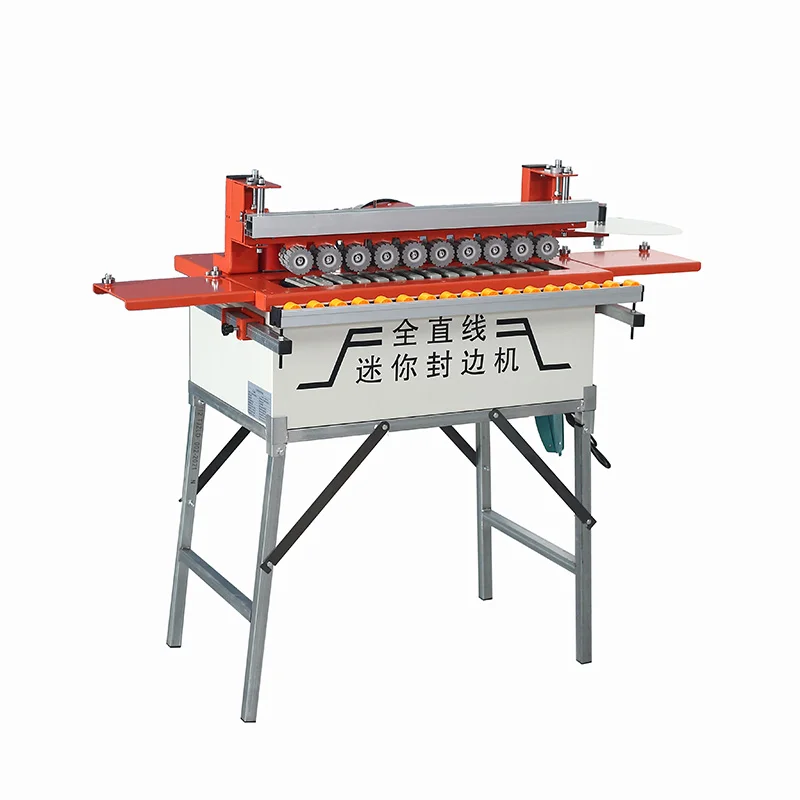
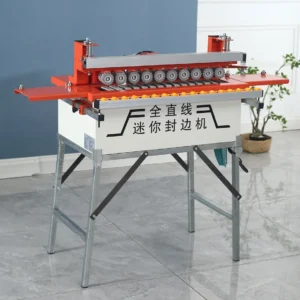
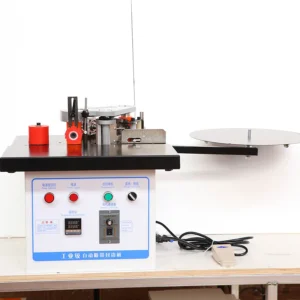
Precision Manufacturing Depth — Every component of the ZDS750 semi-automatic edge banding machine is machined, assembled, and verified under one roof before it carries an OEM partner’s brand.
Technical Specifications
| Parameter |
Value |
| Product Type |
Semi-Automatic Edge Banding Machine |
| Model |
ZDS750 |
| Function |
Portable straight and curve edge banding with automatic tape breaking and board feeding |
| Rated Voltage |
220V (configurable from 110V to 440V for OEM orders) |
| Rated Air Pressure |
0.4–0.6 MPa |
| Strip Thickness Range |
0.5–2 mm |
| Sheet Thickness Range |
7–50 mm |
| Glue Pot Capacity |
1000 ml |
| Heating Power |
800 W (5–8 min heat-up) |
| Plate Feeding Power |
60 W |
| Belt Feeding Power |
25 W |
| Edge Banding Speed |
0–6 m/min |
| Widening Bracket |
Stretch 300 mm |
| Overall Dimensions (L×W×H) |
120×50×50 cm |
| Machine Weight |
50 kg |
| Control Panel |
Inner recessed design for special-shaped edge banding |
| Pressure Beam |
One-piece aluminum alloy, double row of pressure wheels |
| Pressing Rollers |
2 elastic profiling pressing rollers |
| Gluing Device Rotation |
180° for curve edge banding |
| Assembly State |
Partially assembled, KD packing for select components |
Application Suitability
| Application |
Material or Output |
| Small-batch custom furniture edge finishing |
MDF and particleboard panels 7–50 mm thick |
| Curved cabinet door and drawer front banding |
Plywood and shaped solid wood panels |
| On-site joinery and renovation work |
PVC edge banding strips 0.5–2 mm |
| Compact workshop prototyping and sample making |
Veneer edge banding on sheet stock |
Why Voltage Confirmation Must Precede Every Semi-Automatic Edge Banding Machine OEM Factory Order
A machine built for the wrong frequency will overheat its heating element and damage the glue pot before the first panel is edged.
I once stood beside a distributor in Madrid who had just unpacked a portable edge bander wired for 380V three-phase when the workshop ran on 220V single-phase. The motor hummed, the glue never reached temperature, and two days of scheduled demos collapsed. That failure had nothing to do with the machine’s build quality and everything to do with skipping a five-minute voltage conversation. When sourcing a semi-automatic edge banding machine OEM factory order, the electrical specification is the single most consequential line on the purchase order [NEED_CITE: voltage and frequency standards by export market]. Distributors who treat voltage as a footnote absorb returns, freight cost, and reputational damage that far exceed the price of a correct stator winding.

In-House Machining of the Pressure Beam Assembly
The ZDS750 pressure beam is milled from a single aluminum alloy billet rather than welded from sections. This one-piece construction eliminates the micro-deflection points that cause uneven clamping pressure on thin 7 mm panels. The double row of pressure wheels is ground and matched in-house so that tracking force stays uniform across the full 300 mm bracket extension. For an OEM partner placing a private-label order, this matters because the pressure beam is the component most directly tied to visible glue-line quality — and the first thing an end-user blames when edging fails.
Four-Stage Quality Control on Every OEM Batch
Incoming aluminum stock is hardness-tested before it enters machining. During assembly, pneumatic leak-down tests verify every fitting on the 0.4–0.6 MPa air circuit. The finished unit runs a heated glue cycle with actual PVC strip on MDF before packing. Pre-shipment verification includes photographic documentation of the machine running under load. Each stage generates its own record, and the complete dossier travels with the container [NEED_CITE: CE machinery directive requirements for industrial equipment]. OEM partners receive copies so their own service teams can trace any field issue back to the production batch.
How Core Parameters Shape Real Workshop Output
The 800 W heating element paired with a 1000 ml glue pot reaches operating temperature in roughly five to eight minutes, which suits short-run workshops that cannot justify leaving a large industrial glue pot idling all day. The 0–6 m/min feed speed is deliberately modest; pushing PVC strip faster on a 50 kg portable frame would compromise the contact pressure that the two elastic profiling rollers maintain against the workpiece. The 180° gluing device rotation is what makes curve banding possible on a machine this size — the glue head pivots to follow concave and convex radii while the recessed control panel keeps the operator’s hands clear of the strip path. Panel thickness capability from 7 mm to 50 mm covers everything from thin MDF drawer sides to thick plywood shelving without requiring auxiliary spacer kits.
The Hidden Cost of Skipping Pre-Shipment Verification
Distributors who waive factory test runs to save a few days on lead time inherit problems that only surface once the end-user threads real material through the machine. A misaligned pressure wheel that passes a visual check will leave a visible glue line on veneer strip but may not show on PVC. A heater element wound for 60 Hz running on 50 Hz draws more current and degrades prematurely. These are not catastrophic failures; they are slow, expensive erosions of the distributor’s credibility in their territory [NEED_CITE: typical warranty claim patterns for portable woodworking equipment]. The ZDS750 pre-shipment test protocol is designed to catch exactly these mismatches before the crate is sealed.
What Manufacturing Depth Means for OEM Partners
The ZDS750 is built on a single product platform that scales from a distributor’s entry-level catalog to a mid-range portable line simply by adjusting voltage, control language, and cosmetic finish — not by switching factories. Custom paint color and logo placement are applied on the same line that produces the standard version, so build quality remains identical across SKU variants. Multilingual operation manuals and branded spare parts lists are produced in parallel with assembly, avoiding the common delay where documentation ships weeks after the machine. Mixed container orders combining the ZDS750 with full-automatic edge banders share a unified QC dossier and customs documentation package, simplifying the importer’s receiving process.
Documentation & Verification
- CE declaration of conformity issued per batch or per unit on request
- ISO 9001 certificate copy matched to the production run
- Factory test record showing the ZDS750 banding your specified panel thickness and strip material
- Electrical schematic confirming the wound voltage and frequency for your market
- Operation and maintenance manual printed in the language your end-users require
- Packing photographs documenting machine condition and crate sealing before dispatch
Installation, Commissioning & Support
- The 120×50×50 cm footprint requires only a standard 220V single-phase circuit with dedicated 10 A breaker
- KD-packed components arrive with assembly manual and video; two technicians complete setup within one shift
- Initial heat-up cycle should run the 800 W element empty for five minutes to cure the glue pot coating
- Pneumatic regulator must be set to 0.4–0.6 MPa using the onboard gauge before the first strip feed
- Elastic profiling pressing rollers should be inspected every 200 operating hours for surface wear
- Recommended distributor spare stock includes two spare pressing rollers, one heating element, and a replacement glue pot
How to Structure Your OEM Inquiry
To configure a ZDS750 batch for your market, share the target voltage and frequency, the control panel language, and the strip materials your customers most commonly run. Specify whether you need private-label packaging and branded documentation, and confirm the container mix if you are consolidating other machine models. If your end-users work with unusual panel substrates, provide sample material so the factory can run a banding test and include the result in your QC dossier.
Frequently Asked Questions
Q: What customization scope is available for OEM branding on the ZDS750?
A: Logo placement on the machine body and control panel fascia, custom paint color, private-label packaging, and branded documentation including operation manuals and spare parts lists. Voltage is configurable from 110V to 440V, and control panel language is set per order. All branding is applied on the main assembly line, not as an after-market addition.
Q: How does the four-stage QC process apply before an OEM batch ships?
A: Incoming aluminum and pneumatic components are tested on receipt. Assembly-stage checks include leak-down tests on the air circuit. The finished ZDS750 runs a live banding cycle with your specified strip and panel material. Pre-shipment verification produces photographic evidence and a signed test report that accompanies the shipment documentation package.
Q: Can we consolidate the ZDS750 with larger automatic edge banders in one container?
A: Yes. Mixed-model containers are routinely built with unified QC documentation, shared customs paperwork, and coordinated packing plans. Each machine retains its own test record while the container-level documentation simplifies your import clearance process.
Q: What spare parts ship with each OEM unit, and what should a distributor stock?
A: Each ZDS750 ships with a standard spare parts kit including fuses, seals, and a spare heating element. Distributors are advised to stock additional pressing rollers, glue pots, and pneumatic fittings based on their installed base volume and regional service response commitments.
Q: Which certifications and test records are provided per batch?
A: Each batch order includes the CE declaration of conformity, ISO 9001 certificate copy, factory test records specific to the units produced, electrical schematics confirming wound voltage, and pre-shipment photographic verification. Certification documents are prepared in formats accepted by EU and international customs authorities.