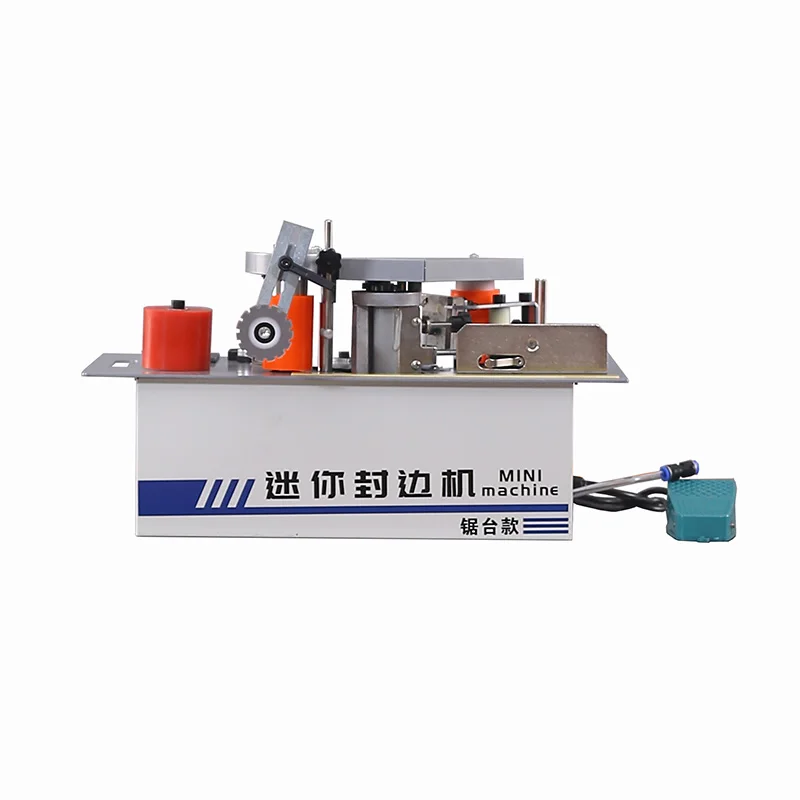
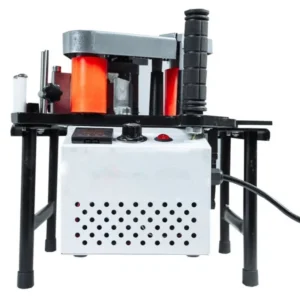
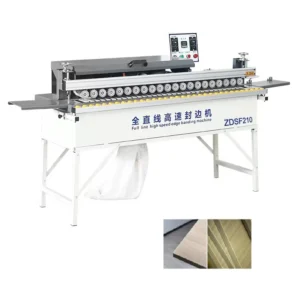
Voltage Lock-In Protocol — every portable edge banding unit undergoes mandatory voltage, frequency, and plug-type verification before assembly begins, preventing the field failures that stall installation projects.
Technical Specifications
| Parameter |
Value |
| Product Type |
Portable Edge Banding Machine |
| Voltage |
220V (configurable from 110V to 440V for OEM orders) |
| Rated Power |
825 W |
| Heating Time |
5–10 min |
| Operating Air Pressure |
0.4–0.6 MPa |
| Glue Pot Capacity |
1000 ml |
| Edge Banding Speed |
0–10 m/min |
| Edge Pattern Compatibility |
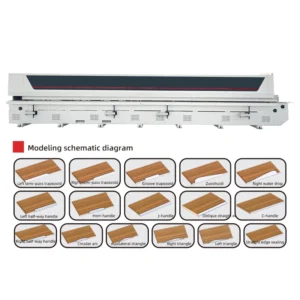
Curves, straight lines, special shaped profiles |
| Overall Dimensions |
50 × 30 × 27 cm |
| Net Weight |
13.5 kg (basis to be confirmed) |
| Control System |
Manual / Semi-automatic (basis to be confirmed) |
Application Suitability
| Application |
Material or Output |
| Custom furniture on-site installation |
MDF, plywood, and particleboard panels with PVC or veneer edge banding |
| Small workshop edge finishing |
Solid wood panels and shaped components requiring curve banding |
| Carpentry and joinery fieldwork |
Irregular profiles and special shaped edges where full-size automatic edge banders cannot reach |
| Cabinet and wardrobe assembly touch-up |
Straight and curved edges on pre-cut board stock in confined workshop spaces |
Why the Voltage Question Should Come Before the Price on Portable Edge Banders
A misconfigured motor winding does not fail gracefully — it fails on the first day.
I once watched a portable edge banding unit arrive at a job site in Vietnam, plugged in, and burn out its motor within minutes. The local supply was 380V; the machine had shipped at 415V because the specification conversation had been rushed. The installer’s entire line sat idle while a transformer was sourced. For a Portable Edge Banding Machine OEM factory, confirming voltage, frequency, and plug type is not a paperwork exercise — it is the single most consequential step in the order process [NEED_CITE: voltage and frequency standards by export market]. Machines quoted without this lock-in regularly arrive unusable, and the cost of downtime far exceeds the machine itself.

Manufacturing Depth Behind a Compact Platform
A portable edge bander may be small, but its internal components — the glue pot heating element, the feed roller mechanism, the banding guide assembly — still require precision sourcing and assembly discipline. Our facility builds these units in-house rather than outsourcing sub-assemblies, meaning component traceability is maintained from incoming raw stock through to pre-shipment testing. This level of control is what allows a Portable Edge Banding Machine OEM factory to offer genuine private-label production with consistent quality across batches.
OEM Customization Beyond a Logo Sticker
Private-label partners often discover that superficial branding changes do not satisfy their end markets. Distributors need multilingual control labels so local operators can read the interface during commissioning. They need voltage wound for their specific grid, not an approximation. The OEM scope here covers logo placement, control panel language, voltage from 110V to 440V, and custom specification sheets — all confirmed in writing before the production order is released [NEED_CITE: CE machinery directive requirements for industrial equipment]. This is how a distributor builds a defensible product line rather than reselling a generic catalog item.
Reading the Specs That Matter for Workshop Deployment
The 1000 ml glue pot capacity and 5–10 minute heating time together define how quickly an operator can begin work after powering on — relevant when a carpenter drives to a site and needs to start banding without a lengthy warm-up. The 0.4–0.6 MPa air pressure requirement tells an installer what class of compressor must accompany the machine; undersized compressors cause intermittent feed and poor glue transfer. Edge pattern versatility — curves, straight lines, and shaped profiles in a single unit — means a small workshop does not need separate machines for different edge geometries. The 0–10 m/min banding speed range gives operators manual control over feed pace, which is important when working with fragile veneer or tight inside curves where a faster feed would cause lifting or misalignment.
What Happens When Configuration Is Skipped
When a distributor orders portable edge banders without specifying the target market’s compressor standards, the machines arrive requiring air pressure that local equipment cannot deliver. Operators blame the machine; the distributor’s reputation suffers. Similarly, units shipped without confirmed panel thickness compatibility may struggle with the stock the end user actually processes, producing inconsistent glue lines and visible banding lift on certain substrates [NEED_CITE: edge banding adhesion failure causes on composite panels]. These are not manufacturing defects — they are configuration oversights that a structured OEM process prevents entirely.
Why Procurement Teams Source Here
In-house manufacturing with patented cutting mechanisms means tolerance is verifiable, not just claimed on a data sheet. Four-stage quality control — incoming material, in-process, finished product, and pre-shipment verification — generates documentation that distributors can present to their own customers as proof of conformance. Voltage and language customization is standard rather than a special request, which eliminates the commissioning delays that plague international equipment orders. Full product range availability, from entry-level portable units to complete production lines, allows a single supplier relationship to scale with a distributor’s territory growth.
Documentation & Verification
- CE declaration of conformity specific to portable edge banding equipment
- ISO 9001 certificate covering the manufacturing quality management system
- Factory test record documenting banding performance on your specified panel material
- Electrical schematic with confirmed voltage and frequency for your destination market
- Operation manual in the operator’s language with illustrated maintenance procedures
- Spare parts list with part numbers matching the as-built configuration
Installation, Commissioning & Support
- 825 W power draw requires only a standard 220V circuit with appropriate breaker rating
- 50 × 30 × 27 cm footprint allows benchtop placement without dedicated floor space
- 0.4–0.6 MPa air supply must come from a compressor with adequate flow reserve
- 5–10 minute glue pot warm-up verified during first-power commissioning check
- Curved and straight edge banding demonstrated on your panel stock during setup
- Spare glue pot heating elements and feed rollers included in initial parts kit
Before You Request a Quotation
To configure a portable edge banding machine for your market, share the panel materials and thicknesses your customers typically process, the edge banding material types you plan to stock, and the local voltage and frequency standard. If you are evaluating this as an OEM or private-label product, indicate your branding requirements, preferred control panel language, and target order volume so the engineering team can prepare a configuration proposal and formal quotation.
Frequently Asked Questions
Q: What OEM customization is available for portable edge banding machines?
A: Customization covers logo placement on the machine body, voltage wound to your local grid from 110V to 440V, control panel labels in your operator’s language, and tailored specification documentation. All modifications are confirmed in writing before production begins, ensuring your private-label product matches your market requirements exactly.
Q: How does the four-stage quality control process apply to portable units?
A: Each stage — incoming material inspection, in-process assembly checks, finished product testing, and pre-shipment verification — is documented with records available per order. For portable edge banders, this includes glue pot heating performance, feed roller alignment, and banding adhesion tests on your specified panel material before dispatch.
Q: Can distributors visit the factory to witness production and testing?
A: Factory visits are welcomed at any stage. Distributors and OEM partners can observe component sourcing, assembly processes, and pre-shipment testing of their specific orders. Witnessing production firsthand builds confidence in manufacturing depth and provides material for your own sales presentations.
Q: How are spare parts and documentation handled for international partners?
A: Each shipment includes a spare parts list with numbers matching the as-built machine, an operation manual in the agreed language, and an electrical schematic confirming your voltage configuration. Replenishment parts are available for reorder, and technical support is provided remotely during installation and commissioning.