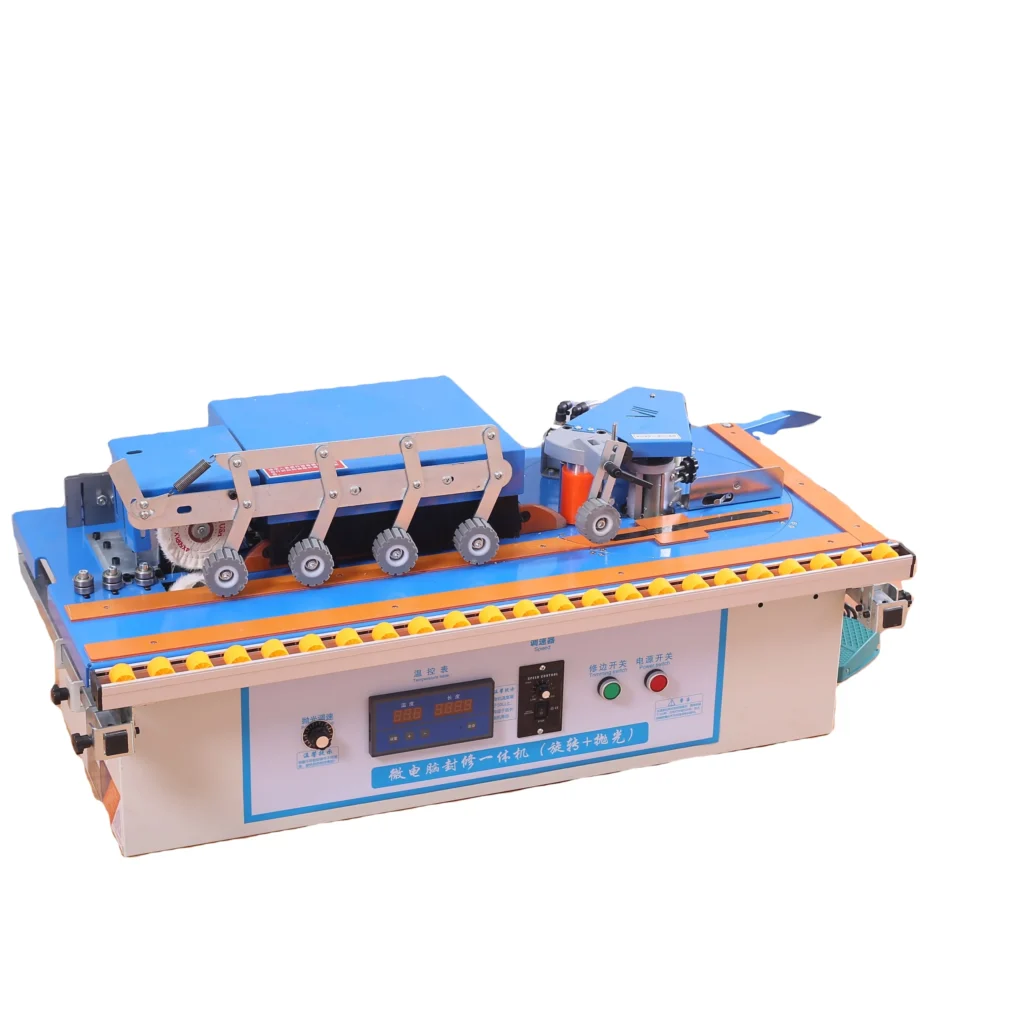
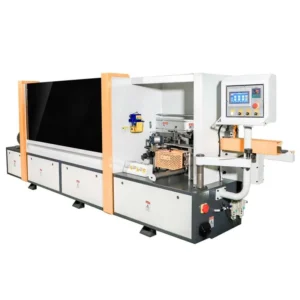
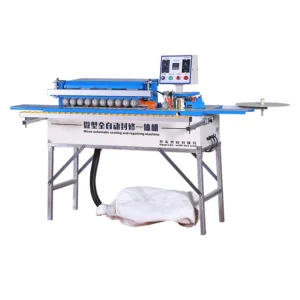
Built on Verified Assembly — Every ZDSF120 portable edge banding machine leaves our floor with documented four-stage QC records, giving OEM partners traceable proof of tolerance before the crate is sealed.
Technical Specifications
| Parameter |
Value |
| Product Type |
Portable Edge Banding Machine |
| Machine Type |
All-in-one polishing and sealing machine (edge banding, trimming, polishing) |
| Rated Voltage |
220V |
| Total Power |
2.4 kW |
| Overall Dimensions (L×W×H) |
105×50×45 cm |
| Net Weight |
45 kg |
| Air Supply Requirement |
0.4–0.6 MPa |
| Strip Thickness Range |
0.5–2 mm |
| Sheet Thickness Range |
10–50 mm |
| Glue Pot Capacity |
1000 ml |
| Glue Pot Heating Power |
800 W |
| Glue Heat-up Time |
5–10 min |
| Belt Feeding Speed |
0–14 m/min |
| Feeding Motor |
25 W |
| Trimming Power |
800 W ×2 |
| Trimming Stations |
Top and bottom trimming, pneumatic trim |
| Gluing Method |
Double-sided gluing |
| Applicable Banding Materials |
PVC, veneer, melamine |
| Warranty |
1 Year |
Application Suitability
| Application |
Material or Output |
| Handicraft workshop edge finishing |
Plywood and MDF panels with PVC or veneer banding |
| Small-scale custom furniture production |
Particleboard and MDF cabinet components, 10–50 mm thick |
| On-site carpentry and joinery |
Solid wood panels and plywood with melamine edge strips |
| Prototype and sample room processing |
Mixed substrates requiring quick changeover between strip thicknesses |
| Small-batch edge banding for renovation contractors |
MDF and plywood cut-to-size panels with PVC banding |
Why Voltage Confirmation Must Precede the Purchase Order
A portable edge banding machine rated for 220V will not start on a 380V three-phase supply, and a transformer retrofit can stall a workshop for weeks.
I learned this the hard way early in my career. We shipped an edge bander to a Middle East customer without rechecking the local single-phase supply. The machine sat idle on their floor for three weeks while a step-down transformer was sourced locally. Panels piled up across the workshop waiting for the machine to run. Since that incident, every electrical configuration is confirmed against the buyer’s local grid before production begins. When sourcing a Portable Edge Banding Machine OEM factory, the first question should always be about the destination voltage and frequency, not the unit price [NEED_CITE: voltage and frequency standards by export market].

How Private-Label Partners Evaluate the Build
Distributors and importers do not just buy a machine; they buy the manufacturing depth behind it. The ZDSF120 is produced in-house with precision-ground components and a proprietary trimming mechanism, not assembled from sourced sub-assemblies. This matters for OEM partners who put their own brand on the equipment and cannot afford field failures that trace back to weak internal construction. Each unit goes through incoming material inspection, in-process checks, finished product verification, and a pre-shipment test run. A Portable Edge Banding Machine OEM factory that controls every stage gives resellers confidence when they stand behind the label on the side panel.
What Four-Stage QC Means in Practice
Incoming inspection catches raw material defects before they enter the line. In-process checks verify that machined surfaces meet tolerance during assembly rather than after. Finished product verification tests every station — gluing, feeding, trimming, polishing — under actual operating conditions. The pre-shipment stage runs the machine on sample panels and records the results before packing. For an OEM buyer, these records form part of the documentation package and provide evidence that the machine was tested, not just switched on. This level of traceability is what separates a true Portable Edge Banding Machine OEM factory from a trading company relabelling stock [NEED_CITE: CE machinery directive requirements for industrial equipment].
Reading the Specs That Actually Affect Output Quality
The double-sided gluing method applies adhesive to both the panel edge and the banding strip simultaneously, which improves bond strength on porous substrates like MDF and particleboard compared to single-sided application. The 1000 ml glue pot with 800 W heating reaches working temperature within minutes, reducing idle time at the start of each shift. The dual 800 W trimming stations handle top and bottom trimming in one pass, and the pneumatic trim mechanism adjusts to strip thickness without manual dial changes. Belt feeding speed from 0 to 14 m/min allows operators to slow down for curves or small workpieces and speed up for straight runs. The sheet thickness range of 10–50 mm covers the majority of panel stock used in cabinet and furniture work, while the 0.5–2 mm strip range handles everything from thin melamine to thicker PVC and veneer banding. These parameters together define what the machine can actually process, not just what the brochure claims.
The Cost of Skipping the Configuration Check
When a portable edge bander arrives at a workshop with the wrong voltage or an incompatible air supply, the machine becomes a heavy object on the floor. We have seen buyers order single machines without confirming that their compressor meets the 0.4–0.6 MPa requirement, only to find the pneumatic trim stations will not cycle. Others have purchased units with control panels in a language their operators cannot read, delaying commissioning while translated overlays are produced. These are not engineering failures — they are configuration oversights that cost time and money in the field [NEED_CITE: industrial equipment commissioning delays due to specification mismatch].
What Sets This Manufacturing Source Apart
In-house production means the trimming mechanism and gluing assembly are built and tested under one roof, not outsourced and bolted together. Voltage can be configured from 110V to 440V and control panels produced in the operator’s language as a standard option, not a special request. OEM partners can specify custom logos, private-label colour schemes, and branded documentation. The four-stage QC process generates test records that travel with the machine, giving distributors documented proof to show their own customers. Engineer-led configuration review happens before the order is confirmed, reducing the chance of a mismatch reaching the shipping container.
Documentation & Verification
- CE declaration of conformity covering the ZDSF120 portable edge banding machine
- ISO 9001 certificate for the manufacturing quality management system
- Electrical schematic with confirmed voltage and frequency for destination market
- Factory test record on buyer’s specified panel and strip material before dispatch
- Operation and maintenance manual in the agreed language with illustrated spare parts list
- Packing photographs and customs documentation support for export clearance
Installation, Commissioning & Support
- Requires a dedicated 220V single-phase circuit rated for at least 2.4 kW continuous draw
- Compressed air line must deliver 0.4–0.6 MPa at the machine inlet with a moisture trap fitted
- Compact 105×50×45 cm footprint allows placement on a standard workbench without floor anchoring
- Net weight of 45 kg means two people can reposition the unit within the workshop as needed
- First commissioning includes glue pot heat-up verification, feed speed calibration, and trim station alignment
- 1000 ml glue pot and dual trimming cutters listed as primary consumables with replacement intervals documented
What to Include in Your Inquiry
To configure the right unit for your market, share the destination voltage and frequency, the banding materials your customers most commonly use, and the panel thickness range they process. If you plan to sell under your own brand, let us know the logo placement and documentation language you need. For distributor partners building a model mix, indicate which other edge bander classes you carry so we can position this portable unit within your range.
Frequently Asked Questions
Q: What OEM customization options are available for private-label edge banding machines?
A: The factory can apply custom logos, configure voltage from 110V to 440V, produce multilingual control panels, and print branded operation manuals. Colour schemes for the machine housing can also be adjusted to match your brand identity. Each customization is confirmed in the specification sheet before production begins.
Q: How is edge banding tolerance verified and documented before shipment?
A: Every machine runs through a four-stage QC process ending with a pre-shipment test on sample panels. Trim quality, glue adhesion, and feed consistency are checked and recorded. The factory test report is included in the documentation package so OEM buyers have written evidence of performance.
Q: What voltage configurations can the factory produce for different export markets?
A: Standard production covers 110V through 440V at either 50 Hz or 60 Hz. The buyer confirms the destination grid specification during the inquiry stage, and the electrical schematic is updated accordingly. This prevents the situation where a machine arrives on site and cannot be powered without an external transformer.
Q: How does the four-stage QC process ensure consistent edge finishing quality?
A: Incoming material inspection rejects substandard components before assembly. In-process checks verify machined tolerances during build. Finished product testing runs all stations under load. The pre-shipment stage repeats critical tests on actual panel samples and records results, catching any drift before the machine is packed.
Q: What spare parts and technical support are provided to OEM partners and distributors?
A: A spare parts list covering consumables like trimming cutters, glue pot heating elements, and feed belt components is included with each machine. Technical documentation provides illustrated assembly references, and the engineering team supports troubleshooting through remote diagnostics during the warranty period.