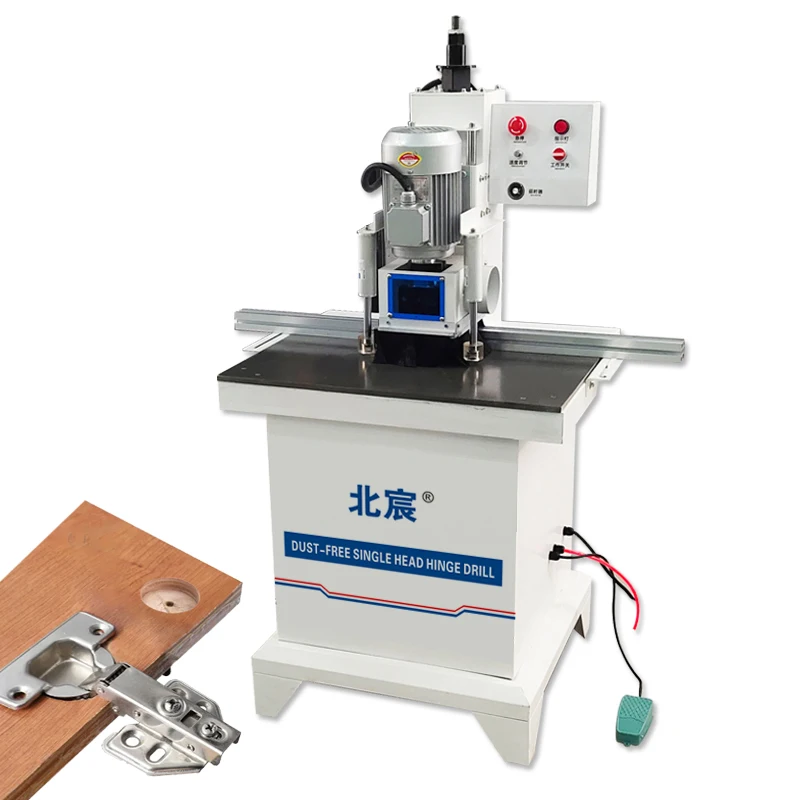
Precision-ground components — every JL-1 hinge boring machine leaves the facility with a factory test record documenting actual drilling accuracy, verified through four-stage QC and available under your private label.
Technical Specifications
| Parameter |
Value |
| Model |
JL-1 |
| Product Type |
Single Row Hinge Boring Machine |
| Rated Power |
1.5 kW |
| Voltage & Frequency |
380V/415V three-phase four-wire (configurable from 110V to 440V) |
| Control System |
Foot switch control |
| Drill Sizes |
Large drill 35 mm, small drill 3 mm |
| Standard Function |
Cabinet door hinge hole opening |
| Guide Rail |
Precision guide rails for sliding |
| Motor Type |
Pure copper motor |
| Overall Dimensions (L×W×H) |
70 × 56 × 145 cm |
| Net Weight |
55 kg |
| Vacuum Power |
External vacuum connection (basis to be confirmed) |
| Language Options |
Chinese and English standard; other languages customizable |
| Customization |
Structure, parameters, OEM logo supported |
| Assembly State |
Fully assembled at factory |
| Certification |
CE, ISO 9001 |
Application Suitability
| Application |
Material or Output |
| Cabinet door hinge cup drilling |
MDF, particleboard, plywood panels |
| Wardrobe door manufacturing |
Melamine-faced chipboard and MDF |
| Loose leaf hinge pilot holes |
Solid wood panels and veneered boards |
| Batch hinge hole processing |
Furniture factories moving from manual to mechanized drilling |
Why Tolerance Claims Fail When Panels Reach the Assembly Line
A ±0.02 mm drilling tolerance means nothing unless it is documented against the actual board density you run.
Many hinge boring machines are rated on standard particleboard during factory tests. But a furniture workshop cutting high-density MDF day in and day out places different loads on the spindle and guide rails. Over time, bore positions drift, hinge cups sit proud or recessed, and assembled doors show misalignment that is visible to the naked eye [NEED_CITE: CE machinery directive requirements for industrial equipment]. The hinge boring machine factory you source from must verify tolerance on the specific substrate you process — not a generic test board.

How This Machine Is Built for Repeatable Accuracy
The JL-1 uses precision-ground guide rails paired with a pure copper motor to maintain low-vibration sliding motion throughout the drilling stroke. The dual drill configuration — a 35 mm large drill for the hinge cup and a 3 mm small drill for the pilot hole — completes both operations in a single setup. This eliminates the repositioning errors that occur when an operator moves the panel between two separate machines or manual jigs.
Manufacturing Depth Behind OEM Capability
As a hinge boring machine factory, the production line covers component sourcing, precision grinding, and final assembly under one roof. OEM partners receive machines with custom logo placement, structural modifications, and multilingual control interfaces — all confirmed with formal design documentation before mass production begins. This depth matters for distributors who need consistent branding and specification across their regional product range [NEED_CITE: voltage and frequency standards by export market].
Reading the Specs That Matter for Hinge Boring
The 1.5 kW rated power drives the spindle through dense substrates without bogging down, but sustained operation on MDF above 750 kg/m³ requires verifying thermal performance during the factory test. The 380V/415V three-phase supply is standard for most industrial markets, yet the voltage remains configurable from 110V to 440V to match local grid conditions — a detail that determines whether the machine can be commissioned on arrival or sits idle waiting for an electrician. Foot switch control keeps both hands free for panel handling, while the vertically and horizontally adjustable drilling position allows rapid changeover between different hinge cup depths and offsets. The 70 × 56 × 145 cm footprint fits alongside existing panel saws and edge banders without requiring dedicated floor space reconfiguration.
The Cost of Skipping Voltage Confirmation
A machine wired for 380V/50Hz arriving in a region running 220V/60Hz will either fail to start or burn out the spindle motor within days. The JL-1 ships with an electrical schematic confirming the exact voltage and frequency built into that unit. Distributors and end users must verify their local supply before the order is placed — not after the crate is opened on the workshop floor [NEED_CITE: electrical safety standards for imported industrial machinery].
What You Get When You Source Directly
In-house manufacturing means every precision-ground component and patented mechanism is traceable to a specific production batch. The four-stage QC process — incoming material inspection, in-process checks, finished product verification, and pre-shipment testing — catches tolerance drift before the machine is crated. Voltage, language, and structural specifications are confirmed in writing with each order. Factory visits are open so distributors can inspect grinding stations, assembly benches, and test rigs firsthand. The JL-1 product family allows a workshop to add capacity without introducing a second supplier’s learning curve.
Documentation & Verification
- CE declaration of conformity for EU market access
- ISO 9001 certificate covering the manufacturing system
- Electrical schematic with confirmed voltage and frequency for your market
- Factory test record drilled on your specified panel thickness and material
- Operation and maintenance manual in the agreed language
- Spare parts list with cross-reference numbers for reorder
Installation, Commissioning & Support
- Requires a level concrete floor; 55 kg net weight needs no special foundation
- Dedicated circuit matching the confirmed 380V/415V or custom voltage specification
- Arrives fully assembled — no on-site mechanical build required
- External vacuum connection to be routed to your existing dust extraction system
- First-run parameter setup and hinge cup depth calibration included in guidance
- Spare drill bits and wear components listed in the shipped parts inventory
How to Structure Your Inquiry
Send your panel material type, board thickness range, and the hinge cup specifications your production uses. Confirm your local voltage and frequency, the language your operators require, and whether you need OEM branding with custom logo and color. If you run a specific substrate density that has caused issues with previous equipment, state that so the factory test can replicate your actual conditions.
Frequently Asked Questions
Q: How is the ±0.02 mm drilling tolerance verified and documented before shipment?
A: Every JL-1 undergoes pre-shipment verification where test holes are drilled on the panel material you specify. The factory test record documents actual measured bore positions against the target coordinates. This record ships with the machine, giving you a baseline for ongoing quality checks.
Q: What OEM customization is available for distributors?
A: Logo placement, voltage from 110V to 440V, multilingual control panels, and structural modifications are all available. Each OEM specification is confirmed with formal design documentation before production begins, ensuring consistency across your entire order batch.
Q: What does the four-stage QC process cover?
A: Incoming material inspection verifies raw component quality, in-process checks monitor grinding and assembly tolerances, finished product testing confirms functional performance, and pre-shipment verification validates drilling accuracy on your specified material before crating.
Q: How does the JL-1 integrate with upstream and downstream equipment?
A: The 70 × 56 × 145 cm footprint and standard feed height allow the machine to sit between a panel saw and an edge bander. Throughput matching depends on your panel size and hinge count per door, which should be confirmed during the configuration discussion.
Q: What spare parts support do distributors receive?
A: Each machine ships with a spare parts list and cross-reference numbers. Distributor service teams can access technical training on adjustment procedures, drill replacement, and guide rail maintenance to handle common service requirements locally.