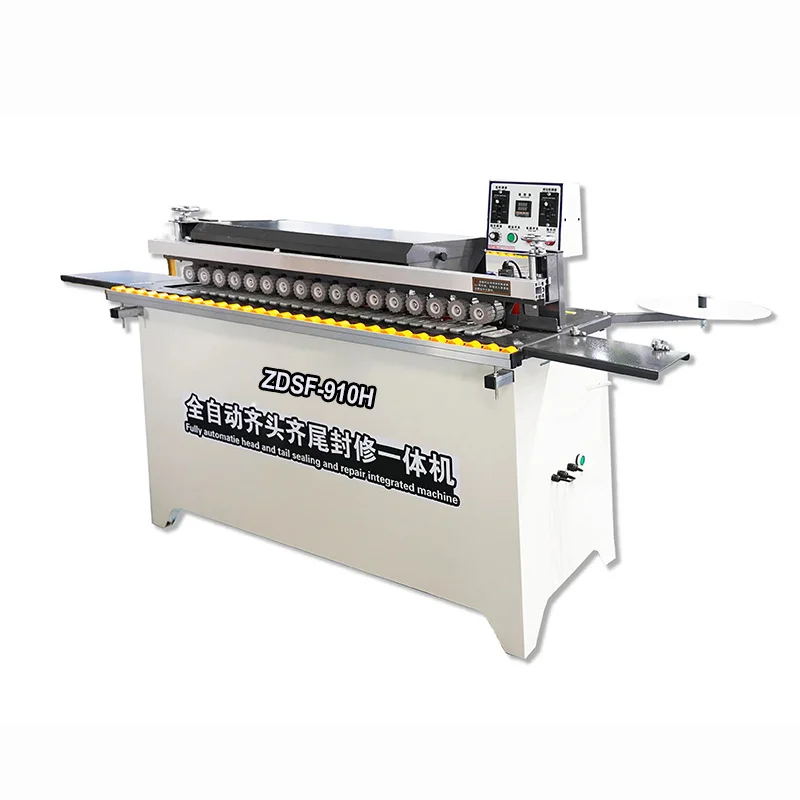
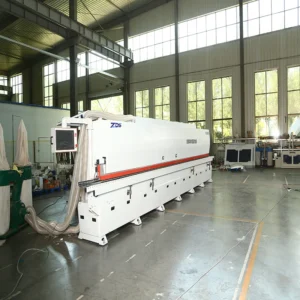
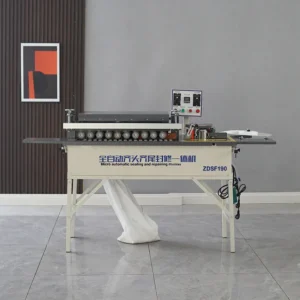
In-house manufacturing depth — the 910H miniature curved and straight edge bander is built on our factory floor with proprietary trimming mechanisms, precision-ground components, and full OEM customization available for distributors.
Technical Specifications
| Parameter |
Value |
| Model |
910H |
| Product Type |
Miniature Fully Automatic Curved and Straight Dual-purpose Edge Banding Machine |
| Function |
Automatic plate feeding, double-sided gluing, upper and lower polishing, automatic head and tail trimming, curved and straight edge banding |
| Edge Type |
Both curved and straight lines |
| Voltage |
220V 50Hz (configurable from 110V to 440V) |
| Rated Power |
4 kW |
| Rated Air Pressure |
0.4–0.6 MPa |
| Suction Power |
1200 W |
| Heating Power |
800 W |
| Polishing Power |
180 W × 2 |
| Trimming Power |
800 W × 2 |
| Sheet Thickness Range |
10–50 mm |
| Strip Thickness Range |
0.5–2.5 mm |
| Glue Capacity |
1000 ml |
| Minimum Board Width for Edge Sealing |
2.5 cm |
| Feed Mechanism |
Steel rod slide rails crawler transmission, double-row rubber pressure wheels |
| Pressure Beam |
Adjustable aluminum alloy |
| Trimming Stations |
2 high-speed motors with alloy arc knife |
| Dust Extraction |
2 large-diameter dust collectors, collection effect up to 99% |
| Overall Dimensions |
1300 × 560 × 1090 mm |
| Net Weight |
140 kg |
Application Suitability
| Application |
Material or Output |
| Custom furniture panel edge banding |
MDF, plywood, particleboard, melamine boards |
| Small-workshop curved panel finishing |
PVC and melamine edge strips on shaped components |
| Cabinet door and drawer front processing |
Straight and contoured edges on substrate panels up to 50 mm thick |
| Prototype and short-run joinery |
Mixed substrate batches requiring quick changeover between curved and straight profiles |
Why Distributors Should Verify Factory Depth Before Placing an OEM Order
A claimed tolerance means nothing if the edge banding machine factory cannot prove it at every QC checkpoint before your container ships.
When an importer sources compact edge banders for regional resale, the first problem that surfaces is rarely the machine itself — it is the gap between what the brochure promised and what the end user experiences on the shop floor. Distributors who have stocked machines from trading companies often discover that component sourcing is opaque, precision grinding standards are undocumented, and pre-shipment testing was limited to a power-on check [NEED_CITE: due diligence expectations for woodworking machinery importers]. The 910H is manufactured entirely in-house, which means an OEM edge bander manufacturer can show you the assembly line, the grinding stations, and the four-stage QC records tied to each serial number.

Component Sourcing and Assembly Transparency
Every critical component on the 910H — from the 800 W trimming motors to the steel rod slide rail crawler — is traceable to its source. For an edge banding machine factory serving distributors, this traceability matters because your service team will eventually need to identify replacement parts in the field. We maintain a full bill of materials for each unit and share it with OEM partners so that regional spare parts inventories can be planned before the first container arrives.
Four-Stage QC Built Around Distributor Accountability
Incoming material inspection catches dimensional drift in pressure beam extrusions before they reach assembly. In-process checks verify that the alloy arc knives on both trimming stations run true at operating speed. Finished-product testing involves running actual MDF and plywood panels through curved and straight cycles. Pre-shipment verification repeats the panel test under the voltage and frequency specified for the destination market [NEED_CITE: export market voltage and frequency verification standards]. Each stage produces a signed record, and these records ship with the machine.
Reading the Specs That Actually Affect Edge Quality
The 10–50 mm sheet thickness range is governed by the adjustable aluminum alloy pressure beam and the double-row rubber pressure wheels; running stock thinner than 10 mm risks insufficient clamping force, while panels above 50 mm may not clear the feed throat. The 0.5–2.5 mm strip thickness range covers standard PVC and melamine banding, and the double-sided gluing system with a 1000 ml glue pot maintains thermal consistency across a shift. The two 800 W trimming motors paired with alloy arc knives handle the transition from straight runs to curved profiles without a manual cutter swap — a feature that reduces changeover time when a workshop alternates between cabinet sides and shaped door fronts. Dust extraction through two large-diameter collectors keeps the trimming zone clear, which directly affects the consistency of the polished edge downstream.
The Hidden Cost of Specifying the Wrong Compact Edge Bander for Your Market
Stocking a compact edge bander that was designed for light-duty hobby use in workshops that run it at production volumes leads to premature wear on the feed mechanism and inconsistent glue application. Distributors who skip the factory audit often find that the pressure beam lacks rigidity, causing the strip to lift on thicker substrates [NEED_CITE: field failure patterns in compact edge banding equipment]. When your end user blames the machine brand on social media, the reputational cost far exceeds the unit price difference. The 910H is engineered for small-workshop production volumes with a steel rod slide rail system that maintains feed stability through sustained daily use.
Why Procure the 910H Through This Factory Channel
The 910H carries proprietary curved and straight dual-purpose trimming mechanisms developed and manufactured on our own floor, so an OEM edge bander manufacturer can offer genuine engineering support rather than relayed messages. Four-stage QC with pre-shipment verification means your container leaves with test records, not just a packing list. Voltage customization from 110 V to 440 V and multilingual control panels are configured as standard options, not special requests. Full OEM scope — custom logo, private-label documentation, territory-specific electrical schematics — is confirmed at the quotation stage so there are no surprises at inspection. Factory visits are welcomed at any production phase, and you can watch your units move through each QC checkpoint before crating.
Documentation & Verification
- CE declaration of conformity covering the 910H electrical and mechanical safety scope
- ISO 9001 certificate for the manufacturing facility producing this edge bander line
- Factory test record on your specified panel thickness and edge strip material before dispatch
- Electrical schematic and voltage confirmation matching the destination market standard
- Operation and maintenance manual in the agreed language with exploded diagrams
Installation, Commissioning & Support
- 220 V 50 Hz single-phase supply on a dedicated 4 kW circuit; confirm local frequency before wiring
- Overall footprint of 1300 × 560 mm fits standard workshop bays; level the floor within 3 mm across the base
- Machine ships fully assembled; connect the 0.4–0.6 MPa air line and two dust extraction hoses on arrival
- First-run calibration covers glue temperature at 800 W heating power and trimming motor alignment on your panel stock
- Two high-speed trimming motors and alloy arc knives are the primary wear items; spare set included in the parts kit
- Grease the steel rod slide rails and inspect double-row rubber pressure wheels at weekly intervals
What to Include in Your Inquiry
Share the substrate materials and edge strip types your regional customers process most frequently, along with the local voltage and frequency standard. Specify whether your market requires control panel labeling in a particular language. If you are building a model mix across entry-level and full-production tiers, outline the throughput range your customers expect so we can position the 910H correctly within the broader line.
Frequently Asked Questions
Q: What is the OEM and private-label capability for this edge bander?
A: The 910H supports full private-label customization including your logo on the machine body, branded control panel overlays, custom-colored housings, and territory-specific documentation. OEM scope is confirmed at quotation stage with a detailed checklist covering visual identity, electrical configuration, and language requirements so that every unit in your order ships under your brand.
Q: How does the four-stage QC process verify trimming accuracy before shipment?
A: Incoming inspection checks pressure beam straightness and alloy arc knife balance. In-process verification measures trimming motor runout at operating speed. Finished-product testing runs MDF and plywood panels through both curved and straight cycles. Pre-shipment verification repeats the test under the destination voltage, and all four records are signed and packed with the machine.
Q: Can voltage, frequency, and control panel language be customized for my market?
A: Yes. The 910H motor and heating circuit can be configured for voltages from 110 V to 440 V, and frequency is matched to 50 Hz or 60 Hz standards. The multi-function button operation panel is labeled in the language you specify. Electrical schematics shipped with the machine reflect the confirmed configuration.
Q: What component sourcing and precision grinding standards are applied during manufacturing?
A: Critical components including the steel rod slide rails and alloy arc knives are sourced from qualified suppliers and inspected on receipt. Precision-ground surfaces on the feed mechanism and pressure beam are measured against dimensional tolerances at each assembly stage. A full bill of materials is available to OEM partners for service planning.
Q: How do you support distributors with spare parts backup and technical training?
A: Each 910H ships with a spare parts list identifying wear items such as trimming knives, rubber pressure wheels, and glue pot seals. We provide technical documentation your service team can reference in the field, and factory training sessions can be arranged during pre-shipment inspection visits to familiarize your technicians with assembly details and common service procedures.