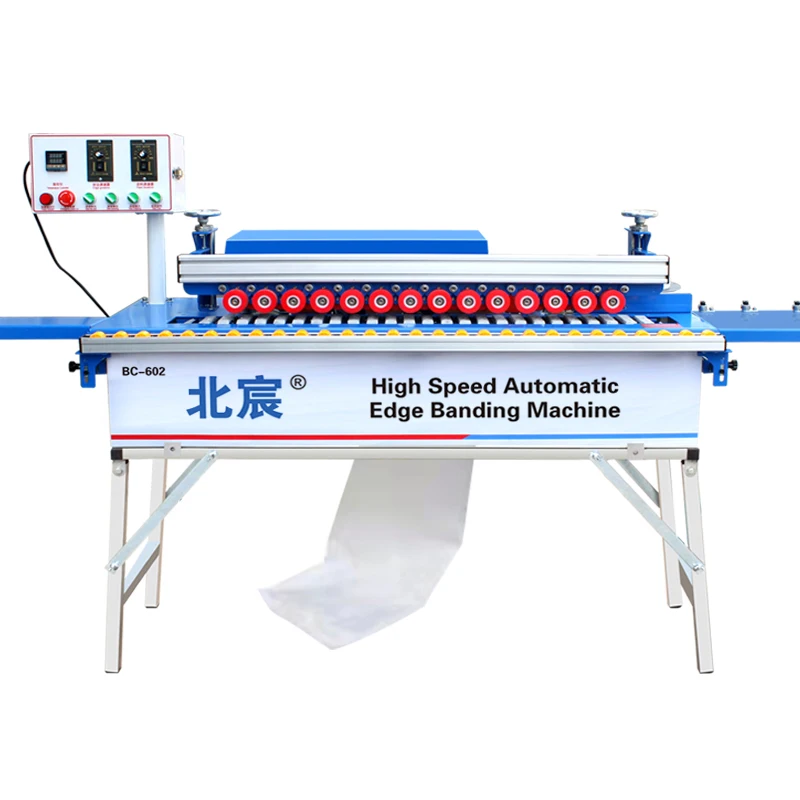
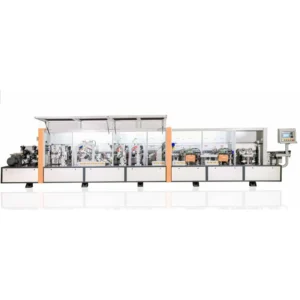
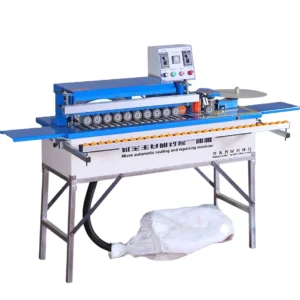
Precision-ground components with OEM private-label capability — The DW602 is built on a factory floor where every component passes four-stage inspection before assembly, giving distributors a verifiable quality story they can carry into their own regional markets.
Technical Specifications
| Parameter |
Value |
| Model |
DW602 |
| Product Type |
Automatic Edge Banding Machine |
| Total Power |
3800W |
| Voltage & Frequency |
220V / 380V / customization available |
| Edge Banding Thickness Range |
0.3–3 mm |
| Edge Banding Height Range |
0–50 mm |
| Minimum Sheet Length |
25 cm |
| Minimum Sheet Width |
5 cm |
| Glue Pot Capacity |
1000 ml |
| Trimming Power |
650W × 2 |
| Polishing Power |
180W × 2 |
| Vacuum Power |
1200W |
| Transmission Power |
60W |
| Edge Motor Power |
20W |
| Air Source Pressure |
0.5–0.8 MPa |
| Overall Dimensions (L×W×H) |
128 × 47 × 69 cm |
| Net Weight |
90 kg |
| Control Panel Language |
Chinese & English standard; Spanish, French, or other languages on request |
| Key Features |
Edge banding, trimming, polishing, automatic head and tail cutting, vacuum assist |
| Certification |
CE |
Application Suitability
| Application |
Material or Output |
| Custom cabinet and furniture panel edging |
MDF and particleboard with PVC or veneer banding |
| Plywood door panel finishing |
Plywood with 0.3–3 mm edge banding materials |
| Blockboard edge processing |
Blockboard substrates requiring straight edge trimming and polishing |
| Polymer door panel production |
Polymer composite panels with adhesive edge bonding |
| Small-batch joinery components |
Narrow stock down to 5 cm width and 25 cm length |
Why the Voltage Question Must Come Before the Quotation
Every DW602 automatic edge banding machine manufacturer should confirm local electrical standards before a single component is sourced.
I spent years on the assembly floor in Shandong before moving into technical sales, and one mistake still sits with me. We shipped a unit to the Middle East without verifying the site voltage — 380V equipment landed on a 415V grid and the transformer burned out on first power-up. The customer’s entire line sat idle for three weeks waiting for a replacement. That failure had nothing to do with engineering quality and everything to do with a missing conversation [NEED_CITE: voltage and frequency standards by export market].
Sourcing Depth and Private-Label Readiness
Distributors evaluating an automatic edge banding machine manufacturer need to look past the brochure and into the production process. The DW602 is assembled in-house from precision-ground components, meaning private-label buyers can audit the actual build quality rather than relying on a trading company’s assurances. Component sourcing, machining tolerances, and assembly sequences are all traceable within the facility.
OEM Configuration Without Compromising Lead Time
Custom logo placement, branded documentation, and tailored machine specifications are standard OEM options rather than special requests. A distributor ordering for a regional market can specify control panel language, voltage format, and edge banding thickness range while keeping production lead times within a typical multi-week window. This matters when a single stocking order needs to serve workshops running different substrates and operator skill levels [NEED_CITE: CE machinery directive requirements for industrial equipment].
Reading the Specification Sheet Against Real Workshop Needs
The 0.3–3 mm edge banding thickness range covers PVC, veneer, and similar materials commonly stocked by furniture and cabinet makers. The dual 650W trimming motors provide sufficient cutting force for clean end-trim cuts on particleboard and MDF without tear-out, while the 180W × 2 polishing units deliver a finished edge surface ready for downstream assembly. The 1000 ml glue pot capacity supports continuous runs on standard panel sizes without frequent refills, and the 0.5–0.8 MPa air pressure requirement is compatible with standard workshop compressor setups. Compact dimensions of 128 × 47 × 69 cm allow the machine to fit into workshops where floor space constrains line layout decisions.

The Hidden Cost of Skipping Electrical Verification
When voltage and frequency are assumed rather than confirmed, the consequences extend beyond a burned transformer. Control boards, motor windings, and heating elements all operate outside their rated parameters, leading to intermittent faults that are difficult to diagnose once the machine is installed. Distributors who receive machines without matching electrical documentation face warranty disputes and eroded customer trust in their territory — problems that no amount of after-sales support can fully repair [NEED_CITE: electrical compliance requirements for exported machinery].
Why Distributors Source This Equipment Here
The DW602 is manufactured entirely in-house, giving OEM partners full visibility into component quality and assembly standards. Private-label capability extends from machine branding to packaging and documentation, supporting a distributor’s own market identity. Voltage customization across 220V, 380V, and additional formats is confirmed at the quotation stage, not discovered at the installation stage. Four-stage quality control — incoming material, in-process, finished product, and pre-shipment verification — means every unit carries documented inspection records. Engineer-led configuration ensures the machine specification matches the buyer’s actual panel materials and production requirements.
Documentation & Verification
- CE declaration of conformity covering the DW602 automatic edge banding machine
- ISO 9001 certificate for the manufacturing quality management system
- Electrical schematic with confirmed voltage and frequency for the destination market
- Factory test record run on buyer-specified panel thickness and edge material
- Operation and maintenance manual produced in the agreed operator language
- Spare parts list with wearing part identification and reorder references
Installation, Commissioning & Support
- 128 × 47 × 69 cm footprint requires a level floor pad with clearance for operator access on three sides
- 3800W total power draw demands a dedicated circuit matching the confirmed voltage and frequency
- Machine ships with glue pot, trimming heads, and polishing units pre-assembled and aligned
- First commissioning includes air pressure calibration within the 0.5–0.8 MPa operating range
- Operator training covers edge banding thickness adjustment across the 0.3–3 mm range
- Spare wearing parts kit supplied for initial operational period and maintenance planning
What We Need to Configure Your DW602 Correctly
Provide the panel materials and thicknesses your customers process most frequently, along with the edge banding materials and thicknesses they specify. Confirm the local voltage, frequency, and plug type at the installation site, and indicate the preferred control panel language for the operators. If the machine will join an existing production line, share the upstream and downstream equipment specifications so feed height and throughput can be matched.
Frequently Asked Questions
Q: What does OEM private-label coverage include for this edge banding machine?
A: OEM scope covers custom logo placement on the machine body, branded packaging, and documentation produced under your company name. Control panel language, voltage format, and specification details can all be configured to your market requirements. Single-unit sample orders through to large production runs are supported.
Q: How is voltage and frequency confirmed before production starts?
A: We request the destination country, site voltage, frequency, and plug type during the inquiry stage. The electrical schematic is reviewed and confirmed before any component sourcing begins, ensuring the DW602 arrives ready to connect to the local grid without transformers or adapters.
Q: Which control panel languages are available for operators?
A: Chinese and English are standard. Spanish, French, and other languages are available on request. The agreed language is confirmed at the quotation stage so the control interface and operation manual match the operator’s working language upon delivery.
Q: What does the pre-shipment testing protocol cover?
A: Each unit undergoes a factory test on panel material and edge banding thickness matching the buyer’s specification. Test records, packing photographs, and inspection documentation are provided before dispatch, giving distributors and end users verifiable proof of machine performance prior to shipment.