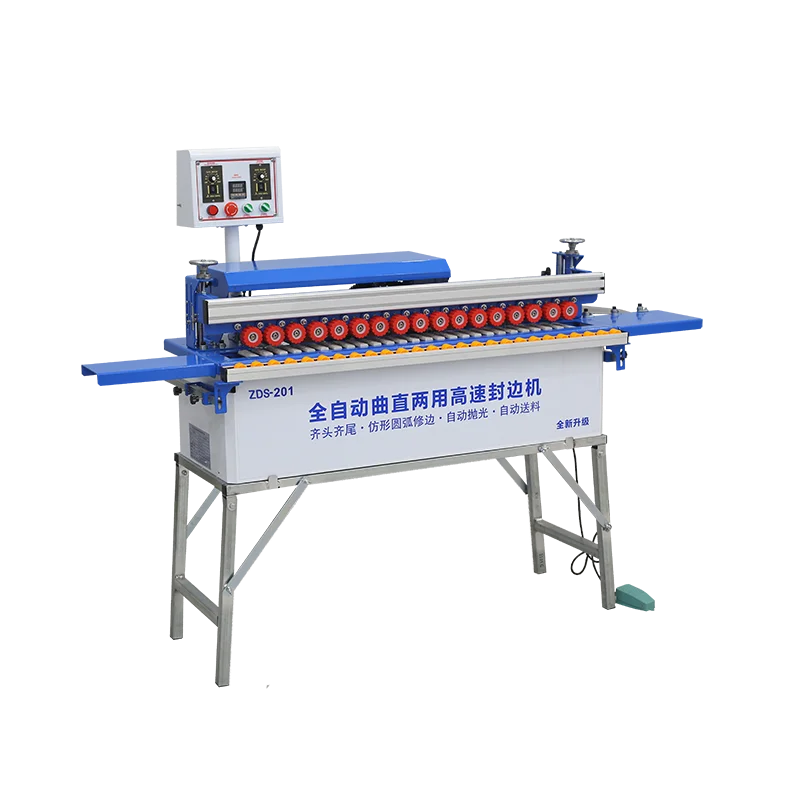
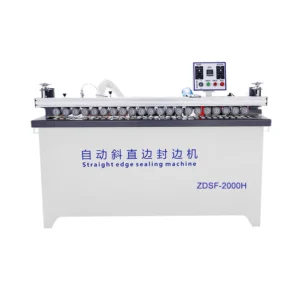
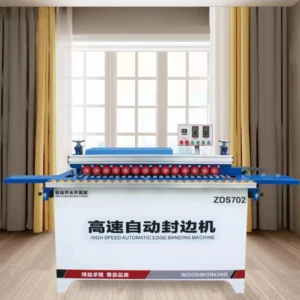
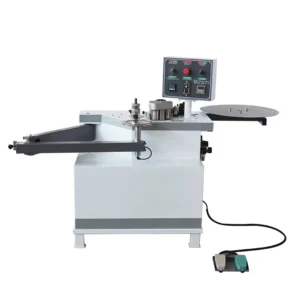
Built for Partners, Not Just Buyers — every curved and straight edge banding machine leaves our facility with a factory test record documenting actual trimming tolerance on your specified MDF thickness.
Technical Specifications
| Parameter |
Value |
| Product Type |
Curved and Straight Edge Banding Machine with Trimming and Buffing |
| Heating Power |
1.2 kW |
| Total Power |
3 kW |
| Transport Power |
180 W |
| Feeding Speed |
0–15 m/min |
| Edge Banding Speed |
0–26 cm/s |
| Edge Banding Thickness Range |
0.3–3 mm |
| Panel Thickness Range |
8–50 mm |
| Trimming Cutter |
4-blade alloy arc knife |
| Slide Rail |
Square slide rail (profiling); steel rod slide rail (crawler transmission) |
| Pressure Beam |
Adjustable aluminum alloy |
| Edge Strip Cutting |
Pneumatically controlled |
| Polishing Device |
Cross polishing (up and down) |
| Dust Collection |
Dual large-diameter collectors (efficiency basis not stated in source) |
| Control Panel |
Multi-function button operation |
Application Suitability
| Application |
Material or Output |
| Straight edge banding |
MDF, particleboard, plywood |
| Curved edge profiling |
Solid wood panels and shaped MDF components |
| PVC and veneer trimming |
0.3–3 mm PVC strips and wood veneer edging |
| Small-batch furniture finishing |
Cabinet doors, drawer fronts, and shelving |
| Joinery workshop output |
Semi-automated edge finishing for mixed panel stock |
What Happens When the Voltage Question Comes After the Contract Is Signed
A 415V workshop receiving a 380V edge bander faces weeks of downtime, not hours.
I was on-site in Sri Lanka when a curved and straight edge banding machine arrived wired for 380V while the local grid delivered 415V/50Hz. The control cabinet tripped immediately upon energizing. A step-down transformer took fifteen days to source and install, and the entire cabinet assembly line sat idle at that one station. This is why every edge banding machine OEM factory contract I manage now locks voltage and frequency through a written confirmation before production begins — the cost of a transformer and lost production time far outweighs a five-minute pre-order conversation. [NEED_CITE: voltage and frequency standards by export market]

Component Sourcing and Assembly Transparency
An edge banding machine OEM factory earns credibility through traceable component decisions, not marketing language. This model uses a steel-rod slide rail for crawler transmission rather than a simple belt drive, chosen specifically for consistent feed pressure on curved MDF profiles where slippage degrades edge adhesion. The square slide rail governing the profiling head maintains alignment under continuous lateral load. Distributors evaluating this equipment for regional resale can review sourcing documentation for these critical assemblies before committing to inventory.
Private-Label Build Depth Beyond a Logo Swap
OEM partnerships fail when the factory’s only customization is a nameplate. This curved and straight edge banding machine supports custom voltage configurations from 110V to 440V, multilingual control panel overlays, and specification tailoring at the component level — such as adjusting the pneumatic cutting device stroke for specific PVC thickness ranges. The four-stage QC process covers incoming material inspection through pre-shipment verification, giving OEM partners documented proof of build consistency across production runs. [NEED_CITE: CE machinery directive requirements for industrial equipment]
Trimming Precision and Feed Mechanics Explained
The 4-blade alloy arc knife is not simply a sharper cutter — its curved geometry maintains constant contact with the workpiece profile, which matters when trimming veneer on radiused MDF edges where a flat blade would chatter. Panel thickness range of 8–50 mm means the adjustable aluminum alloy pressure beam must accommodate both thin shelving stock and thick countertop blanks without deflection; the beam’s clamping force directly affects whether the trimming cutter engages at a consistent depth. Feed speed spanning 0–15 m/min allows operators to slow travel on tight curves where centrifugal feed forces can push the edge strip away from the glue line. Dust collection through dual large-diameter ports removes trimming swarf before it can embed in freshly applied adhesive, though actual collection efficiency depends on your shop’s extraction static pressure and ductwork routing.
The Hidden Cost of Underspecifying the Crawler Drive
A workshop running daily curved profiling on MDF cabinet doors will discover within weeks whether the feed mechanism was built for that duty cycle. Machines using light-duty belt drives on curved work show uneven edge strip adhesion where feed pressure fluctuates around tight radii. The resulting rework — stripping failed banding, re-gluing, re-trimming — consumes more operator hours than the time saved by running a machine not designed for continuous curved work. [NEED_CITE: common edge banding failure modes in curved profile production]
Why Procurement Decisions Land Here
In-house manufacturing with a patented cutting mechanism means the trimming assembly is not a purchased sub-component with unknown provenance. The four-stage QC protocol documents incoming material hardness verification, in-process assembly checks, finished-product tolerance measurement, and pre-shipment functional testing — records that ship with your order. Voltage and frequency confirmation happens before production starts, preventing the transformer-delay scenario that stalls commissioning. Factory visits are standard practice, allowing distributor technical teams to inspect precision grinding stations and assembly benches firsthand. Engineer-led configuration recommendations arrive within 24 hours of a complete inquiry, addressing your market’s specific panel materials and edge strip thickness ranges.
Documentation & Verification
- CE declaration of conformity covering machinery and low-voltage directives
- ISO 9001 certificate available for distributor compliance audits
- Factory test record documenting trimming tolerance on your MDF thickness range
- Electrical schematic with confirmed voltage and frequency for local compliance
- Operation manual in your operator’s language with illustrated maintenance schedules
- Spare parts list with OEM part numbers for distributor inventory planning
Installation, Commissioning & Support
- 3 kW total power requires a dedicated circuit matching confirmed voltage and frequency
- Compact 1200 × 450 × 750 mm footprint fits standard workshop bays without floor reinforcement
- Adjustable aluminum pressure beam calibrated on-site for your thinnest and thickest panels
- Pneumatic cutting device requires clean, dry compressed air supply at specified pressure
- Multi-function control panel walk-through included for operators during commissioning
- Dual dust collection ports sized for connection to standard workshop extraction systems
Building Your Quotation with the Right Inputs
To configure this edge banding machine for your production environment, we need your target panel materials and their typical thickness range, the edge strip materials and thicknesses you run most often, and your local voltage and frequency. Share your daily output expectations and whether curved profiling represents a significant portion of your workload, so we can recommend appropriate feed speed settings and consumable inventory. If your market requires multilingual operator interfaces or specific documentation for customs clearance, include those requirements in your initial inquiry.
Frequently Asked Questions
Q: What OEM customization options are available beyond logo application?
A: Customization extends to voltage configuration from 110V to 440V, control panel language overlays matched to your market, pneumatic cutting stroke adjustment for specific PVC or veneer thickness ranges, and specification tailoring at the component level. Each modification is documented in the production order and reflected in the as-built electrical schematic shipped with the machine.
Q: How does the four-stage QC process apply to this specific model?
A: Incoming inspection verifies alloy hardness on the 4-blade arc cutter and bearing tolerances on the square slide rail. In-process checks confirm crawler transmission alignment and pressure beam parallelism. Finished-product testing measures trimming output on actual MDF panels across the 8–50 mm thickness range. Pre-shipment verification runs the complete cycle with your specified edge strip material and documents results.
Q: Can our technical team visit the factory before placing a bulk order?
A: Factory visits are standard and encouraged. Your team can inspect precision grinding stations, review component sourcing records, observe assembly procedures, and witness test runs on materials matching your market requirements. We recommend scheduling visits during production of machines configured similarly to your intended order for the most relevant assessment.
Q: What documentation ships with the machine for distributor-level support?
A: Each unit ships with the CE declaration, electrical schematic reflecting confirmed voltage, operation and maintenance manual in the agreed language, illustrated spare parts list with OEM numbers, packing photographs for insurance purposes, and factory test records. Customs documentation support is provided to streamline import clearance in your destination market.
Q: How are spare parts supplied for distributor inventory planning?
A: Wear components including the alloy arc trimming blades, pneumatic cutting elements, and slide rail bearings are standardized across this product family. The spare parts list identifies consumption intervals based on duty cycle, enabling distributors to stock appropriately for their service territory. Replacement component lead times are confirmed at order placement.