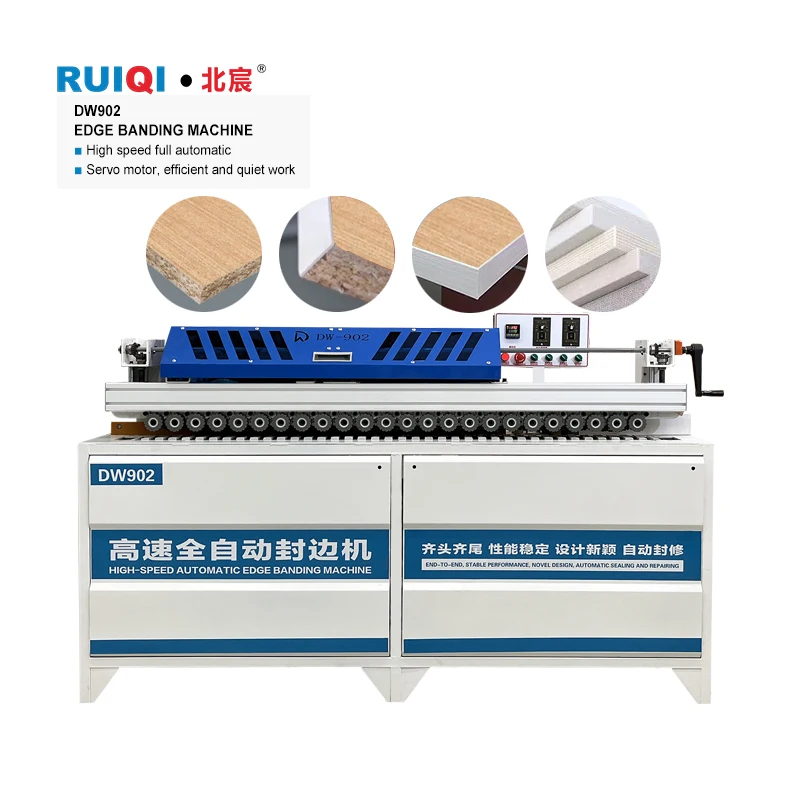
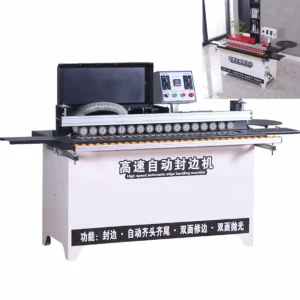
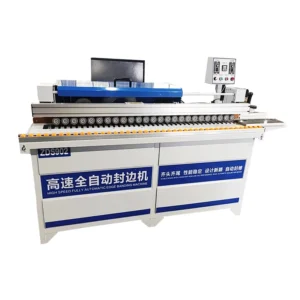
Patented Mechanisms — Proprietary cutting assemblies verified through multi-stage inspection ensure consistent edge finish on every DW902 unit leaving the factory floor.
Technical Specifications
| Parameter |
Value |
| Model |
DW902 |
| Product Type |
Automatic Edge Banding Machine |
| Total Power |
4000W |
| Voltage & Frequency |
220V/380V/customization available |
| Trimming Power/Speed |
800W × 2, 24000 r/min |
| Polishing Power/Speed |
380W × 2 |
| Vacuum Power |
550W |
| Edge Power/Speed |
140W |
| Transmission Power/Speed |
140W |
| Glue Pot Capacity |
4000 ml |
| Edge Banding Thickness |
0.3–3 mm |
| Edge Banding Height |
5 cm |
| Minimum Sheet Length |
25 cm |
| Minimum Sheet Width |
10 cm |
| Air Source Pressure |
0.5–0.8 MPa |
| Product Size |
175 × 87 × 112 cm |
| Product Weight |
240 kg |
| Standard Features |
Edge banding, trimming, polishing, automatic trimming, scraping, with vacuuming |
| Feed Speed |
(basis to be confirmed) |
| Tolerance |
(basis to be confirmed) |
Application Suitability
| Application |
Material or Output |
| Custom cabinet door edge banding |
MDF and particleboard panels with PVC or melamine edge strips |
| Plywood furniture component finishing |
Plywood substrates with veneer or ABS edge banding |
| Ecological board edge sealing |
Ecological board and blockboard for home decoration production |
| Solid wood panel edge treatment |
Solid wood boards requiring 90-degree edge banding |
| Batch production for furniture factories |
Medium-scale furniture and household manufacturing lines |
What "Voltage Confirmed at Order" Actually Means for Your Automatic Edge Banding Machine
Confirming local voltage and frequency before production prevents machines that arrive but cannot run.
I have watched entire commissioning schedules collapse because a 380V three-phase machine was shipped to a workshop with only single-phase 220V supply. The control board fries, the glue pot heater never reaches temperature, and the trimming motors stall under load. When we build an Automatic Edge Banding Machine for export, the voltage question has to come before the configuration conversation. [NEED_CITE: voltage and frequency standards by export market]
Dual Hot Air System and Substrate Matching
The DW902 integrates a double hot air design that preheats both the panel edge and the banding material before glue contact. This matters because MDF and particleboard absorb heat at different rates — MDF’s denser fibre structure pulls heat away from the glue line faster, while particleboard’s open cell structure holds temperature longer. The dual hot air arrangement compensates for this difference, maintaining consistent glue activation regardless of which substrate is running through the machine.
Pressure Wheel Configuration and Edge Contact
Four groups of oblique pressure wheels apply staged contact force along the banding path. The first group seats the strip against the panel edge, the second and third groups maintain pressure through the glue open time window, and the fourth group ensures final adhesion before trimming. This oblique arrangement handles both straight and angled edge profiles, which is why this Automatic Edge Banding Machine handles 90-degree edge banding across mixed substrate batches. [NEED_CITE: CE machinery directive requirements for edge bonding equipment]
Reading the Specification Sheet Against Your Production Reality
The 800W × 2 trimming motors running at 24000 r/min deliver clean cuts on PVC and melamine strips up to 3 mm thick. Below that speed, trimming leaves micro-tears on harder materials like ABS or acrylic. The 4000 ml glue pot capacity supports continuous runs without frequent refills, reducing thermal cycling that degrades adhesive consistency. The 550W vacuum system captures trim waste at the cutting point — critical when running MDF, which generates fine particulate that settles on the glue roller and contaminates subsequent panels. Panel minimums of 25 cm length and 10 cm width set the lower boundary; smaller offcuts from nested manufacturing will not feed reliably through the transport chain.

The Real Cost of Skipping Substrate-Specific Testing
When a buyer purchases based on a test run using standard PVC but then switches to acrylic or veneer banding in production, glue temperature, feed rate, and pressure all shift outside the original process window. The first two weeks of output show visible glue lines, edge lift on curved panels, and trimming chatter marks. Rework consumes more labor than the machine was supposed to save. [NEED_CITE: adhesive behavior differences across PVC, ABS, and wood veneer edge banding materials]
Why Source This Machine Through Our Factory
Our in-house manufacturing controls every precision-ground component in the DW902, from the transport chain rails to the trimming spindle housings. The four-stage QC process — incoming material inspection, in-process dimensional checks, finished assembly verification, and pre-shipment testing — means each machine is run on actual panel stock before crating. Voltage and control panel language are configured to your workshop’s requirements as a standard step, not an afterthought. We support OEM branding and specification adjustments, so distributors can align the machine to their regional market needs. Factory visits are open, and we run your material samples on the machine before you commit.
Documentation & Verification
- CE declaration of conformity specific to the DW902 Automatic Edge Banding Machine
- ISO 9001 certificate covering the manufacturing and QC process
- Factory test record showing edge quality on your specified panel material and thickness
- Electrical schematic confirming voltage, frequency, and breaker requirements for your facility
- Operation and maintenance manual in your operator’s language with illustrated spare parts diagrams
- Pre-shipment photograph set documenting machine condition and packing configuration
Installation, Commissioning & Support
- Foundation must support 240 kg static load with leveling access on all four feet across the 175 × 87 cm footprint
- Dedicated electrical circuit matching confirmed voltage (220V or 380V) with appropriate breaker rating for the 4000W total draw
- Machine ships assembled with protective covers; trimming and polishing guards require on-site fitting after positioning
- Initial commissioning includes glue pot temperature calibration and pressure wheel alignment using your production panel stock
- Operator training covers banding material changeover, trimming adjustment for 0.3–3 mm strip thickness, and daily vacuum filter maintenance
- Spare parts list identifies wear items including trimming cutters, pressure wheel surfaces, and glue pot seals with reorder codes
What We Need to Configure Your Machine Correctly
Send us the panel materials you run most frequently — MDF, particleboard, plywood, or solid wood — along with typical panel thickness and the edge banding material type and thickness range. Tell us your workshop voltage and phase supply, the language your operators read, and whether you need the machine integrated into an existing line or operating standalone. If your edge banding material is non-standard (acrylic, thick veneer, or pre-finished ABS), we run sample tests at the factory before finalizing the configuration.
Frequently Asked Questions
Q: How do I verify edge banding tolerance on my specific panel material before purchasing?
A: We run your actual panel stock and edge banding material on the DW902 at our factory and document the results. You receive the factory test record showing edge adhesion quality, trimming finish, and any process parameter adjustments needed for your substrate combination. This eliminates guesswork after delivery.
Q: What voltage and frequency options are available for different international markets?
A: The DW902 is configurable across 220V and 380V systems with frequency matching to your local grid standard. Voltage and phase requirements are confirmed during the quotation stage, and the electrical schematic reflects your specific configuration. The control components and heaters are matched to the confirmed supply before assembly.
Q: Can the control panel language be set to match my operators’ requirements?
A: Yes. The control panel supports multilingual configuration, which is confirmed at the order stage alongside voltage settings. The operation manual is also produced in the agreed language. This ensures operators can read parameter settings and fault codes from day one without translation delays.
Q: How do I match the DW902 to my production volume and substrate mix?
A: Share your daily panel count, the range of panel materials, and the edge banding types you use. We compare this against the machine’s glue pot capacity, trimming station configuration, and feed capability to confirm suitability. If your volume exceeds what a single-pass machine handles efficiently, we recommend a line configuration instead.
Q: What spare parts support is available after installation?
A: Each DW902 ships with a spare parts list identifying wear items and their reorder codes. Trimming cutters, pressure wheel surfaces, and glue pot seals are the primary consumables. Our technical team provides troubleshooting guidance remotely, and replacement parts are dispatched with customs documentation support when needed.