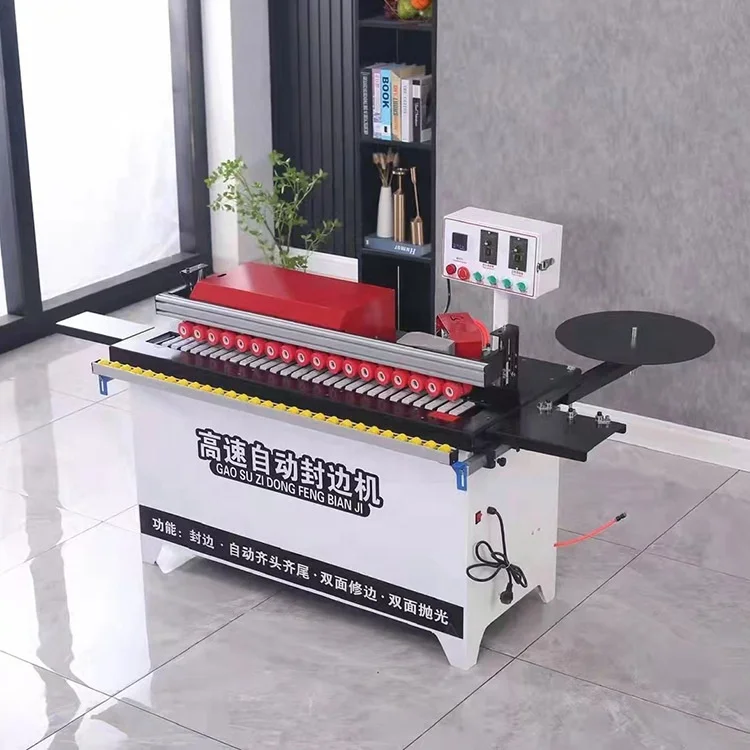
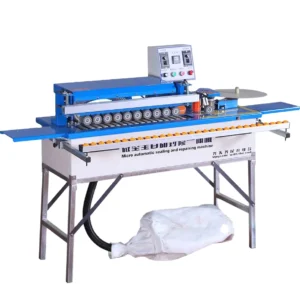
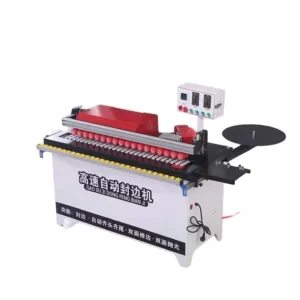
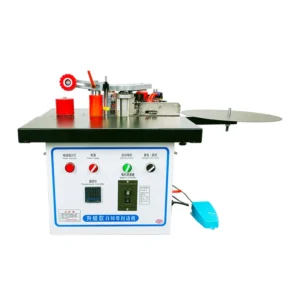
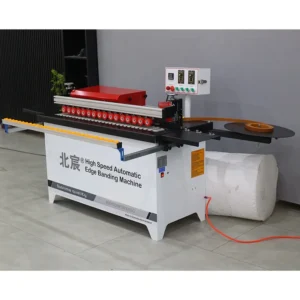
Precision-Ground Components — Every ZDSF802 edge bander is built on our own production floor where component grinding, assembly, and four-stage QC happen under one roof, giving OEM partners full traceability from raw casting to pre-shipment test.
Technical Specifications
| Parameter |
Value |
| Model |
ZDSF802 |
| Product Type |
Automatic Edge Banding Machine |
| Function Sequence |
Gluing, End cutting, Trimming, Vacuuming, Buffing |
| Rated Voltage |
220V |
| Rated Power |
4 kW |
| Strip Thickness Range |
0.5 – 2.5 mm |
| Sheet Thickness Range |
10 – 50 mm |
| Rated Air Pressure |
0.6 – 0.8 MPa |
| Working Speed |
0 – 7 m/min |
| Conveyor Belt Speed |
0 – 14 m/min |
| Glue Pot Capacity |
4000 ml |
| Overall Size |
190 × 60 × 130 cm |
| Machine Weight |
150 kg (basis to be confirmed) |
| Control Panel |
Digital display with independent switch |
| Pressure Beam |
Integrated, double rows of pressure wheels, silicone belt |
| Trimming Unit |
Double high-speed motors, up and down |
| Buffing Unit |
Up and down two polishing motors |
| Feed Extension |
Extendable fluent strips for large plates |
Application Suitability
| Application |
Material or Output |
| Custom cabinet door edge banding |
MDF and plywood panels 10 – 50 mm thick |
| Wardrobe and shelving panel finishing |
Particleboard with PVC or melamine strip |
| Small-batch furniture production runs |
Solid wood panels with veneer edge banding |
| Workshop-scale panel processing |
Laminate and ABS strips 0.5 – 2.5 mm |
Why Voltage Confirmation Must Come Before the Purchase Order
A machine wired for the wrong grid will not start, no matter how precise its trimming motors are.
I spent years running technical support in Latin America, and the most expensive delays I witnessed had nothing to do with mechanical failure. A Colombian furniture factory once received a 380 V edge bander while their workshop ran on 220 V. The machine sat idle for two weeks waiting for a step-up transformer, pushing back their entire production schedule and costing more in lost output than the transformer itself. Since then, I review every electrical schematic before signing off on a shipment. The ZDSF802 is rated at 220 V as standard, but voltage and frequency vary considerably across export markets [NEED_CITE: voltage and frequency standards by export market], and confirming your local supply before production begins avoids costly post-delivery surprises. An automatic edge banding machine factory OEM build should always ship with a confirmed electrical match.

How In-House Manufacturing Controls Edge Quality
When a furniture panel leaves the edge bander with a visible glue line on MDF but not on plywood, the root cause often traces back to inconsistent pressure distribution across the feed path. The ZDSF802 addresses this with an integrated pressure beam carrying double rows of pressure wheels and a silicone material conveyor belt, distributing clamping force evenly regardless of substrate density. Because every component is precision-ground and assembled within the same facility, tolerance stack-up between stations is controlled rather than left to chance across multiple outside suppliers.
OEM and Private Label Customisation at the Source
Distributors and importers evaluating an automatic edge banding machine factory OEM partner need to see beyond the nameplate. The ZDSF802 platform supports custom logo application, control panel language selection, and specification adjustments before the machine enters final assembly. Private label builds follow the same four-stage QC sequence as standard production — incoming material inspection, in-process checks, finished product verification, and pre-shipment testing — so a branded unit carries the same manufacturing record as any other machine leaving the floor [NEED_CITE: CE machinery directive requirements for industrial equipment]. This matters when a regional distributor is accountable for after-sales quality in their own territory.
Reading the Spec Sheet Against Real Workshop Conditions
The 4000 ml glue pot capacity means fewer interruptions during continuous production runs, which matters when a small factory is pushing through a batch of cabinet sides before a delivery deadline. Working speed of 0 – 7 m/min paired with a conveyor speed up to 14 m/min gives the operator a usable range to match feed rate to strip thickness — slower for 2.5 mm PVC to allow proper glue activation, faster for thin 0.5 mm melamine. The double high-speed trimming motors handle up-and-down trimming in a single pass, reducing the need for secondary clean-up on the bench. Pneumatically controlled strip cutting ensures the end cut is square, which directly affects how tightly two panels meet at a corner joint during assembly.
The Hidden Cost of Skipping Pre-Shipment Verification
Buying an edge bander without confirming actual test output on your own panel material is one of the most common procurement mistakes I have encountered. A machine that performs well on the supplier’s sample board may behave differently on the specific MDF density or particleboard grade used in your workshop. Tolerance claims that cannot be verified at the factory become assembly problems on the shop floor — panels that do not close properly in a carcass joint, edge strips that lift after a few weeks of humidity cycling [NEED_CITE: common edge banding failure modes in humid environments]. Requesting a factory test on your own material before shipment eliminates this gap.
Why Sourcing Directly from the Production Floor Matters
Every ZDSF802 is assembled, tested, and verified in the same facility where its components are ground and inspected, removing the layer of a trading company between the buyer and the production line. Patented cutting mechanisms are developed and maintained in-house, which means replacement parts and technical drawings come from the same engineering team that built the machine. Voltage and control language customisation is handled as a standard production step, not an afterthought negotiated post-order. The four-stage QC process covers incoming material, in-process build, finished product function, and pre-shipment verification with documented records. Engineer-led configuration proposals with formal quotations are typically provided within 24 hours of a confirmed inquiry.
Documentation & Verification
- CE declaration of conformity covering the ZDSF802 automatic edge banding machine
- Factory test record run on your specified panel thickness and strip material before dispatch
- Electrical schematic confirming voltage and frequency match for your local supply
- Operation and maintenance manual in your agreed language with illustrated spare parts list
- Packing photographs documenting machine condition at the point of crating
Installation, Commissioning & Support
- Allocate a level floor area exceeding 190 × 60 cm with clearance for the extendable fluent strips
- Provide a dedicated 220 V circuit matching the 4 kW rated power draw with proper earthing
- Machine ships as a single unit; connect compressed air at 0.6 – 0.8 MPa before first run
- Set glue pot temperature via the digital display to match your specific edge banding material
- Silicone conveyor belt and pressure wheels should be cleaned weekly to maintain feed grip
- Keep trimming motor brushes and buffing pads as routine replacement items from the spare parts list
What We Need to Prepare Your Quotation
To move from inquiry to a formal configuration proposal, we typically need your panel material types and thickness range, the edge strip materials you plan to run, and your confirmed local voltage and frequency. If you are integrating this machine into an existing line, let us know the upstream and downstream equipment so feed heights and throughput can be matched. For OEM or private label orders, share your branding requirements and preferred control panel language at the inquiry stage.
Frequently Asked Questions
Q: How can I verify the ±0.02 mm tolerance claim before placing an order?
A: We run a factory test using your own panel samples and edge strip material, then measure the finished edge with calibrated instruments. The test record, including measured values and photographs, is included in the pre-shipment documentation package so you have verifiable evidence before the machine leaves our floor.
Q: What voltage options are available for different export markets?
A: The ZDSF802 is rated at 220 V as standard. We configure voltage and frequency to match your local grid as a standard production step. Confirming your exact supply specifications at the inquiry stage ensures the electrical system is built correctly before assembly begins, avoiding transformer workarounds after delivery.
Q: Can the control panel language be set for my local operators?
A: Yes. The digital control panel can be configured in the language your workshop team reads. We confirm the preferred language during the specification review so the interface is ready at commissioning, eliminating the delay of operators trying to navigate unfamiliar menus during their first production run.
Q: How does the OEM logo and private label process work?
A: Custom branding is applied during the final assembly stage following the same four-stage QC sequence as standard machines. You provide artwork and placement specifications at the order stage, and we supply proofs for approval before application. The manufacturing record and test documentation remain identical across all builds.
Q: Which edge banding materials can this machine handle reliably?
A: The ZDSF802 handles PVC, melamine, and veneer strips in the 0.5 – 2.5 mm range. The 4000 ml glue pot maintains stable temperature across materials, while the double high-speed trimming motors adjust to different strip hardness. We recommend a factory test on your specific material to confirm finish quality before shipment.