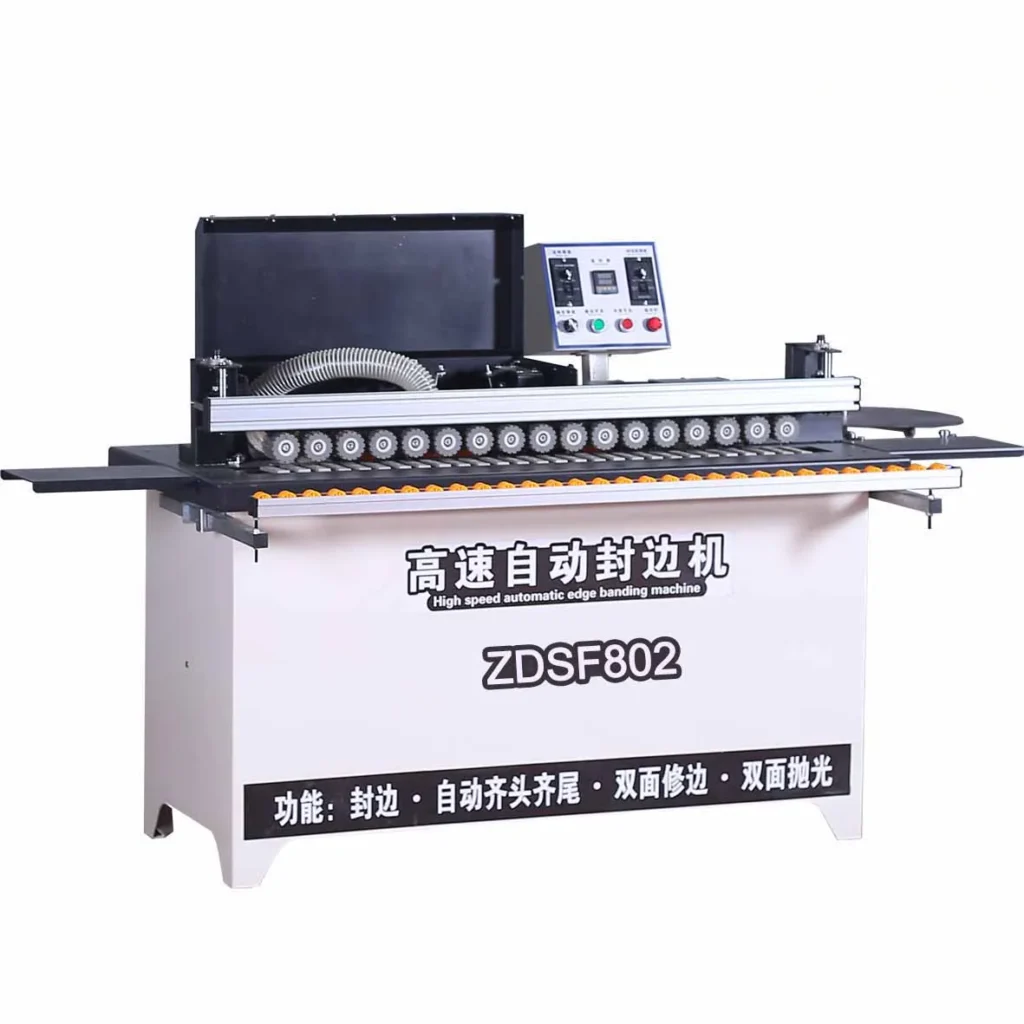
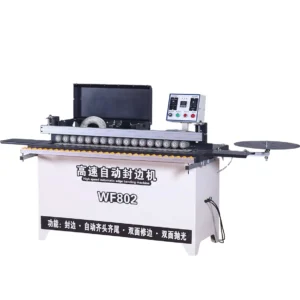
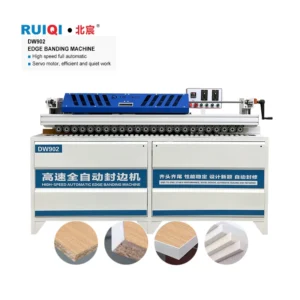
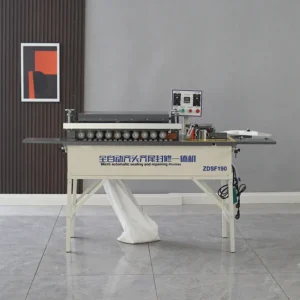
Precision-Ground Components — Every ZDSF802 unit runs through a four-stage inspection from incoming material to pre-shipment verification, ensuring the tolerances we quote are the tolerances you measure on your shop floor.
Technical Specifications
| Parameter |
Value |
| Model |
ZDSF802 |
| Product Type |
Automatic Edge Banding Machine |
| Edge Type |
Straight line |
| Function |
Gluing, End cutting, Vacuuming, Trimming, Polishing |
| Rated Voltage |
220V |
| Rated Power |
4 kW |
| Heating Power |
1000 W |
| Glue Pot Capacity |
4000 ml |
| Glue Pot Heat-up Time |
5–10 min |
| Trimming Power |
800 W × 2 |
| Polishing Power |
180 W × 2 |
| Suction Power |
1200 W |
| Rated Air Pressure |
0.4–0.6 MPa |
| Feed Speed |
0–10 m/min |
| Strip Thickness Range |
0.5–2.5 mm |
| Sheet Thickness Range |
10–50 mm |
| Pressure Beam |
One-piece integrated, double rows of pressure wheels |
| Conveyor Belt Material |
Silicone |
| Belt Breaking Method |
Pneumatically controlled |
| Trimming Configuration |
Double high-speed motors, up and down |
| Polishing Configuration |
Up and down, dual polishing |
| Extendable Support |
Fluent strips for large plate support |
| Dust Extraction |
Integrated vacuum device |
| Control Panel |
Digital display of glue pot temperature, independent switches |
| Overall Dimensions |
190 × 65 × 75 cm |
| Machine Weight |
150 kg |
Application Suitability
| Application |
Material or Output |
| Custom furniture panel edge banding |
MDF and particleboard with PVC edge banding |
| Cabinet door and carcass production |
Plywood panels with veneer or PVC strips |
| Joinery workshop straight-line finishing |
Solid wood panels within 10–50 mm thickness |
| Small-batch panel processing |
Melamine-faced board with 0.5–2.5 mm edge material |
Why the Voltage Question Should Come Before the Price on Any Automatic Edge Banding Machine
Confirming your local voltage and frequency before a machine enters production prevents the most costly mistake in cross-border equipment trade: a unit that arrives and simply will not run.
I have watched importers take delivery of woodworking equipment only to discover the motor wiring does not match their three-phase supply. The machine sits on the factory floor, still crated, while electricians try to source a transformer or rewire the control cabinet. That downtime is not the supplier’s problem once the container is opened. With this automatic edge banding machine, voltage and frequency are locked in writing before the first component is pulled from stock, and the electrical schematic ships with the machine so your local electrician can verify everything on day one. [NEED_CITE: voltage and frequency standards by export market]

How the Manufacturing Process Holds Tolerance
The ZDSF802 is assembled from precision-ground components that are inspected at each stage rather than checked only at the end of the line. The one-piece integrated pressure beam is machined as a single unit, which eliminates the cumulative stacking error you get when multiple bracket sections are bolted together. This matters because the pressure beam is what keeps the panel flat against the conveyor belt through every station — gluing, end cutting, trimming, and polishing. When the beam is true, the trimming motors can hold their cut depth consistently across the entire panel length. Distributors evaluating manufacturing depth will find the component sourcing and assembly sequence documented and available for on-site review.
What Four-Stage Quality Control Actually Catches
Incoming material inspection screens bearings, motors, and pneumatic valves before they reach the assembly bench. In-process checks verify belt alignment and pressure wheel contact after the conveyor is tensioned. Finished-product testing runs the machine under load with actual panel stock and edge banding material — not just a dry cycle with no material in the feed. Pre-shipment verification repeats the full functional test after crating preparation, catching anything that shifted during handling. Each stage generates a record that ships with the machine. For OEM partners, this means the quality documentation behind your private label is auditable, not just a certificate on the wall. [NEED_CITE: CE machinery directive requirements for industrial equipment]
Reading the Specs That Matter on the Shop Floor
The 10–50 mm sheet thickness range covers most furniture panel work, from thin cabinet backs to thick shelving stock. What matters just as much is the silicone conveyor belt: it grips the panel without marring the surface, which is critical when you are running pre-finished melamine or veneered board. The feed speed of 0–10 m/min is adjustable, and the lower end of that range is where you want to be when running thin wood veneer edge banding — too fast and the glue does not transfer evenly, too slow and you risk scorching. The 4000 ml glue pot capacity with digital temperature display means the operator can monitor and adjust heat without guesswork, reducing the cold-glue failures that show up as peeling edges hours after the panel leaves the machine. The dual high-speed trimming motors at 800 W each handle both the top and bottom edge in a single pass, and the pneumatically controlled belt breaking mechanism cuts the strip cleanly without the operator needing to reach for a knife. Dust extraction runs through an integrated vacuum device at 1200 W, keeping the trimming zone clear so offcuts do not interfere with the polishing wheels downstream.
The Hidden Cost of Skipping Configuration Confirmation
A machine that arrives with a control panel in a language your operators cannot read will sit idle while someone translates the interface or waits for a multilingual manual to be printed. When feed height, belt speed, and upstream saw output are not matched before the order is placed, you end up with a bottleneck that no amount of operator skill can fix. I have seen workshops buy a single edge bander based on a catalog photo, then discover the strip thickness range does not cover the thin veneer their customer specified. That mismatch stops production until a different machine arrives. [NEED_CITE: common causes of commissioning delays in imported woodworking machinery]
Why Distributors and OEM Partners Source Here
In-house manufacturing with patented cutting mechanisms means the production process is controlled from raw component to finished unit, not outsourced to a third-party assembler. Voltage configuration from 110V to 440V, multilingual control panels, and custom branding are handled as standard options rather than special requests, which shortens the quoting cycle for regional variants. The full product family spans entry-level to full-function models, so a distributor can serve both startup workshops and established factories without adding a second supplier. Factory visits are welcomed at any stage, and pre-shipment test records are generated for every unit before it leaves the floor. Engineer-led configuration recommendations are backed by formal quotation within 24 hours, keeping the distributor’s own sales pipeline moving.
Documentation & Verification
- CE declaration of conformity specific to the ZDSF802 automatic edge banding machine
- ISO 9001 certificate covering the manufacturing facility and quality management system
- Electrical schematic with confirmed voltage and frequency for the destination market
- Factory test record run on the buyer’s specified panel thickness and edge banding material
- Operation and maintenance manual provided in the agreed language before shipment
- Spare parts list with part numbers matching the as-built configuration
Installation, Commissioning & Support
- Requires a dedicated 220V circuit rated for at least 4 kW continuous draw with proper grounding
- Overall footprint of 190 × 65 × 75 cm needs clear access on the feed and discharge sides for panel handling
- Pneumatic supply must deliver 0.4–0.6 MPa clean, dry air to the belt breaking and pressure systems
- First startup includes glue pot heat-up verification at 1000 W and digital temperature calibration across the 5–10 minute warm-up range
- Extendable fluent strip supports must be leveled to the conveyor height before running full-size panels
- Routine maintenance covers silicone belt tension checks, trimming motor brush inspection, and vacuum filter cleaning at defined intervals
Before You Request a Quotation
Send us the panel substrates you plan to run, the edge banding material type and thickness, and the local voltage and frequency at the installation site. If you are configuring a regional product line under your own brand, let us know the language requirements for the control panel and documentation, plus any logo or color specifications for the machine housing. For turnkey projects, share the upstream and downstream equipment already in the line so we can confirm feed height and throughput compatibility before production begins.
Frequently Asked Questions
Q: What OEM and private-label customization is available for the ZDSF802?
A: Custom logo placement, machine housing color, control panel language, and packaging design are all configurable. Voltage is set to match your market from 110V to 440V. Each customization is confirmed in the specification sheet before production starts, and the as-built configuration is documented in the shipment paperwork so your service team knows exactly what is on each unit.
Q: How is voltage and frequency confirmed before production?
A: The buyer provides the local supply specification during the inquiry stage. Our engineers issue an electrical schematic showing the confirmed voltage and frequency, which the buyer approves before the machine enters assembly. This schematic ships with the machine so local electricians can verify the installation matches the documented configuration.
Q: What does the four-stage QC process cover?
A: Incoming material inspection screens all purchased components. In-process checks verify assembly accuracy at critical stations. Finished-product testing runs the machine under load with actual panel and edge banding material. Pre-shipment verification repeats the functional test after crating preparation. A written record from each stage accompanies every unit.
Q: Can trimming and polishing stations be configured differently?
A: The ZDSF802 ships with dual high-speed trimming motors and dual polishing motors as standard. For distributors building a tiered product range, station configuration can be discussed to match the feature set expected in your regional market. Any change is documented in the specification sheet and reflected in the factory test record.
Q: What spare parts and technical training support is provided?
A: A detailed spare parts list with part numbers matching the as-built machine ships with every unit. Consumable items such as trimming blades and polishing wheels are identified with reorder intervals. Technical training for the distributor’s local service team can be arranged at the factory or through remote guidance during initial commissioning.