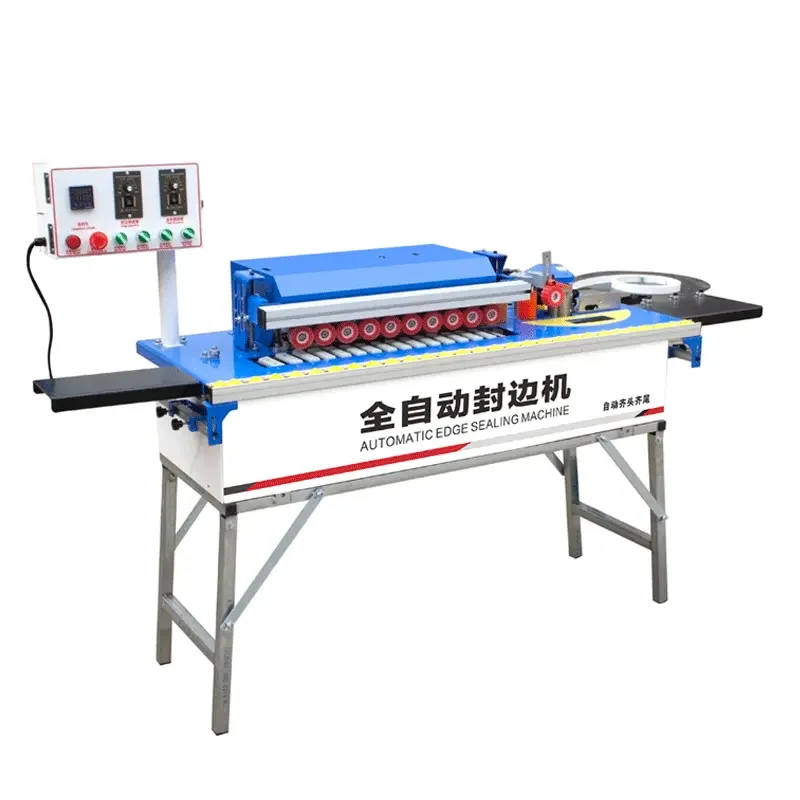
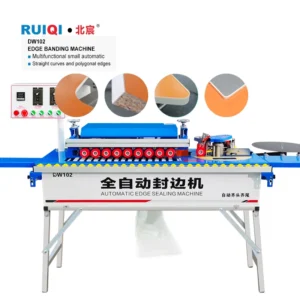
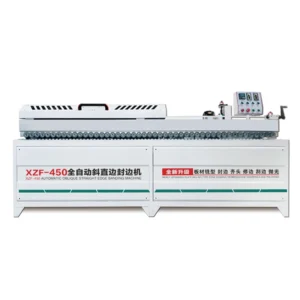
OEM-ready manufacturing depth — DW102 edge bander supports full private label customization from control panel language to voltage configuration, built on a production floor with verified precision grinding and four-stage quality checks.
Technical Specifications
| Parameter |
Value |
| Model |
DW102 |
| Product Type |
Automatic Edge Banding Machine |
| Total Power |
3800W |
| Voltage |
220V / 380V / customizable (frequency to be confirmed) |
| Edge Banding Thickness |
0.3 – 3 mm |
| Edge Banding Height |
0 – 50 mm |
| Minimum Sheet Length |
25 cm |
| Minimum Sheet Width |
5 cm |
| Trimming Power |
650W × 2 |
| Polishing Power |
180W × 2 |
| Vacuum Power |
1200W |
| Transmission Power |
60W |
| Edge Power |
20W |
| Glue Pot Capacity |
1000 ml |
| Air Source Pressure |
0.5 – 0.8 MPa |
| Product Size |
128 × 47 × 69 cm |
| Product Weight |
75 kg |
| Control Panel Language |
Chinese / English (customizable to Spanish and other languages) |
| Plug Options |
EU / USA / AU / UK |
| Key Features |
Curved and straight edge banding, edge trimming, polishing, automatic head and tail cutting, vacuum assist |
Application Suitability
| Application |
Material or Output |
| Cabinet door edge finishing |
MDF and particleboard with PVC or melamine edge bands |
| Furniture panel processing |
Plywood and blockboard up to 3 mm band thickness |
| Polymer door production |
Polymer composite panels requiring curved and straight banding |
| Medium-scale workshop output |
Wood panels for custom cabinet and shelving manufacturers |
Why the Voltage Question Should Come Before the Price on an Edge Banding Machine OEM Factory Order
Confirming local voltage and frequency before production starts prevents a machine from arriving dead on the workshop floor.
I once watched a distributor lose two full weeks of commissioning time because the edge bander they sourced was hard-wired for 380V/50Hz while their customer’s facility ran on a different supply standard. The machine was physically perfect but electrically incompatible. For importers evaluating an Edge Banding Machine OEM factory, the voltage and plug configuration must be locked into the purchase specification alongside the mechanical requirements [NEED_CITE: voltage and frequency standards by export market]. This DW102 model ships with 220V or 380V winding options and plug formats for EU, USA, AU, and UK markets, but the frequency side — 50Hz or 60Hz — needs explicit confirmation at order stage.

Manufacturing Depth Behind Every Private Label Unit
When a distributor stamps their own brand on an edge bander, the underlying build quality either supports that brand or undermines it. The DW102 is produced on a line where component-level precision grinding is standard procedure, not an optional upgrade. Each shaft, guide rail, and trimming head seat is ground to tolerance before assembly, which matters when your customer calls you — not the original factory — about a glue line defect. This Edge Banding Machine OEM factory approach means the unit carrying your logo performs identically to one carrying ours.
Four-Stage Quality Control Across the Production Run
Incoming material inspection catches alloy or bearing inconsistencies before they enter the assembly bay. In-process checks verify alignment at each station — trimming, polishing, head and tail cutting — as the machine takes shape. Finished product testing runs actual board and edge band material through the DW102 under load. Pre-shipment verification includes packing photographs and electrical continuity tests. For an OEM partner, this protocol means your batch of ten units arrives with the same tolerance as the sample you approved [NEED_CITE: CE machinery directive requirements for industrial equipment].
What the Spec Sheet Numbers Mean for Daily Production
The 0.3–3 mm edge banding thickness range covers the full spectrum of PVC, ABS, and veneer strips that a cabinet or furniture workshop typically handles. Going below 0.3 mm risks band fracture during the trimming pass; exceeding 3 mm demands a heavier feed mechanism than this class of machine is designed around. The dual 650W trimming motors provide enough torque to clean both straight and curved profiles without bogging down on denser substrates like blockboard. The 1000 ml glue pot capacity supports continuous runs on standard panel sizes without frequent refill stops, though high-volume environments running oversized boards should factor in refill intervals. Air source pressure between 0.5 and 0.8 MPa governs the pneumatic actuators that handle automatic head and tail cutting — pressure outside this band causes either incomplete cuts or premature blade wear. The 128 × 47 × 69 cm footprint keeps floor space requirements manageable for workshops adding this unit alongside existing saws and boring machines.
The Real Cost of Skipping a Pre-Shipment Material Test
I learned this the hard way with a Southeast Asian customer who sent sample board and edge strip for our trial, then ran the machine with a different, thicker PVC profile in their own shop. The trimming cutters could not handle the extra 0.8 mm, and their entire line stopped. When sourcing from an Edge Banding Machine OEM factory, the consequence of mismatched material assumptions falls on the distributor — your customer blames you, not the factory three time zones away. Running a pre-shipment test with the customer’s actual production material removes this variable entirely [NEED_CITE: material compatibility testing in woodworking machinery procurement].
Why Distributors Source This Model Repeatedly
The DW102 carries proprietary cutting mechanism patents that hold verified tolerance across production runs, not just on the first sample unit. Voltage customization from 110V to 440V is handled as a standard configuration option, not a special engineering request. Multilingual control panels are configured before the machine leaves the factory, so your customer’s operators can read the interface on day one. The complete product family — from entry-level to full-function pre-milling models — lets a distributor serve a startup workshop and a scaling factory from one supplier relationship. Factory visits are open, and your team can inspect the grinding stations and QC checkpoints directly.
Documentation & Verification
- CE declaration of conformity matched to DW102 electrical and mechanical specifications
- ISO 9001 certificate covering the manufacturing process behind this unit
- Factory test record run on your specified board thickness and edge band material
- Electrical schematic confirming voltage, frequency, and plug configuration at order
- Operation and maintenance manual written in your chosen control panel language
- Packing photographs and customs documentation support for your import clearance
Installation, Commissioning & Support
- Floor space allocation based on the 128 × 47 × 69 cm footprint with operator clearance on three sides
- Dedicated electrical circuit matching confirmed voltage and the 3800W total power draw
- Pneumatic line connection set to 0.5–0.8 MPa to drive the head and tail cutting actuators
- First-run parameter tuning for your specific edge band thickness within the 0.3–3 mm range
- Operator walk-through on the customizable control panel in the agreed language
- Spare parts list covering trimming blades, polishing wheels, and glue pot seals
Preparing Your Inquiry for Accurate Configuration
To configure the DW102 for your market, share the edge band materials and panel substrates your customers actually process, along with the local voltage and frequency standard. If you plan to apply private label branding, specify the logo placement and packaging requirements at this stage. Let us know whether you need a single evaluation unit or a batch order so we can align production scheduling accordingly.
Frequently Asked Questions
Q: What OEM customization options are available for the DW102 edge banding machine?
A: The DW102 supports custom logo application, voltage winding from 110V to 440V, plug format selection across EU, USA, AU, and UK standards, and control panel language customization including Spanish and other languages. Each configuration is confirmed in writing before production begins so the unit arriving at your warehouse matches your market specification exactly.
Q: How does the four-stage QC process protect my brand as a distributor?
A: Incoming material inspection, in-process alignment checks, finished product testing under load, and pre-shipment verification with photographic evidence all apply to every DW102 regardless of whose logo is on the nameplate. Your brand reputation depends on consistent machine performance, and this protocol ensures each unit in a batch meets the same tolerance standard as the approved sample.
Q: What documentation accompanies the machine for customs and local certification?
A: Each DW102 ships with a CE declaration of conformity, electrical schematic confirming the configured voltage and frequency, factory test record, operation manual in the specified language, and packing photographs. Additional customs documentation support is provided to facilitate import clearance in your destination market.
Q: Can you provide spare parts backup and technical training for our regional service team?
A: A spare parts list covering consumable and wear items is included with every shipment. Distributor service teams can receive technical training at the factory covering maintenance procedures, trimming head adjustment, and fault diagnosis specific to the DW102 platform and its component configuration.