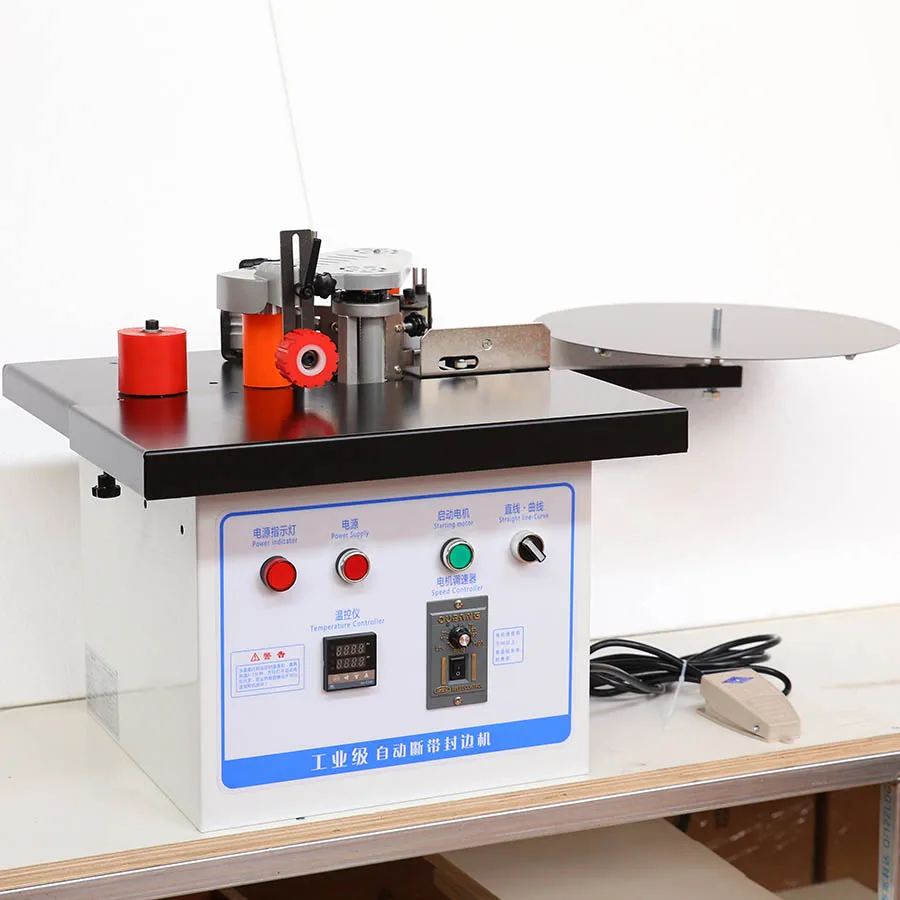
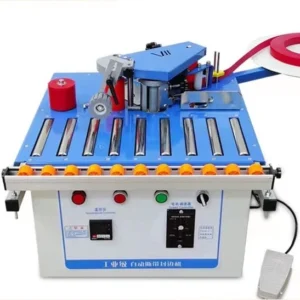
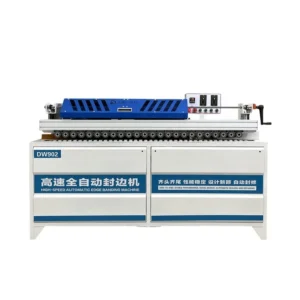
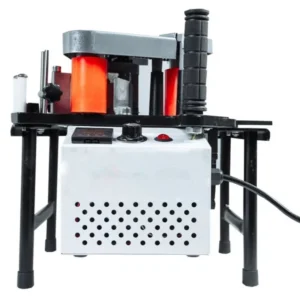
Precision Manufacturing Depth — Every ZDSF50 mini edge banding machine is built in-house with proprietary glue application mechanisms, verified through four-stage quality control before OEM labeling and dispatch.
Technical Specifications
| Parameter |
Value |
| Model |
ZDSF50 |
| Product Type |
Mini Edge Banding Machine |
| Rated Voltage |
220V (configurable from 110V to 440V) |
| Rated Power |
1.2kW |
| Function |
Double side gluing for Straight & Curved & Shaped Edge |
| Rated Air Pressure |
0.4-0.6MPa |
| Strip Thickness Range |
0.5-1.5mm |
| Sheet Thickness Range |
10-60mm |
| Glue Pot Capacity |
1000ml |
| Heating Time |
5-10min |
| Feed Speed |
0-6m/min |
| Overall Dimensions (L×W×H) |
54×54×56cm |
| Net Weight |
26kg |
| Glue Application |
Double-sided glue-coated rollers |
| Edge Breaking |
Pneumatically controlled belt breaking device with foot switch |
| Straight Edge Breaking |
Equipped with travel switch for automatic belt breaking |
| Pressure Rollers |
Adjustable rubber pressing rollers |
| Edge Strip Transport |
Adjustable bayonet according to edge strip height |
| Glue Heating |
4 heating tubes |
| Standards |
CE, ISO 9001 |
Application Suitability
| Application |
Material or Output |
| Small Workshop Furniture Edging |
MDF and Plywood Panel Edges |
| Custom Cabinet Making |
Particleboard and Solid Wood Boards |
| On-Site Portable Edge Banding |
PVC Edge Banding Strips |
| Joinery Shop Production Scaling |
Veneer and Melamine Edge Profiles |
Why Voltage Confirmation Must Precede the Mini Edge Banding Machine Factory Order
Electrical mismatch remains the most frequent cause of delayed commissioning in international equipment procurement.
When a regional distributor imports woodworking equipment without verifying the destination grid frequency, the result is often a machine that physically cannot energize upon arrival. I recall a project where a semi-automatic edge bander sat idle in a Southeast Asian facility because the local 440V grid was incompatible with the standard 380V motor configuration, requiring a multi-week transformer retrofit. For a portable unit like the ZDSF50, ensuring the 1.2kW heating and drive system matches the exact voltage and phase of the local workshop prevents these operational standstills [NEED_CITE: voltage and frequency standards by export market].
Component Sourcing and Assembly Integrity
The manufacturing of a reliable mini edge banding machine factory output begins with the sourcing of the 4-tube rapid heating system and the pneumatic components. Precision grinding of the adjustable bayonet and the rubber pressing rollers ensures that the 0.5-1.5mm strip thickness range is maintained consistently. OEM partners evaluating this equipment can trace the assembly of the double-sided glue-coated rollers and the foot-switch-controlled breaking device through documented checkpoints.
Private Labeling and Factory Audit Protocols
For distributors seeking private-label capabilities, the facility supports custom logo application and multilingual control panel integration on the ZDSF50 chassis. The 54×54×56cm footprint and 26kg weight make it a viable candidate for mixed-container shipping alongside larger automated lines. Factory visits are encouraged so OEM partners can audit the four-stage QC process, from incoming material inspection to the final pre-shipment verification of the 1000ml glue pot and pneumatic circuits [NEED_CITE: CE machinery directive requirements for industrial equipment].
Interpreting the 10-60mm Sheet Thickness and Glue Dynamics
The 10-60mm sheet thickness range and the 0-6m/min feed speed are critical variables that interact with the glue heating system. In woodworking, the thermal stability of the glue pot—maintained by four heating tubes—determines how well the adhesive bonds to different substrates. If the temperature fluctuates, porous materials like particleboard may absorb the glue too quickly, while non-porous PVC strips might fail to adhere. The adjustable rubber pressure rollers must be calibrated to the specific board thickness to ensure a uniform bond line across both straight and curved profiles.

The Cost of Overlooking Air Pressure and Feed Calibration
A common oversight in entry-level equipment deployment is neglecting the 0.4-0.6MPa air pressure requirement. If a workshop’s compressor cannot sustain this range, the pneumatically controlled belt breaking device may fail to snap the PVC strip cleanly, leading to manual trimming and surface damage. Furthermore, pushing the feed speed beyond the recommended range for specific curved edges can cause the strip to misalign, resulting in wasted material and rework [NEED_CITE: pneumatic system requirements for portable woodworking machinery].
Manufacturing Accountability in Equipment Export
This ZDSF50 is produced within a facility that maintains proprietary cutting and glue application patents. The four-stage quality control protocol includes a specific pre-shipment test where the unit is run against actual panel samples to verify edge-breaking accuracy. Electrical schematics are confirmed against the destination market’s standards before the machine leaves the assembly floor. The documentation package includes CE declarations and ISO 9001 verification, ensuring compliance for regional importers.
Documentation & Verification
- Factory test record on your panel thickness range and glue temperature stability before dispatch
- Electrical schematic and voltage confirmation document matching destination power standards
- CE declaration of conformity and ISO 9001 certificate for market compliance
- Operation and maintenance manual in the agreed language for operator training
- Spare parts list with specific part numbers for rollers and heating tubes
Installation, Commissioning & Support
- Verify workshop 220V (or customized) dedicated circuit capacity for the 1.2kW power draw
- Connect to a stable 0.4-0.6MPa air source to ensure proper pneumatic edge breaking
- Calibrate the adjustable bayonet to match the height of your primary edge strips
- Set the 4-tube heating system to the specific thermal requirement of your PVC or veneer
- Review the foot switch and travel switch logic with operators for curved and straight edges
Preparing Your Technical Inquiry
To facilitate an accurate configuration proposal, please provide the specific voltage and frequency of the target market, along with the primary board materials (MDF, plywood, or particleboard) and edge strip types you intend to process. If you are an OEM partner, please specify your requirements for private-label placement, custom packaging, and the desired language for the control interface and manual.
Frequently Asked Questions
Q: What OEM and private-label customization options are available for the ZDSF50?
A: We support custom logo placement on the chassis, multilingual control panel overlays, and tailored packaging. Voltage can be configured from 110V to 440V to match specific regional grids, and manuals can be produced in the local language of the end-user market.
Q: How does the factory verify tolerance and edge quality before shipment?
A: Every unit undergoes a pre-shipment test using actual panel samples to verify glue temperature stability and edge-breaking accuracy. A formal factory test record is provided to the buyer, documenting the performance against the specified 10-60mm sheet thickness range.
Q: Can the ZDSF50 be configured for 110V/60Hz or other non-standard frequencies?
A: Yes, the electrical system is engineered to accommodate various voltage and frequency combinations. The motor and the 4-tube heating elements are matched to the target grid specifications to prevent overheating or underperformance in the destination country.
Q: What spare parts backup does the factory provide to distributors?
A: We provide a comprehensive spare parts list with specific identifiers for high-wear components like the rubber pressure rollers, glue-coated rollers, and heating tubes. We also offer technical training materials to help distributor service teams perform routine maintenance and minor repairs.