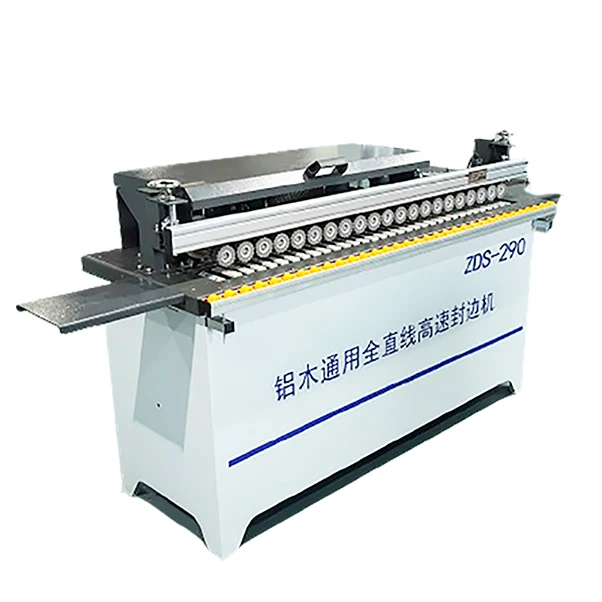
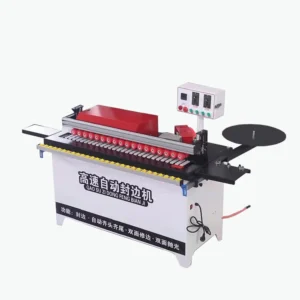
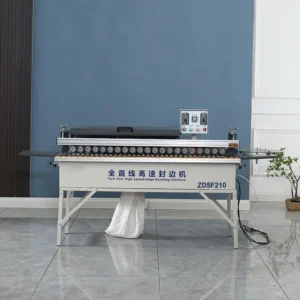
Integrated thickened aluminum alloy pressure beam with OEM branding capability — verified through in-house assembly, four-stage QC, and private label readiness on the ZDS290 platform.
Technical Specifications
| Parameter |
Value |
| Model |
ZDS290 |
| Product Type |
Aluminum-Wood Universal Full Linear High-Speed Edge Banding Machine |
| Rated Voltage |
220V (configurable from 110V to 440V) |
| Rated Power |
4165W |
| Edge Banding Speed |
6 m/min (basis to be confirmed) |
| Conveying Motor |
180W |
| Trimming Motor |
800W × 2 |
| Polishing Motor |
180W × 2 |
| Vacuuming Motor |
1200W |
| Glue Pot Heating |
800W |
| Rated Air Pressure |
0.6–0.8 MPa |
| Strip Thickness Range |
0.5–2.5 mm |
| Panel Thickness Range |
10–50 mm |
| Glue Pot Capacity |
1000 ml |
| Pressure Beam |
Integrated thickened aluminum alloy |
| Pressure Wheel |
Double-row inclined |
| Board Thickness Display |
Digital display |
| Pressure Beam Height Adjustment |
Hand-crank wheel |
| Glue Pot Type |
Imitation glue pot with concave-convex gum wheel |
| Additional Stations |
Secondary scraping and cleaning |
| Machine Size |
150 × 57 × 96 cm |
| Warranty |
1 year |
Application Suitability
| Application |
Material or Output |
| Custom furniture panel edge banding |
MDF, melamine board, particleboard |
| Cabinet door and carcass processing |
Plywood, MDF with PVC or veneer strip |
| Small to medium workshop production |
Solid wood panels and engineered boards |
| OEM and private label machine builds |
Configured to distributor specifications |
Why the Voltage Question Should Come Before the Price
Every Edge Banding Machine OEM factory contract must lock voltage and frequency before production starts.
I once watched a fully automatic edge bander sit idle for two weeks in a Nigerian furniture factory. The local grid ran at a different voltage than what the machine was built for, and the main control board burned out within minutes of the first power-on. The operator had no way to know — the nameplate said one thing, the wall outlet delivered another. That workshop lost production time, paid for air-freight replacement parts, and questioned every machine purchase that followed [NEED_CITE: voltage and frequency standards by export market]. The ZDS290 is configurable across a wide voltage range, but the exact local supply must be confirmed and written into the order specification before assembly begins.
How the ZDS290 Addresses Glue Line Inconsistency
Visible glue lines on finished panels are a frequent complaint when workshops process mixed substrates — MDF, particleboard, and plywood in the same batch. The ZDS290 uses an imitation glue pot with a concave-convex gum wheel that distributes adhesive more evenly across the strip width, reducing thick patches that show through thin PVC or veneer banding. This design choice directly affects output quality on lighter-colored melamine boards where excess glue is most noticeable.
Manufacturing Depth Behind the Edge Banding Machine OEM Factory Label
An Edge Banding Machine OEM factory must control more than surface branding. The ZDS290 is built with an integrated thickened aluminum alloy pressure beam, which resists deflection under continuous feed load and keeps the panel flat against the conveyor bed throughout the banding cycle. Double-row inclined pressure wheels then maintain consistent strip-to-panel contact. These component choices are made during in-house assembly rather than sourced as a complete sub-assembly, giving the factory control over alignment and tolerance at each station [NEED_CITE: machinery assembly precision standards].
Reading the Specifications That Matter
The panel thickness range of 10–50 mm covers most furniture and cabinet board stock, and the hand-crank height adjustment with digital thickness display means an operator can switch between 18 mm particleboard and 36 mm blockboard without guesswork. The two 800W trimming motors handle both top and bottom flush trimming in a single pass, while the secondary scraping and cleaning stations downstream remove residual adhesive before the panel leaves the machine. The 1200W vacuuming motor extracts trim waste at the source, keeping the work zone clear and preventing offcuts from interfering with the polishing wheels. Glue pot heat-up draws 800W and requires several minutes before the gum wheel reaches working temperature — a detail that affects the first batch of panels each shift.

The Cost of Skipping Pre-Shipment Verification
When a distributor orders edge banders without requesting a pre-shipment test, the first sign of a problem often appears after the container arrives and the machine is wired up. A misaligned trimming motor might produce a stepped edge on melamine-faced board, or a pressure wheel set too aggressively might mark soft plywood veneer. These faults are straightforward to correct on the assembly floor but become costly once the machine is overseas and the buyer lacks the tooling to realign stations [NEED_CITE: pre-shipment inspection standards for woodworking machinery]. Requesting a test run on sample panels matching the buyer’s actual board stock eliminates most of these risks before the machine leaves the factory.
Why Source This Machine From This Facility
The ZDS290 is assembled in-house with a four-stage quality control process covering incoming materials, in-process checks, finished product inspection, and pre-shipment verification. Patented cutting mechanisms and precision-ground components are verified on the production floor rather than assumed from supplier certificates. Voltage, control panel language, and branding are confirmed per order, and the factory welcomes visits so that distributors and OEM partners can inspect assembly practices directly. Every machine ships with documentation matched to the destination market’s compliance requirements.
Documentation & Verification
- CE declaration of conformity matched to the ZDS290 configuration
- ISO 9001 certificate covering the manufacturing facility
- Electrical schematic confirming agreed voltage and frequency
- Factory test record on buyer’s specified panel thickness range
- Machine specification sheet with all station power ratings listed
- Packing photographs showing crated machine before dispatch
Installation, Commissioning & Support
- Requires a dedicated circuit matching the confirmed rated voltage and 4165W total draw
- Floor space of approximately 150 × 57 cm with clearance for panel infeed and outfeed
- Arrives partially assembled; pressure beam and glue pot require on-site alignment check
- Compressed air supply must deliver 0.6–0.8 MPa clean dry air to the rated connection
- First-run parameter setting includes glue temperature, feed speed, and trimming depth calibration
- Spare parts list covers gum wheel, scraping blades, and polishing pads for initial inventory
What to Include in Your Inquiry
Provide the panel materials you process most frequently, the thickness range you need covered, and your local voltage and frequency so that the electrical system is built to match. Specify the control panel language your operators read and whether you require OEM branding on the machine body and documentation. If you have a sample panel you want tested before order confirmation, send the dimensions and edge banding strip specification so that a processing trial can be arranged.
Frequently Asked Questions
Q: What OEM and private label customization options are available for the ZDS290?
A: The Edge Banding Machine OEM factory supports custom logo placement on the machine body and control panel, configurable voltage from 110V to 440V, and multilingual control interfaces. Color, documentation language, and packaging branding can also be matched to distributor requirements. Each customization is confirmed in writing before production begins.
Q: How is component sourcing and precision grinding controlled during assembly?
A: Critical components such as the pressure beam, gum wheel assembly, and trimming motor mounts are sourced and precision-ground in-house. Each part passes incoming inspection before entering the assembly line, and alignment is verified at each station using calibrated measurement tools rather than relying solely on supplier tolerances.
Q: What does the four-stage QC process cover from incoming material to dispatch?
A: Incoming materials are checked against specification before assembly. In-process inspections verify station alignment and motor mounting during build-up. Finished product testing runs sample panels through all stations. Pre-shipment verification confirms electrical safety, mechanical function, and edge finish quality on agreed test panels before crating.
Q: Can I visit the factory or request a sample processing test before ordering?
A: Factory visits are welcomed so buyers can observe assembly practices, QC checkpoints, and the ZDS290 build process directly. Alternatively, a sample processing test using the buyer’s panel material and edge banding strip can be arranged, with photographs and video of the edge finish provided before order confirmation.
Q: What documentation is provided for customs clearance and compliance?
A: Each ZDS290 ships with a CE declaration of conformity, ISO 9001 certificate for the manufacturing facility, full electrical schematic, machine specification sheet, operation manual in the agreed language, spare parts list, and packing photographs. Additional customs documentation support is available for specific import market requirements.