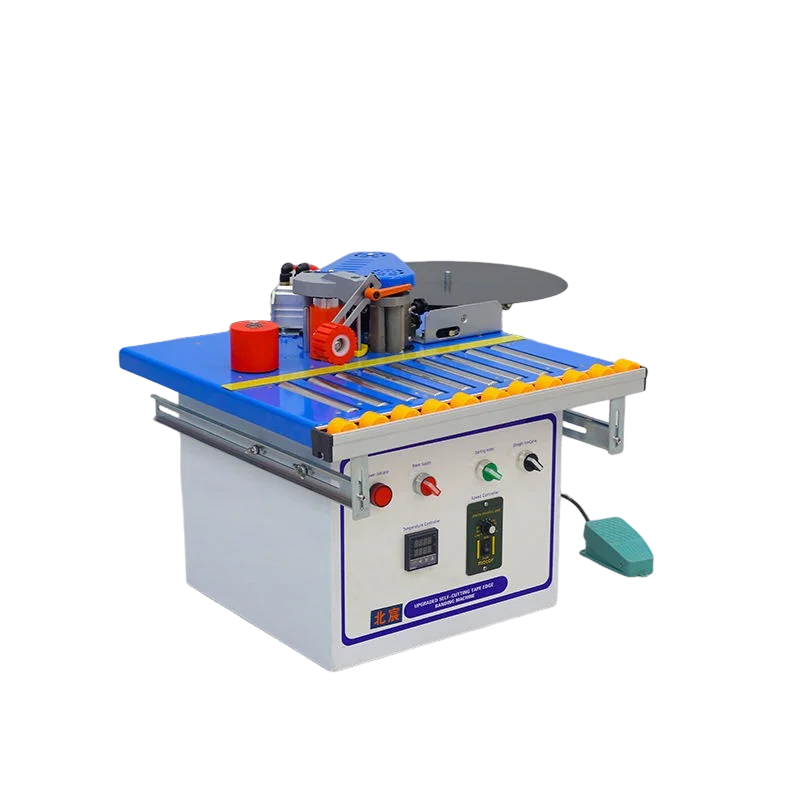
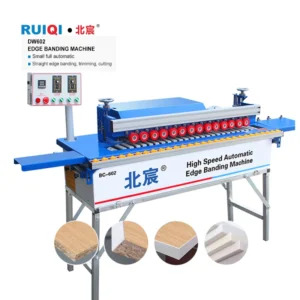
OEM Branding Integration — we apply your logo, color scheme, and packaging design to the ST-70 during assembly, ensuring brand consistency from factory floor to end-user unboxing.
Technical Specifications
| Parameter |
Value |
| Model |
ST-70 |
| Product Type |
Mini Portable Edge Banding Machine |
| Rated Power |
1000W |
| Edge Power |
20W |
| Voltage & Frequency |
220V/380V/customization |
| Edge Banding Thickness |
0.3-3MM |
| Edge Banding Height |
0-50MM |
| Glue Pot Capacity |
1000ml |
| Feed Speed |
0-6m/min |
| Minimum Sheet Length |
25CM |
| Minimum Sheet Width |
3CM |
| Air Source Pressure |
0.5-0.8Mpa |
| Product Size |
505047CM |
| Product Weight |
23KG |
| Standard Features |
Curved and straight edge banding, manual control, tabletop/portable assembly |
Application Suitability
| Application |
Material or Output |
| Small workshop furniture production |
MDF and particleboard panels for custom cabinets |
| Home decoration site work |
Plywood and ecological board cut-to-size components |
| Furniture repair and modification |
Solid wood board edge restoration and re-banding |
| Prototype and sample making |
Mixed substrate test pieces for client approval |
Why the Voltage Question Must Precede the Mini Edge Banding Machine factory OEM Order
Confirming local grid specifications before production prevents a machine from arriving as dead weight.
I have seen importers lose entire shipments because a 220V/50Hz unit was sent to a region running 110V/60Hz, and the motor simply burned out on first power-up. With a compact machine like the ST-70, the assumption is often that "small means universal," but the internal transformer and heating element are wound for a specific voltage-frequency pair. When a distributor places a bulk order without verifying each destination market’s electrical standard, the result is a warehouse full of unsellable inventory. [NEED_CITE: voltage and frequency standards by export market] The ST-70 supports configuration across a wide voltage range, but the factory must receive the confirmed specification before the stator winding stage begins.

Private-Label Readiness for Regional Distributors
A Mini Edge Banding Machine factory OEM engagement starts with branding scope definition. We apply custom silk-screen logos, match housing paint to your corporate color code, and produce packaging artwork carrying your import details and compliance marks. This extends to the operation manual, which we print in your target market’s language so the end-user sees your brand, not ours. Each customization element is locked in through signed artwork proofs before the production batch enters the assembly line.
Sample-First Validation for New Import Partners
Before committing to a container load, an importer typically requests a single sample unit built to the exact specification intended for the market. We produce this sample with the same precision-ground components and four-stage QC applied to volume runs, so the test piece genuinely represents what will arrive in bulk. The sample undergoes a full functional test using your specified edge banding material and substrate, and we ship the test record alongside the unit. [NEED_CITE: CE machinery directive requirements for industrial equipment]
Decoding the Specification Sheet for Production Reality
The ST-70’s 0.3–3MM edge banding thickness range covers PVC, melamine, and thin wood veneer, but attempting real hardwood lipping at the upper limit requires careful feed speed management and adequate glue open time. The 1000ml glue pot sustains extended small-batch runs without constant refilling, though operators must monitor temperature when switching between EVA and PUR-compatible hot melts. At 23KG and 50×50×47CM, the unit sits on a standard workbench, but the 0.5–0.8Mpa air source requirement means a dedicated mini-compressor is necessary — a detail often overlooked when workshops assume a portable machine runs purely on electricity. The manual control system keeps the learning curve flat, yet it demands that the operator set feed speed by feel, which is acceptable for repair work but requires training for repeatable furniture-grade output.
The Hidden Cost of Skipping Configuration Verification
When a distributor orders a batch of edge banders without confirming the end-user’s primary substrate, machines arrive with glue rollers calibrated for PVC only, leaving wood veneer orders delaminating within weeks. The ST-70’s glue application system handles multiple material types, but only when the factory sets the roller gap and temperature profile to match the stated application. Skipping this conversation means the buyer’s customer blames the machine, and the distributor absorbs warranty replacements that could have been prevented with a single email. [NEED_CITE: substrate and adhesive compatibility in edge banding] The cost of a returned container dwarfs the time spent on a pre-order specification call.
Why Source This Machine From Our Production Floor
In-house manufacturing means every ST-70 leaves the same facility where its components are precision-ground and assembled — there is no trading company layer obscuring the build process. We hold proprietary cutting mechanism patents that maintain the stated tolerance across production batches, verified at the pre-shipment QC stage. Voltage customization is treated as a standard engineering step, not a special request, so a 110V order for the Americas and a 380V order for Southeast Asia move through the same workflow. The four-stage quality protocol — incoming material, in-process, finished product, pre-shipment — generates a test record specific to your unit, not a generic batch certificate. Engineer-led configuration means you receive a formal quotation with confirmed specifications rather than a catalog price that later changes once your actual requirements surface.
Documentation & Verification
- CE declaration of conformity matching the ST-70’s configured voltage and market destination
- ISO 9001 certificate covering the manufacturing process of this specific production batch
- Factory test record documenting edge banding performance on your specified substrate material
- Electrical schematic reflecting your confirmed voltage, frequency, and plug type
- Operation and maintenance manual printed in your agreed language with exploded diagrams
- Spare parts list with OEM part codes for long-term reorder accuracy
Installation, Commissioning & Support
- Bench-mount the 23KG unit on a stable surface with at least 50CM clearance on all sides for panel maneuvering
- Connect to a dedicated circuit matching the confirmed voltage, separate from welders or compressors to avoid surges
- Supply clean dry air at 0.5–0.8Mpa via a filtered mini-compressor to protect the pneumatic glue valve
- Run initial glue temperature calibration using your actual edge banding stock before processing saleable panels
- Schedule a remote video commissioning session to walk your technician through feed speed and roller pressure adjustment
- Stock recommended spare glue rollers and trimming blades from the provided parts list for uninterrupted operation
Start the Specification Conversation
To move forward, share the primary substrates and edge banding materials your customers process, along with the destination country’s voltage and frequency standard. Let us know the preferred control panel language and whether you require your own brand artwork on the machine housing and packaging. If a pre-shipment sample test on your specific panel stock is needed, send a material sample or confirm the exact specification so we can source it locally for the trial run.
Frequently Asked Questions
Q: What customization options are available for OEM branding on the ST-70?
A: We offer custom logo application via silk-screen or engraved nameplate, housing color matched to your Pantone code, and full packaging artwork carrying your company details. The operation manual, warranty card, and spare parts catalog are all printable in your brand identity. Artwork proofs are confirmed and signed off before any batch production begins, ensuring every unit reflects your market positioning.
Q: Can the voltage and plug type be configured for different export markets?
A: Yes, the ST-70 supports voltage configuration across a wide range including 110V, 220V, and 380V options, with frequency matched to either 50Hz or 60Hz as required. Plug types for EU, USA, UK, Australian, and other regional standards are installed at the factory. We require written confirmation of the exact electrical specification before production to ensure the motor winding and heating element are correctly matched to the destination grid.
Q: Is it possible to order a single sample unit before placing a bulk order?
A: A single sample unit is produced to the exact same specification and quality control standard as a volume batch. We run a full functional test using your specified edge banding material and substrate, and the test record ships with the unit. This allows you to verify build quality, branding execution, and edge sealing performance in your own showroom or workshop before committing to container-quantity orders.
Q: What languages are available for the control panel and documentation?
A: Control panel labels, digital display text, and the operation manual can be produced in English, Spanish, Russian, Arabic, French, Portuguese, and other languages upon request. We confirm the required language during the specification stage and provide a layout proof for approval. This ensures the end-user operator can read all instructions and safety warnings without translation delays during commissioning.
Q: How is the machine packed to survive international ocean freight?
A: Each ST-70 is secured within a plywood export crate with internal foam cushioning protecting the glue pot, feed mechanism, and control panel. The crate is sized to fit standard LCL and FCL container loading plans, and we include desiccant packs to manage humidity during transit. Packing photographs are taken before the crate is sealed and shared with the buyer for shipping insurance documentation.