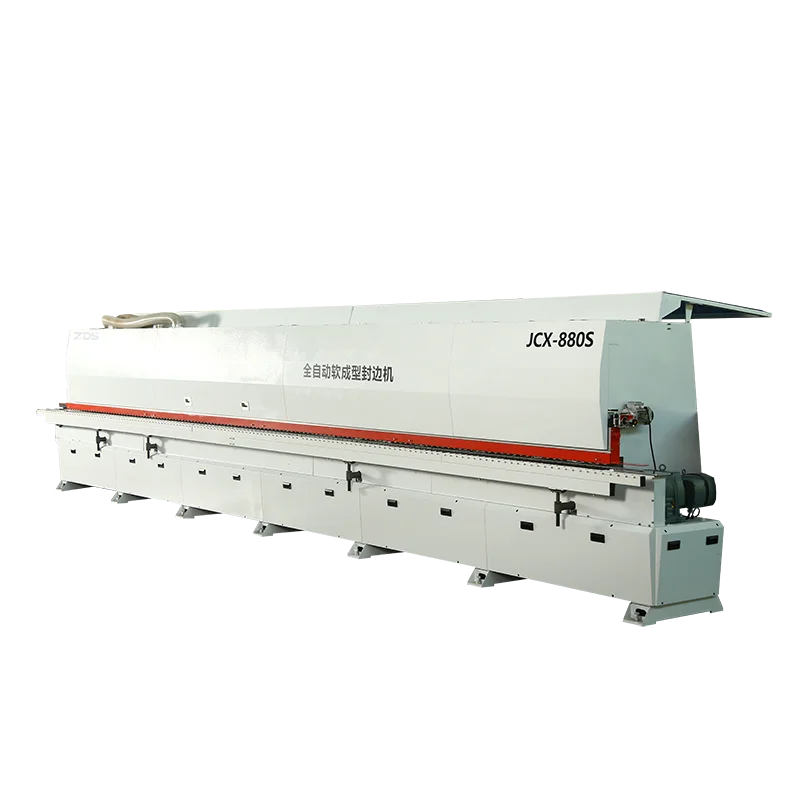
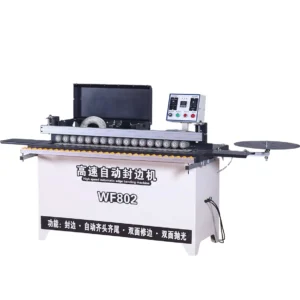
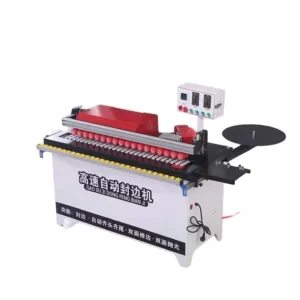
Precision-Verified Assembly — Every ZDSJCX-880S Automatic Edge Banding Machine leaves the factory with a documented test record traceable to its serial number, a practice enforced after too many field disputes over claimed versus actual tolerances.
Technical Specifications
| Parameter |
Value |
| Model |
ZDSJCX-880S |
| Product Type |
Automatic Edge Banding Machine |
| Overall Dimensions (L×W×H) |
8.82 × 1.07 × 1.85 m |
| Total Weight |
3200 kg |
| Total Power |
47.1 kW |
| Voltage |
380 V (frequency to be confirmed per market) |
| Air Pressure Requirement |
0.6 – 0.8 MPa |
| Dust Extraction Ports |
Ø100 mm × 6 |
| Panel Thickness Range |
18 – 22 mm |
| Edge Banding Thickness Range |
0.5 – 0.8 mm |
| Edge Banding Width |
58 mm |
| Minimum Sheet Width |
150 mm |
| Minimum Sheet Length |
300 mm |
| Conveying / Feed Speed |
6 – 8 m/min |
| Supported Machining Shapes |
J type, C type, oblique straight, semi-pass (L/R), water drop, rhombus, triangle — 15+ profiles |
| Control System |
To be confirmed (PLC / manual / CNC options) |
| Glue Pot Temperature |
To be confirmed |
| Trimming Stations |
To be confirmed |
| Language Options |
To be confirmed |
| Assembly State |
To be confirmed |
| Warranty |
1 year (verify against purchase agreement) |
| Standards |
CE (verify against current certificate), ISO 9001 |
Application Suitability
| Application |
Material or Output |
| Custom cabinet door and carcass production |
Melamine-faced MDF and particleboard with PVC or ABS banding |
| Built-in wardrobe panel edging |
Plywood panels with veneer or melamine edge material |
| Office furniture flat panel finishing |
Laminated MDF and particleboard components |
| Retail fixture and shelving manufacture |
Melamine board with thin PVC edge banding |
| Contract hospitality furniture |
Plywood and MDF panels requiring shaped edge profiles |
Why Voltage Confirmation Must Precede the Purchase Order
Every electrical drawing is reviewed against the buyer’s actual workshop supply before production begins.
I once stood next to a crated edge bander on a dock in suburban Chicago — the buyer had taken delivery three weeks late because the machine arrived wired for 380 V and the facility ran 480 V, 60 Hz. No one had asked, and no one had checked [NEED_CITE: voltage and frequency standards by export market]. The transformer retrofit cost more in downtime than the surcharge for a correctly wound motor would have been. On an Automatic Edge Banding Machine of this power class, the main drive motors and the glue-pot heaters together pull close to the full 47.1 kW, which means voltage deviation shows up immediately as inconsistent feed speed or unstable glue temperature. Confirming the supply at the quotation stage is not paperwork; it is the single most important engineering decision for the installation.

Component Sourcing and the OEM Implication
For a distributor evaluating this machine as a private-label candidate, the build depth matters as much as the exterior finish. The ZDSJCX-880S uses precision-ground guide rails and feed-chain components that are sourced and inspected under a four-stage QC protocol — incoming material, in-process, finished assembly, and pre-shipment verification. When you rebrand a unit, your name goes on the tolerance it holds six months after commissioning, not just on day one. Knowing the grinding and inspection stages are documented in-house gives an OEM partner a defensible story when a customer asks why the edge finish stayed consistent across a long production run.
Four-Stage QC and the Pre-Shipment Test Record
Most edge quality complaints do not arrive on day one; they surface after a few hundred operating hours when a worn guide or a slightly off-square trimming station begins to show up as a visible glue line on light-colored melamine. The four-stage QC process is designed to catch drift before it becomes a field issue. Every ZDSJCX-880S Automatic Edge Banding Machine ships with a factory test record that logs the specific panel thickness and banding material used during the pre-shipment run [NEED_CITE: CE machinery directive documentation requirements for woodworking equipment]. This record is what allows a regional service team to diagnose whether a later deviation is a wear item or a process change at the buyer’s end.
Reading the Specs That Actually Shape Daily Output
The 18 – 22 mm panel thickness range may look narrow, but it aligns exactly with the 18 mm standard that dominates cabinet and furniture carcass work in most export markets. Running consistently within this window means the glue roller, pressure zone, and trimming cutters are all set up for one dominant job rather than constantly adjusted across a wide range. The 0.5 – 0.8 mm edge banding thickness range pairs with this: it covers PVC, ABS, and thin melamine strip — the materials that produce the cleanest joint on melamine-faced board when the trimming station is correctly set. Feed speed of 6 – 8 m/min is moderate by industrial standards, which is deliberate: at higher speeds, a small tracking error on a 58 mm band translates into visible overhang or under-coverage on every panel. The six Ø100 mm dust extraction ports are distributed along the machine length to pull chips and fine dust from the pre-milling, trimming, and scraping zones separately; tying them to a single undersized collector defeats this layout and degrades edge finish over time.
The Hidden Cost of a Mis-Matched Infeed
A common failure mode on edge banders of this class is not the machine itself, but what arrives at the infeed. When panels are cut on a sliding saw that leaves a rough or chipped edge, the pre-milling station has to remove more stock than it was set up for, which shifts the reference edge and forces the trimming cutters to work outside their optimal window. The result is a glue line that looks acceptable on dark walnut melamine but reads clearly on white or light grey — exactly the finishes that dominate modern cabinetry. Buyers who specify the ZDSJCX-880S without checking the upstream cut quality often conclude the bander is at fault, when the real fix is a better panel saw or a dedicated pre-cut step [NEED_CITE: relationship between upstream cut quality and edge banding joint appearance].
Why Procurement Happens Here Rather Than Through a General Trader
In-house manufacturing means the patented cutting mechanisms referenced in the documentation are produced under the same roof as the frame welding and final assembly, not bought in as a branded sub-assembly. A full product family — from entry-level units to full-function pre-milling machines — allows a workshop or a distributor to scale the line over several orders without switching supplier, keeping service training and spare-part stocking consistent. Voltage adaptation from 110 V to 440 V, multilingual control panels, and custom logo application are handled as standard configuration options rather than special engineering projects. The factory test record, CE declaration of conformity, ISO 9001 certificate, electrical schematic, and packing photographs travel with every shipment, which simplifies customs clearance and local compliance checks. Visits to the assembly floor are welcomed, so a distributor’s own service engineers can watch the machine run against their sample panels before signing off.
Documentation & Verification
- CE declaration of conformity matched to the ZDSJCX-880S model and destination market requirements
- ISO 9001 certificate covering the manufacturing facility producing this unit
- Factory test record documenting the 18–22 mm panel and 0.5–0.8 mm banding used during pre-shipment run
- Electrical schematic with voltage and frequency confirmed for the buyer’s workshop supply
- Operation and maintenance manual produced in the buyer’s agreed language
- Spare parts list cross-referenced to the specific ZDSJCX-880S serial number
Installation, Commissioning & Support
- Foundation must support the 3200 kg total weight on a level slab with anchoring points matching the 8.82 m footprint
- Dedicated circuit rated for the 47.1 kW total load at the confirmed voltage and frequency
- Machine ships as a single assembly; confirm door and aisle clearances against the 1.07 m width and 1.85 m height
- First-run commissioning includes calibration of the 6–8 m/min feed speed to the buyer’s actual banding material
- Operator training covers profile selection across the 15+ machining shapes using the confirmed control language
- Recommended spare-part stocking based on the Ø100 × 6 dust port layout and trimming cutter set
What to Include with Your Next Inquiry
To move from quotation to configuration on the ZDSJCX-880S Automatic Edge Banding Machine, we need the specific panel materials and thicknesses you will run most often, the edge banding materials and widths, and the confirmed voltage and frequency at your workshop. Let us know whether you are integrating this unit into an existing line with established upstream saws and downstream boring machines, or whether you are planning a full-cell layout. If you intend to use the machine under your own brand, confirm the logo, colour, and control-panel language requirements at the quotation stage so the electrical drawing reflects them from the start.
Frequently Asked Questions
Q: What can be customized under an OEM or private-label agreement?
A: Logo, exterior colour, and control-panel language are standard customization options. Voltage is configurable from 110 V to 440 V to match local supply, and the electrical schematic is updated accordingly. Private-label partners can request branded documentation and packing. All customization points are locked in at the quotation stage so the factory test record reflects the final configuration.
Q: Can we send our own panels for a sample test before ordering?
A: Yes. You can ship representative panel samples in your standard 18–22 mm thickness range along with the edge banding material you intend to use. The factory runs a production test on the ZDSJCX-880S and records the results in the pre-shipment documentation. Factory visits are also welcomed so your team can observe the setup and edge quality firsthand.
Q: How does lead time differ between a single unit and a batch order?
A: A single unit typically follows a standard production slot, while a multi-unit OEM batch requires additional time for consistent component allocation, custom branding application, and individual test records per machine. Exact lead times depend on the current production schedule and the scope of customization. Confirm the delivery window at the formal quotation stage.
Q: Which spare parts should a regional distributor stock locally?
A: The recommended stocking list focuses on the trimming cutters, scraping blades, glue-pot wear items, and the edge-tracking guide components that see the highest wear during the 18–22 mm panel runs typical of cabinet production. The parts list supplied with each ZDSJCX-880S is cross-referenced to the serial number, allowing the distributor’s service team to reorder against a known bill of materials.