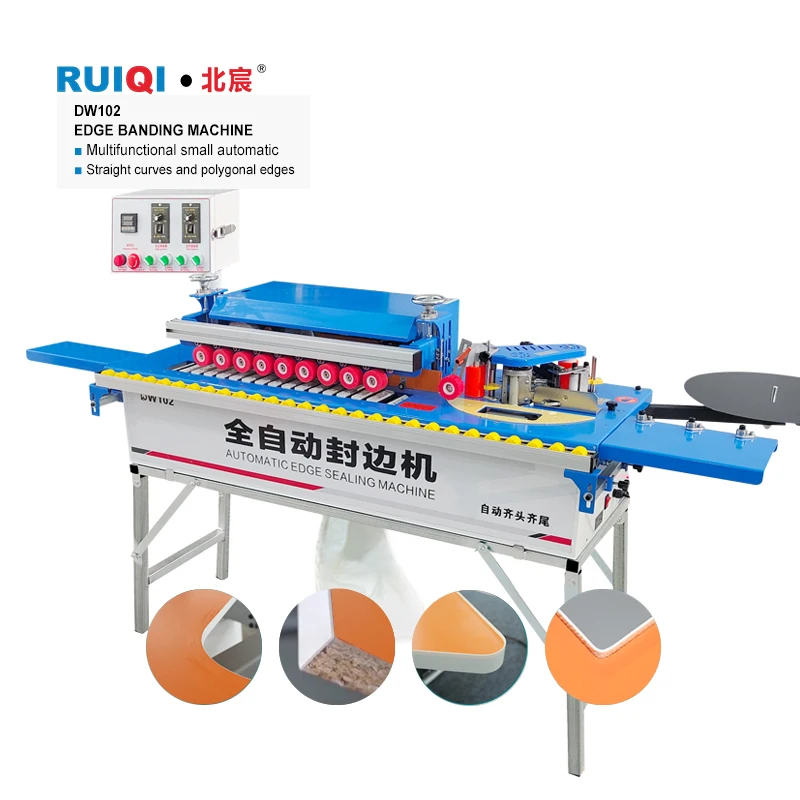
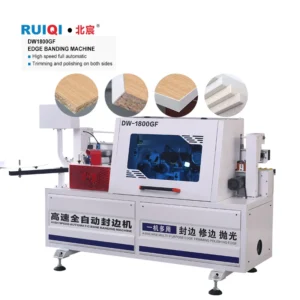
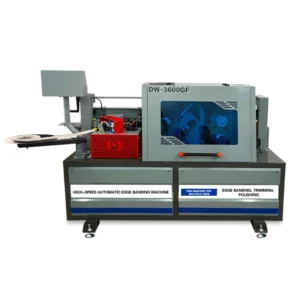
Voltage-Locked Manufacturing — Every DW102 edge banding machine ships with a formal electrical schematic and pre-production voltage confirmation matched to the destination grid, eliminating the arriving-unusable failures that plague poorly coordinated imports.
Technical Specifications
| Parameter |
Value |
| Model |
DW102 |
| Product Type |
Automatic Edge Banding Machine |
| Total Power |
3800W |
| Voltage |
220V / 380V / customization available |
| Edge Banding Height |
0–50 mm |
| Edge Banding Thickness |
0.3–3 mm |
| Minimum Sheet Length |
25 cm |
| Minimum Sheet Width |
5 cm |
| Glue Pot Capacity |
1000 ml |
| Air Source Pressure |
0.5–0.8 MPa |
| Vacuum Power |
1200W |
| Trimming Power |
650W × 2 |
| Polishing Power |
180W × 2 |
| Edge Power |
20W |
| Transmission Power |
60W |
| Product Size |
128 × 47 × 69 cm |
| Product Weight |
75 kg |
| Key Features |
Curved and straight edge banding, edge trimming, polishing, automatic head and tail cutting, integrated vacuum |
| Language Options |
Chinese, English; customization available (Spanish and others) |
| Plug Options |
EU, USA, AU, UK |
| Assembly State |
Fully assembled |
Application Suitability
| Application |
Material or Output |
| Cabinet door edge finishing |
MDF and particleboard with PVC or veneer banding |
| Wardrobe panel processing |
Plywood and blockboard with melamine edge strips |
| Custom furniture short-run edging |
Solid wood panels and polymer door blanks |
| Workshop-scale production |
Mixed substrate batches with curved and straight profiles |
| Small-batch OEM output |
Branded furniture components for regional distribution |
Why the Voltage Question Should Come Before the Price on Every Edge Banding Machine Factory Order
Machines that arrive dead on the dock cost more than any discount ever saved.
I once helped a buyer source a compact edge bander for a Canadian cabinet shop. The purchase order went through smoothly, the price was right, and the container shipped on schedule. Six weeks later the machine sat silent on the floor because the local supply was 575V three-phase and the unit had been built for 380V. The variable frequency drive locked out immediately, and the cost of a field-rated transformer plus rewiring wiped out the margin on the entire deal [NEED_CITE: voltage and frequency standards by export market]. That failure had nothing to do with engineering quality — it was a communication gap. Every DW102 order now begins with a confirmed electrical schematic before production starts.

How OEM Partners Lock Down Electrical Compliance Early
For an OEM edge bander destined for resale under a distributor’s own brand, electrical mismatches are reputational damage waiting to happen. The DW102 program addresses this by requiring a photo of the destination workshop’s main distribution panel or a written voltage declaration before the build sheet is finalized. Frequency confirmation — 50 Hz or 60 Hz — travels alongside voltage on the same document, so the motor winding specification, transformer tap, and control circuit are all aligned to the actual supply. This step adds days to the front of the process but removes weeks of troubleshooting at the back end.
Private Label Branding Beyond the Logo Plate
An edge banding machine factory that only swaps a nameplate is not delivering real OEM value. The DW102 supports custom color on the machine housing, branded control panel overlays in the target market language, and private label packaging for container loading. Distributors building a regional catalog can specify plug type — EU, USA, AU, or UK — and have the correct cord set and plug installed at the factory rather than relying on adapters that violate local electrical codes [NEED_CITE: CE machinery directive requirements for industrial equipment]. The result is a product that looks, reads, and connects as if it were manufactured locally.
Reading the Spec Sheet Against Real Workshop Conditions
The DW102 carries a total rated power of 3800W, which means a standard single-phase 220V circuit in many markets can handle the load without a dedicated three-phase supply — a practical advantage for smaller workshops adding edge banding capability without upgrading their entire electrical infrastructure. The integrated vacuum system at 1200W accounts for nearly a third of total draw, so the extraction line should be treated as a continuous load when sizing breakers. Edge banding thickness range from 0.3 to 3 mm covers thin PVC through thicker solid wood veneer strips, but the operator must match feed speed to material stiffness to avoid chatter marks on softer substrates. The glue pot at 1000 ml is sized for sustained short-run production; operators running long continuous batches should plan refill intervals to avoid temperature drops that weaken adhesive bonding. Trimming power at 650W per side provides adequate torque for clean cuts on MDF and particleboard without tear-out at the panel edge.
What Happens When Configuration Details Slip Through
A distributor who accepts a generic quotation without verifying control panel language often discovers the problem during commissioning, when the operator cannot navigate the menu to adjust trimming depth or glue temperature. The machine works perfectly — it just speaks the wrong language. Similarly, specifying a machine without confirming minimum sheet dimensions leads to frustration when short offcuts from a panel saw cannot be fed through the banding station. The DW102 accepts sheets as short as 25 cm and as narrow as 5 cm, which accommodates most cabinet component sizes, but buyers processing only oversized panels should verify that the feed mechanism handles their maximum dimensions with equal stability [NEED_CITE: panel dimension ranges in custom furniture manufacturing]. These mismatches do not show up in a brochure comparison — they surface only when the machine meets the shop floor.
Why Distributors Consolidate Their OEM Edge Bander Sourcing Here
In-house precision grinding of critical components means the DW102 trimming and polishing stations hold alignment without relying on third-party machined parts that introduce tolerance stack-up. A four-stage quality control sequence — incoming material, in-process, finished product, and pre-shipment verification — catches electrical and mechanical deviations before the crate closes. Patented cutting mechanisms reduce the wear pattern that typically forces distributors to stock oversized spare part inventories. Full OEM customization, from logo to language to plug configuration, is managed within a single production workflow rather than outsourced to separate vendors. Engineer-led configuration review ensures that every unit leaving the floor matches its destination market’s electrical and operational requirements.
Documentation & Verification
- CE declaration of conformity matched to DW102 configuration and destination market
- ISO 9001 certificate covering manufacturing process for this edge banding line
- Electrical schematic with confirmed voltage, frequency, and circuit protection values
- Factory test record on your specified panel thickness and banding material before dispatch
- Operation and maintenance manual in agreed language with illustrated spare parts list
Installation, Commissioning & Support
- Requires a dedicated circuit rated for 3800W total draw at confirmed voltage and frequency
- Fully assembled delivery — position the 128 × 47 × 69 cm unit and connect power and air supply
- Air line must deliver 0.5–0.8 MPa clean dry air to all pneumatic actuators
- First-run calibration of trimming depth and polishing pressure against your actual banding material
- Spare parts list covers wear items for the trimming cutters, polishing wheels, and glue pot heater
Before You Request a Quotation
Provide your workshop supply voltage and frequency, the edge banding materials you run most often, and the control panel language your operators need. If you are branding the DW102 for resale, include your logo artwork, preferred housing color, and target plug standard so the factory can prepare a complete build specification.
Frequently Asked Questions
Q: Can the DW102 carry our brand logo, custom color, and private label packaging?
A: Yes. The OEM scope includes custom housing color, branded nameplate, control panel overlay in your market language, and private label packaging for container shipping. Minimum order quantities depend on the level of customization — a simple logo swap has a lower threshold than a full color and packaging overhaul. Confirm details during the configuration review stage.
Q: How is voltage and frequency confirmed before production to avoid arriving-unusable machines?
A: Before the build sheet is released, we require either a photograph of your workshop’s main electrical panel nameplate or a written voltage and frequency declaration. The electrical schematic is then prepared to match, covering motor winding, transformer tap, and control circuit specifications for the confirmed supply.
Q: What does the four-stage QC process cover, and can we witness pre-shipment testing?
A: The sequence covers incoming material inspection, in-process assembly checks, finished product functional testing, and pre-shipment verification. Each DW102 runs through all functional stations with test panels before crating. Distributors and OEM partners are welcome to attend or request video documentation of the pre-shipment test.
Q: What spare parts backup and technical training do you provide for our local service team?
A: Every shipment includes a spare parts list identifying wear components — trimming cutters, polishing wheels, glue pot elements — along with recommended stock quantities. Technical documentation is delivered in the agreed language, and remote commissioning support is available to train your service technicians on adjustment and maintenance procedures.