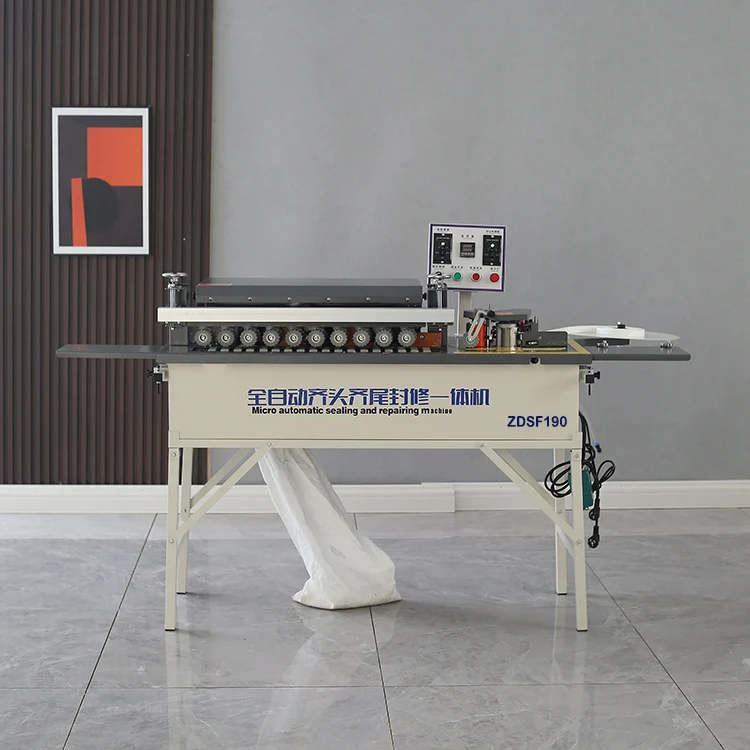
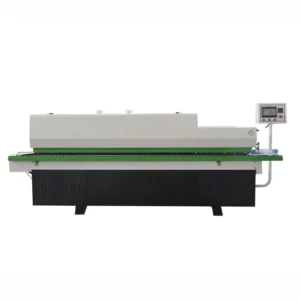
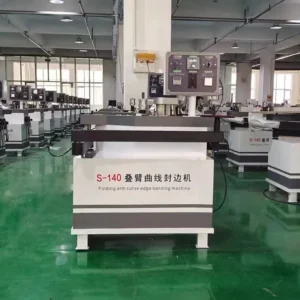
Voltage-First Manufacturing — Every ZDSF190 order locks in confirmed voltage and frequency before production, eliminating on-site electrical failures common with unverified exports.
Technical Specifications
| Parameter |
Value |
| Model |
ZDSF190 |
| Product Type |
Automatic Edge Banding Machine |
| Function |
Automatic plate feeding, belt cutting, double-sided gluing, upper and lower trimming, polishing, curved and straight edge banding |
| Edge Type |
Both curved and straight lines |
| Rated Power |
4 kW |
| Voltage |
220V 50Hz (configurable from 110V to 440V) |
| Feed Speed |
0–14 m/min |
| Panel Thickness Range |
10–50 mm |
| Edge Strip Thickness Range |
0.5–2.5 mm |
| Glue Capacity |
1000 ml |
| Rated Air Pressure |
0.4–0.6 MPa |
| Suction Power |
1200 W |
| Heating Power |
800 W |
| Trimming Power |
800 W × 2 |
| Polishing Power |
180 W × 2 |
| Transmission Type |
Crawler transmission with steel rod slide rails |
| Pressure Beam |
Adjustable aluminum alloy |
| Feed Mechanism |
Double-row rubber pressure wheels |
| Trimming Stations |
Upper and lower trimming with 4-blade alloy arc knife |
| Overall Dimensions (L×W×H) |
1900 × 560 × 1300 mm |
| Weight |
120 kg |
| Warranty |
One year (factory defect spare part replacement) |
Application Suitability
| Application |
Material or Output |
| Custom cabinet door edge finishing |
MDF and plywood panels with PVC or veneer strips |
| Small-batch curved furniture components |
Solid wood and particleboard with 0.5–2.5 mm banding |
| Joinery workshop panel edging |
Particleboard shelving and carcass parts up to 50 mm thick |
| Low-to-medium volume edge banding |
Straight and curved profiles on flat panel substrates |
Why the Voltage Question Comes Before the Price for an Automatic Edge Banding Machine Factory
A machine wired for the wrong frequency is a machine that will not run on day one.
I once watched a customer in the Middle East wait three weeks while an electrician rewired their shop because the three-phase supply on arrival did not match their grid. The machine was fine. The paperwork was not. For any distributor or OEM partner sourcing an automatic edge banding machine factory unit, voltage confirmation is not a courtesy — it is a prerequisite that should appear on the quotation before tooling starts. Electrical schematics issued after production begins are too late to catch a 50 Hz versus 60 Hz mismatch on motor windings. [NEED_CITE: voltage and frequency standards by export market]
Dual-Purpose Curved and Straight Configuration
The ZDSF190 handles both curved and straight profiles on a single pass, with a 180° rotation capability that lets a compact workshop reposition the machine against a wall or corner without losing feed access. For an automatic edge banding machine factory evaluating this model for distributor inventory, the dual-purpose design means one SKU covers two common edge profiles rather than stocking separate curved-only and straight-only units.
Four-Blade Alloy Arc Knife Trimming
Upper and lower trimming stations use a four-blade alloy arc knife, engineered to follow curved contours without tearing PVC or veneer banding material. The arc knife geometry matters when panels have radiused corners — a flat blade will leave chatter marks on curves while the arc profile maintains contact across the radius. This trimming head is central to the ±0.02 mm tolerance claim, verified during the pre-shipment factory test. [NEED_CITE: CE machinery directive requirements for industrial equipment]
How Feed Speed, Panel Thickness, and Glue Capacity Interact at the Bench
The 0–14 m/min feed speed range gives operators control over glue open time on thicker substrates. At the upper end, thin MDF with PVC banding moves through quickly. At slower speeds, 50 mm solid wood panels receive adequate glue coverage from the 1000 ml pot before the pressure wheels engage. The double-sided gluing system and adjustable glue roller let operators dial in adhesive volume for porous particleboard versus sealed plywood faces. Crawler transmission with steel rod slide rails keeps the panel stable during curved edge work, where lateral drift would otherwise cause trimming misalignment. The 1200 W suction system connects to large-diameter vacuum collectors to manage trim waste at the point of generation.
What Happens When Specification Gaps Surface After Delivery
A machine quoted without verified local voltage arrives with motor windings wound for the wrong frequency, drawing excess current and tripping breakers repeatedly. Control panels printed in a language the operator cannot read stall commissioning while the buyer sources translation. Entry-level edge banders pushed into production volumes they were never designed for develop premature wear on feed wheels and trimming bearings. These are not manufacturing defects — they are configuration oversights that surface only when the machine is bolted to the floor. [NEED_CITE: CE machinery directive requirements for industrial equipment]
What Manufacturing Depth Means for OEM and Distributor Partners
The ZDSF190 is built in-house with a patented cutting mechanism, not assembled from sourced sub-assemblies under a badge. Voltage, control panel language, and logo are configurable as standard — not as an expensive add-on negotiated after the fact. Four-stage QC covers incoming material inspection, in-process assembly checks, finished product verification, and pre-shipment testing with the buyer’s panel samples. Formal quotation with confirmed specifications is issued within 24 hours of inquiry, and factory visits for witness testing are accommodated. The machine sits within a full product family, so a distributor can add higher-tier models from the same factory as their market scales.
Documentation & Verification
- Electrical schematic with confirmed voltage and frequency issued before production begins
- Factory test record on buyer’s specified panel thickness and banding material before dispatch
- CE declaration of conformity included in the shipment documentation package
- Operation and maintenance manual supplied in the buyer’s agreed language with illustrated spare parts list
- Pre-shipment photographs of the completed unit with serial number and configuration verification
Installation, Commissioning & Support
- Requires a dedicated 4 kW circuit matching the confirmed voltage and frequency stated on the electrical schematic
- Compact 1900 × 560 mm footprint fits standard workshop floors without special foundation requirements
- Adjustable aluminum alloy pressure beam calibrated during commissioning to match the buyer’s typical panel thickness range
- Double-row rubber pressure wheels inspected and tension-set during first-run testing on site
- Large-diameter vacuum connection point identified for integration with existing dust extraction ducting
- One-year warranty covers factory defect spare part replacement with illustrated parts list for reordering
Preparing Your Inquiry
To configure the ZDSF190 correctly, share the panel substrates and thickness range you process most frequently, the local voltage and frequency at the installation site, and your preferred control panel language. If you are evaluating this model as an OEM or distributor, specify the branding, documentation language, and any market-specific certification requirements upfront so the quotation reflects the complete delivered configuration.
Frequently Asked Questions
Q: What OEM customization options are available for logo, voltage, and control panel language?
A: The ZDSF190 supports custom logo placement on the machine body, voltage configuration from 110V to 440V matched to your local grid, and multilingual control panel labels. Each customization is confirmed on the formal quotation before production begins, so the delivered unit arrives ready for your market without post-delivery modification.
Q: How is the ±0.02 mm tolerance verified and documented before shipment?
A: Every ZDSF190 undergoes a pre-shipment factory test using the buyer’s specified panel material and edge strip thickness. Trimming accuracy is measured and recorded in the factory test report, which ships with the machine. This ensures the tolerance claim is verified on your actual substrates, not assumed from a generic test sample.
Q: What is the four-stage QC process and can buyers witness pre-shipment testing?
A: The four stages cover incoming material inspection, in-process assembly checks, finished product functional verification, and pre-shipment testing with sample panels. Buyers and distributor representatives are welcome to visit the factory and witness the final test stage. A test record with photographs is provided regardless of whether a visit takes place.
Q: How does the ZDSF190 compare to higher-tier models within the same product family for future scaling?
A: The ZDSF190 covers curved and straight edge banding with core trimming and polishing functions in a compact footprint. Higher-tier models in the same family add pre-milling, multi-stage finishing, and faster feed speeds for production-scale output. Because all models share the same manufacturing source, upgrading later means dealing with the same factory and documentation standards.
Q: What spare part backup and technical training support is available for distributor service teams?
A: Each shipment includes an illustrated spare parts list matched to the specific machine configuration. Distributor service teams can request technical documentation covering electrical schematics, trimming head adjustment procedures, and glue system maintenance. Replacement parts are available directly from the factory with configuration records on file for every shipped unit.