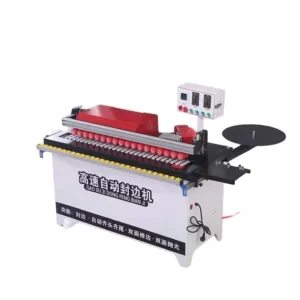
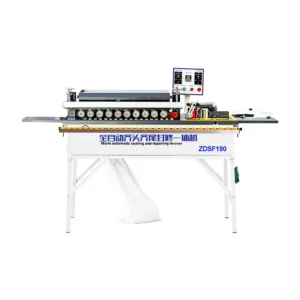
Proven Manufacturing Depth — Every unit undergoes four-stage inspection from raw material to pre-shipment, with full electrical schematics confirmed before assembly begins.
Technical Specifications
| Parameter |
Value |
| Product Type |
Edge Banding Machine |
| Brand |
ZDS |
| Machine Type |
Gluing, Rough Trimming, Scraping |
| Feed Speed |
14 m/min |
| Voltage and Frequency |
220V / 50Hz (configurable from 110V to 440V) |
| Total Power |
4 kW |
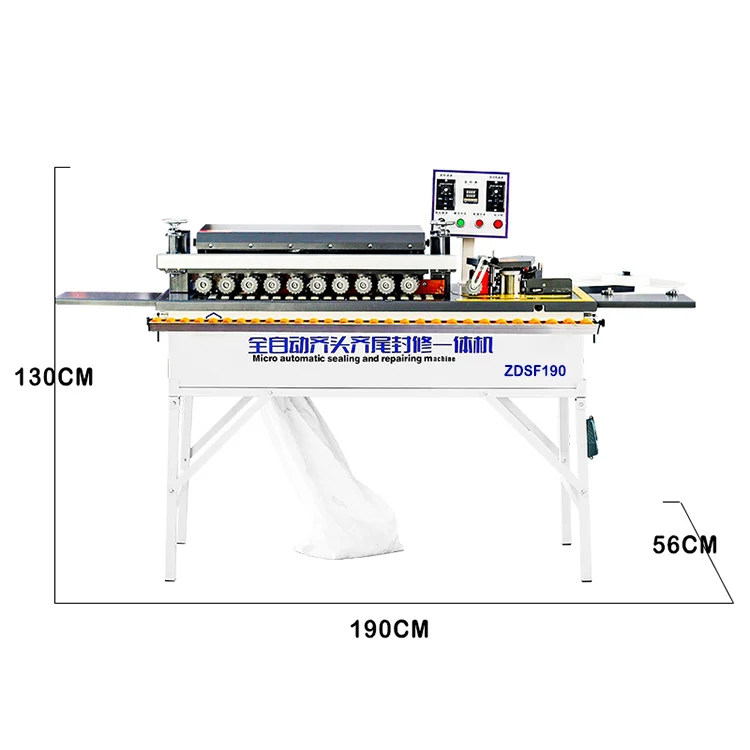
| Overall Dimensions (L×W×H) |
1900 × 560 × 1300 mm |
| Net Weight |
120 kg |
| Widening and Extension |
300 mm |
| Host Height |
630 mm |
| Total Height |
1220 mm |
| Belt Feeding Motor |
25 W |
| Plate Feeding Motor |
60 W |
| Trimming Motor |
800 W × 2 |
| Control System |
PLC |
| Core Components |
Bearing, Motor, Pump, Gear, PLC, Gearbox, Pressure Vessel, Engine |
| Warranty |
One year |
| Assembly State |
KD packing, user manual and video provided |
| Panel Thickness Range |
(basis to be confirmed) |
| Tolerance |
(basis to be confirmed) |
Application Suitability
| Application |
Material or Output |
| Plywood panel edge finishing |
Plywood boards with PVC or melamine edge banding |
| Small-batch furniture panel processing |
Particleboard and MDF with adhesive-backed edge strips |
| Workshop-scale cabinet component edging |
Solid wood panels and veneer banding materials |
| Entry-level production line integration |
Panel materials requiring gluing, trimming, and scraping in one pass |
Why Voltage Confirmation Must Happen Before the Factory Builds Your Edge Banding Machine
An edge banding machine factory that ships without verifying local voltage is gambling with your production timeline.
I once watched a plywood factory stand idle for nearly three weeks because an edge bander arrived with a 380V motor wired for a 440V supply. The drive board burned the moment the operator flipped the breaker. The entire finishing line sat still while a replacement control cabinet was built and shipped. That downtime cost the buyer far more than the machine itself [NEED_CITE: voltage and frequency standards by export market].
When you evaluate an edge banding machine factory for OEM or distribution partnerships, the electrical conversation must happen at the quotation stage — not after the crate arrives at your warehouse. A factory with real manufacturing depth treats voltage, frequency, and plug type as configurable parameters, not afterthoughts.

How OEM Partners Evaluate Component Sourcing Transparency
Distributors committing to a private-label edge banding machine need full visibility into what sits inside the cabinet. This platform specifies its core components openly: PLC controller, dual 800W trimming motors, gearbox, bearings, and pump assemblies are all listed by function. That transparency lets you assess whether the component grade matches the production volume your regional customers will demand. A factory that hides its bill of materials is asking you to trust blindly. An edge banding machine factory that publishes it is inviting you to verify.
Private-Label Branding and Regional Configuration
OEM partnerships require more than a logo swap. The control panel language must match your market’s operators, the voltage must align with local grid standards, and the documentation must support your own service technicians [NEED_CITE: CE machinery directive requirements for industrial equipment]. This machine supports custom branding, multilingual control interfaces, and voltage adaptation across the 110V to 440V range. For distributors building a regional portfolio, that configuration flexibility means one platform can serve multiple markets without maintaining separate inventory streams.
What the Specifications Mean for Downstream Assembly
The dual 800W trimming motors handle rough trimming in a single pass, which matters when plywood edges tend to chip if the cutter speed is too low relative to the feed rate. At 14 m/min feed speed, the trimming station must maintain consistent RPM to avoid tear-out on veneer banding materials. The PLC control system coordinates belt feeding, plate feeding, and trimming stations so that timing drift does not compound across the workpiece length. For plywood production specifically, the 300mm widening extension accommodates wider panel formats without requiring a secondary pass. The compact 1900mm footprint and 120kg weight also affect container loading calculations — importers shipping mixed machinery consignments need to plan cubic meter allocation carefully.
The Hidden Cost of Skipping Pre-Shipment Verification
Buyers who skip the factory test often discover tolerance problems only when panels fail assembly at the customer site. Glue lines that look acceptable under workshop lighting become visible seams once the panel is installed in a finished cabinet. Trimming stations that leave micro-burnish marks on PVC banding may pass visual inspection but fail the fingernail test that furniture buyers apply. An edge banding machine factory that refuses to run your specific panel material through the machine before shipping is asking you to absorb that risk [NEED_CITE: edge banding quality standards for furniture-grade plywood].
Why Distributors Choose This Manufacturing Partner
In-house manufacturing with patented cutting mechanisms means the factory controls the tolerance chain from raw casting to finished assembly — not merely bolting together sourced subassemblies. Four-stage quality control covering incoming material, in-process inspection, finished product verification, and pre-shipment testing ensures every unit leaves the floor documented. Voltage, language, and specification customization are standard offerings, not premium add-ons. Engineer-led configuration recommendations arrive as formal quotations within 24 hours, giving distributors the response speed they need to close deals in competitive regional markets. The factory welcomes visits, allowing OEM partners to audit assembly depth before committing to a private-label program.
Documentation & Verification
- CE declaration of conformity matched to your import classification
- ISO 9001 certificate covering the manufacturing scope
- Electrical schematic confirming voltage and frequency before production
- Factory test record run on your specified plywood panel thickness
- Operation manual translated into your local language
- Spare parts list with component specifications for local sourcing
Installation, Commissioning & Support
- 1900 × 560 mm footprint requires a level concrete floor with clearance for the 300mm extension
- 4 kW total power demands a dedicated circuit matching confirmed voltage and frequency
- KD packing means on-site assembly with manual and video guidance provided
- PLC controller configuration and feed speed calibration during first startup
- Dual 800W trimming motor alignment verified against your panel edge material
- Bearings and gearbox greasing schedule documented in the maintenance manual
What We Need to Build Your Configuration
To prepare an accurate quotation and engineering proposal, share your target market’s standard voltage and frequency, the plywood panel thickness range your customers process, and the edge banding materials you plan to stock. If you are evaluating OEM branding, provide your logo files and preferred control panel language. For container planning, let us know whether this unit ships alone or alongside other woodworking machinery in a mixed consignment.
Frequently Asked Questions
Q: Can the factory apply custom logos and adapt voltage for different regional markets?
A: Yes. The factory supports full OEM private-label branding including custom logos on the machine body and packaging. Voltage is configurable from 110V to 440V, and control panels can be supplied in multiple languages to match your local operator base. Each configuration is confirmed in writing before production begins.
Q: Are core components sourced from identifiable suppliers with verifiable specifications?
A: The component list includes PLC controllers, motors, gearboxes, bearings, and pumps identified by function and rating. Distributors can request detailed supplier information and specification sheets during the evaluation phase to verify that component grades match the production demands of their regional customer base.
Q: What does the pre-shipment test record cover for this edge banding machine?
A: The factory test record documents actual panel runs using your specified plywood thickness and edge banding material. It covers feed speed consistency, trimming quality on both edges, glue line uniformity, and scraping finish. Buyers can request video documentation of the test or arrange to witness it in person.
Q: Does the factory provide technical training for distributor service teams?
A: Yes. The factory offers training covering installation procedures, commissioning steps, PLC parameter adjustment, and common fault diagnosis for the dual trimming motor and feed systems. Training materials and spare parts documentation are provided in the distributor’s agreed language.
Q: How does the factory handle single-unit orders versus batch production runs?
A: Both single-unit and batch orders are accepted. Single units typically ship within standard lead times, while batch production runs are scheduled based on factory capacity and component availability. Distributors planning regional inventory builds should discuss phased delivery timelines during the quotation stage.